Amos Crane and Howard
Down Cemetery RoadAmos Crane and Howard are colleagues in the same government agency, but their relationship breaks down when Amos’s grief over Axel Crane becomes a private campaign against Michael Downey. Howard tries to keep the pursuit within institutional limits; Amos treats those limits as obstacles and makes clear that neither his employment nor Howard’s safety will take precedence over revenge. Their conflict exposes the strain between bureaucratic control and an operative who has made the job personal—and whose colleagues fear he can no longer be controlled.
From colleague to adversary
The rupture takes shape after Axel’s death. Howard asks whether Amos is mourning and then raises the question of Mark Trafford, asking whether Amos dealt with the husband the previous night. Amos answers that he is mourning and is also looking for the man who put him in mourning, explaining that this is why he is at his desk. Grief is not separate from his work: it has become the stated reason for continuing it. Howard’s question about Mark also places Amos’s private mission against a background of other dangerous business, though the exchange does not establish that Howard shares Amos’s personal purpose.
Amos’s insistence that the hunt is personal becomes explicit when he asks Howard whether he is making it personal. He then dismisses the question as self-evident and tells Howard to leave him to his work. The bluntness shifts their disagreement beyond a dispute over tactics. Howard is trying to address an employee whose motives may compromise an operation; Amos rejects the premise that his motives should be professionally separable from it.
The dispute over control
Howard argues that the agency does not operate for Amos’s sole benefit. He acknowledges that Axel failed, but insists that the failure should produce lessons rather than a revenge campaign. His warning is practical and disciplinary: if Amos acts alone and spills unnecessary blood, Howard will leave him without institutional protection, and Amos might as well reserve a grave beside Axel’s. Howard is not asking Amos to abandon the pursuit of Downey; he is demanding that it be conducted properly and under control.
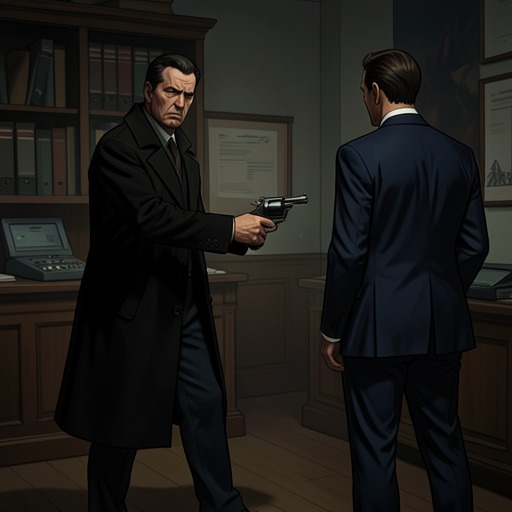
Amos treats that distinction as a threat. When Howard warns that Amos has no friends in the Ministry and notes that people were relieved when Downey killed Axel, Amos jabs Howard in the throat. Howard drops to his knees, struggling for breath. The assault converts their conflict from sharp professional argument into physical intimidation. Amos then tells Howard that he will find Downey, perhaps later if not now, and predicts that Downey will come for the girl. He says he will kill Downey when he finds him and threatens to push Howard from an office window if Howard objects. The warning makes Amos’s priorities unmistakable: he regards the hunt as his own, and he uses violence to keep Howard from exercising authority over it.
Institutional resistance and fear
Howard is not the only figure who sees Amos as a danger to the operation. A superior later tells Howard that Amos has gone too far: the brothers’ poor work has left another civilian on the dead list, and Downey’s killing of Axel has made Amos’s pursuit especially likely to end in further violence. The superior orders Howard to take Amos off the job, bring him home, and make the removal appear properly managed; the instruction also insists that Amos’s body must never turn up. The order shows how the agency’s concern about Amos combines fear of an uncontrolled operative with a determination to manage the consequences out of public view.
Howard’s own position is precarious. After the confrontation, he has heard that Amos put him on the floor, and he tells the superior that he does not know where Amos is, only that he thinks Amos has gone after Downey. The superior calls Amos an animal and demands that Howard rein him in. Howard is thus caught between an operative who has physically overpowered and threatened him and an organization that expects him to restore control. The conflict is not simply personal: Howard’s authority is being tested from below while his competence is being judged from above.
A break made explicit
The agency’s attempt to manage Amos ends in an uneasy absence. Howard receives a formal apology from Amos for the afternoon’s incident, but its polished wording leaves the violent assault unnamed. The apology does little to reassure him. Amos’s letter says that he is taking the afternoon’s events as constructive dismissal, requests his pay and other entitlements, and announces that he is going to Scotland. He also insists that Downey is his and warns Howard that he will deal with him on his return.
Howard has already arranged surveillance on Amos’s flat. Three freelance watchers—two in a van marked with a large rabbit eating a cookie and one in a nearby launderette—are waiting for a product to arrive. Howard tells himself that using freelancers spares Amos the insult of having colleagues watch him, but recognizes the deeper reason: people who have worked with Amos would not volunteer to target him, not out of friendship or loyalty, but out of fear. When the watchers report that the product has arrived, Howard waits for the next report; none comes. The surveillance makes visible the distrust that their professional relationship has become, while its silence leaves Howard without confirmation of what Amos is doing.
Amos’s final written message turns a workplace dispute into an announced separation, though not a relinquishment of the pursuit. He frames his departure as constructive dismissal, but the letter’s last warning preserves the same personal claim he made at his desk: Downey remains his target, and Howard remains in the path of that claim. Their relationship ends, for the time being, not with a negotiated resolution but with Howard left behind to manage the agency’s response and Amos heading for Scotland beyond his control.