Amos Crane kills the assassins sent by Howard
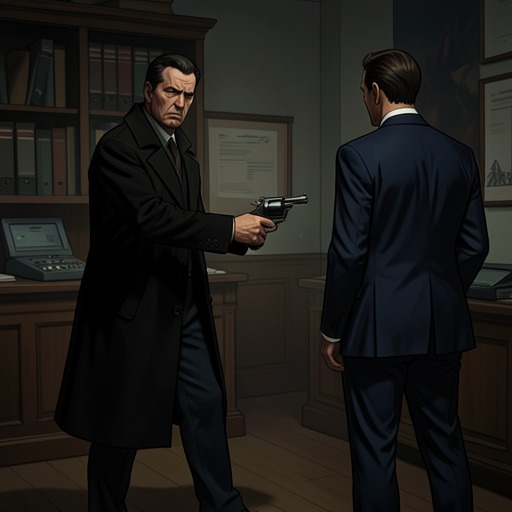
Down Cemetery RoadAmos Crane’s killing of the three assassins Howard sends to his flat is a reversal in which the intended target survives and the employer is left to confront the consequences. The attack is never shown directly: its outcome emerges through the silence of the surveillance team, Howard’s mounting fear, a letter from Crane, and the discovery that all three men are in the bath. That indirect disclosure makes the episode as much about Howard’s effort to control information as about Crane’s lethal competence.
The operation and its cover
Crane’s apparent departure for Scotland gives Howard an opportunity to arrange his removal. A written apology from Crane has reached Howard’s desk, couched in fulsome, carefully coded language that refers to an incident without calling it a violent assault. The apology also says Crane is taking several hours off to sleep and will return to the office before leaving. Howard knows that Crane is indeed at home because he has had the flat watched.
The surveillance is deliberately inconspicuous. Two watchers sit in a van painted with the name The Fabulous Bakin’ Brothers beside an image of a large rabbit eating a cookie; a third waits in a nearby launderette, watching the same washing cycle round. Howard has hired all three as freelancers. He tells himself that this arrangement spares colleagues the indignity of being sent to see Crane off, but recognizes the less sentimental reason: anyone who had worked with Crane would be too afraid to take him on. The operation is thus founded on a contradiction. Howard treats Crane as a target that can be managed through procedure while knowing that Crane inspires fear even among people who know him professionally.
Silence and reversal
Three hours after the watchers report that the product has arrived and will be sent out as soon as possible, Howard has heard nothing further. He tries to reassure himself that the young men may have completed the job and left for an early supper without reporting in. That explanation does not hold: he knows they have not simply forgotten to call. They are beyond the reach of any mobile phone. The blank interval, which should have been a routine gap in communication, becomes evidence that the operation has gone wrong.
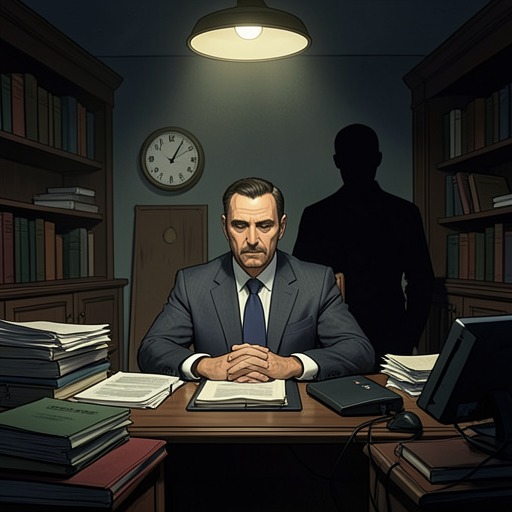
Howard’s unease registers physically. He repeatedly buttons and unbuttons his jacket before forcing his hands onto the desk, and his fingers are trembling severely. He considers the possibility that Crane has been killed, but his reflections expose how little he understands the man he has tried to eliminate: Crane is not an easy mark, and the three freelancers are young and overconfident. Howard distinguishes this assignment from arranging an accident for a minister whose private appetites might cause public embarrassment. Crane is a professional, not a soft target for a discreet political fix. At last, Howard decides that he must go and see what happened himself.
The flat and the evidence
Howard travels by Underground a few stops through Central London and reaches the block in Soho where Crane has kept a flat above a failing record shop. Crane has moved several times a year, but Howard has never asked whether the habit comes from professional caution or an inability to settle. On the journey and at the flat, Howard belatedly wonders whether anyone offers Crane the ordinary human contact most people take for granted, particularly now that Axel is dead. The thought briefly shifts attention from Crane as an operational problem to Crane as an isolated person, but it does not alter the immediate danger Howard faces.
Inside, Howard finds a sheet of writing paper on the glass-topped coffee table. Crane’s message treats the afternoon’s events as constructive dismissal, complains of the manner of his departure, and demands the pay and other emoluments he expects. It says he is going to Scotland, then makes the conflict explicit: Downey belongs to Crane, and Howard will be dealt with when Crane returns. A brief apology for the mess in the bathroom follows. The letter is at once a bitter account of a workplace rupture and a warning that the violence has not ended with the failed operation. Crane does not present himself as having vanished; he announces a continuing pursuit of Downey and promises to settle matters with Howard later.
What the aftermath establishes
Howard finishes his wine before going to the bathroom, since there is no longer any particular hurry. The mess is less bad than he expected. Crane has left all three men in the bath. Their presence establishes the result of the operation: the assassins sent to kill Crane have instead been killed by him. The account supplies no description of the fight, the method, or the precise moment of their deaths, so the scene’s force lies in the contrast between Howard’s elaborate preparations and the stark evidence awaiting him at the flat.
The episode also leaves Howard with the knowledge that his choice of freelancers has not insulated him from responsibility. He arranged the surveillance and dispatched the men, then went in person because he wanted to be the first to learn what had happened and thereby choose how events would be presented. That impulse to control the account now collides with the facts in Crane’s bathroom and with Crane’s written threat. The killings turn a covert attempt to remove a colleague into an open personal conflict: Crane remains at large, Downey is his declared target, and Howard himself has been placed on notice.