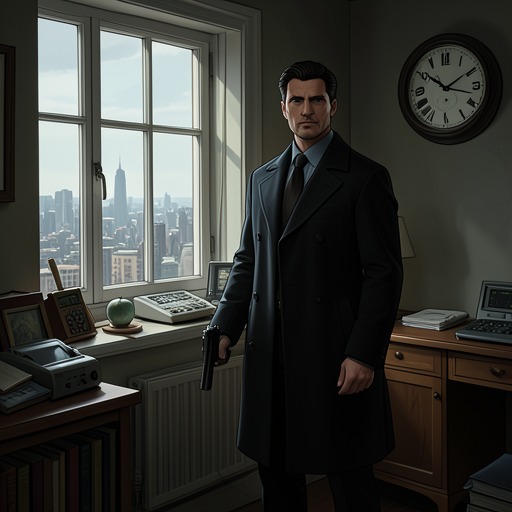
Amos Crane's failed attempt to attack Downey at the hotel
Down Cemetery RoadAmos Crane’s failed attempt to attack Downey at the hotel turns a carefully prepared assassination into a mistaken-room encounter. Crane has used a hotel database to track a cash-paying couple he believes may be his quarry, but the lead is uncertain; when he finally moves, the people in the room are not the couple he is seeking. A startled intervention by Michael Downey and Sarah Trafford forces Crane to retreat, leaving his intended targets alive and his supposed one-shot opportunity spent.
The lead and the wager
The attempt begins with information that looks precise but is not secure. Crane has accessed the database of an upmarket hotel chain and found a couple who paid cash for a double room, arrived without reservations, and, according to an unchecked box on the screen, had no luggage. Their name appears as Smithson, with the slight awkwardness of a name that seems to have begun as Smith and then been corrected. The entry gives Crane a room and a possible identity, not proof that he has found Downey and Sarah.
Crane understands the risk. He has stopped looking after finding this pair, and knows that if they are not at the hotel he will not locate them before they move on. He nevertheless likes the odds. The operation is a wager built on guesswork, and he expects neither a warm welcome at his desk nor a secure return to his former position. His thoughts turn to Axel’s maxim, “Never let them tell you it’s not a game,” a remembered phrase that lends the pursuit a competitive gloss even as Crane recognizes that his career may already be over.
That confidence sits beside a practical awareness of how memory works. Before entering, Crane buttons his raincoat carefully, recalling a job in which four witnesses remembered a bright red scarf but, beyond that detail, he had been a ghost. The coat is not decoration: it is an effort to control the fragment an observer might retain. His preparation is meticulous, but the hotel lead itself remains vulnerable to a basic mistake.
The approach and interruption
Crane reaches the hotel in the middle of the night after a long drive, with another long drive still ahead. The building’s scattered lights and canopies bring a ship to mind, but he dismisses the image as an indulgence. A faint sound from the lobby reminds him that a hotel of this size never wholly sleeps. He tells himself that he need not take risks, then takes them anyway, measuring necessity by the attraction of the danger as much as by the demands of the job.
A skeleton card, one of the benefits of his government work, has already opened his own door without a squeak. To avoid the heavier video surveillance around the lifts, he uses the stairwell and firedoor. He knows the target room is 231, on the second floor, and approaches it on foot. The procedure shows Crane trying to minimize noise and exposure; it also narrows his attention to the room number and the presumed identity attached to it. He pauses at the threshold before reaching for his key, allowing the moment to gather weight.
Inside the hotel, however, the encounter does not unfold as an unseen, controlled entry. Downey reacts to a figure at the door: he opens it in one fluent movement, pulls the lurking person into the room, trips him, and drops on top of him. Sarah jumps back on the bed. Downey has a heavy glass ashtray in his hand, and raises it until Sarah tells him not to strike. Her intervention stops the blow before the confusion can become a killing.
The man on the floor says he has the wrong room. He is described as young and American, and as slightly drunk, or as having been so. A woman screams in the corridor and then enters timidly, apologizing that they thought this was the room. Sarah answers that they had frightened her and Downey. The hotel’s ordinary confusion—the wrong door, an unexpected guest, a frightened couple—has disrupted Crane’s attempt to approach his intended targets without attracting notice.
Withdrawal and consequence
Crane leaves the room silently and returns to the stairwell. The withdrawal is the decisive outcome: he does not kill Downey or Sarah, and the people whose names drew him to the hotel remain outside his grasp. The brief encounter brings him close enough to the room for his presence to become part of its disturbance, but not close enough to complete the attack. The contrast is stark: Crane has a government-issued tool for entry and the confidence to proceed unarmed, yet the operation is undone by uncertainty about whom he has actually found.
Back in his own room, Crane tries to make the failure bearable by turning it into an exercise in philosophy. He imagines being one of the Smithsons, asleep downstairs and unaware that their lives had come close to ending. He treats their survival as a gift he has granted them, though nothing in the episode suggests that he deliberately spared them; the encounter failed because he did not reach the people he meant to attack. His imagined generosity therefore disguises a simple defeat. He even considers whether he should have left them a card, converting the near miss into a bitter private joke.
Crane’s final assessment is practical rather than triumphant: Worcester was the wrong choice, and Malvern would have been better. The destinations mark the limit of his improvisation. He has mistaken his lead, failed to find his targets, and must reconsider where to look next. The scene makes the hotel’s quiet machinery—database, keycard, stairwell, room number—part of an operation that seems almost frictionless until an ordinary human error breaks its chain. Crane’s professionalism remains real, but it cannot make uncertain intelligence certain, and his confidence in the game cannot turn this failed attempt into a victory.