Bombing of the Singleton house
Down Cemetery RoadThe bombing of the Singleton house shatters a dinner party in South Oxford, exposing the gulf between what witnesses see and what the authorities will say happened. Its immediate aftermath is a physical ruin beside the river; its political aftermath is an official gas-leak story and a senior official’s anger that a covert operation has become impossible to contain quietly.
Causes and Background
The explosion arrives during an already awkward evening. The Trophy Wife has come early, Sarah Trafford is preoccupied with a kitchen crisis, and Mark Trafford is left pouring drinks and drawing out information. Gerard Inchon is forty-five minutes late. Wigwam arrives without Rufus, whose plans, as usual, remain vague. The dinner-party small talk has not found its footing when Sarah Trafford says she will make coffee. The ordinary, slightly comic social scene gives way abruptly to an event no one present can explain.
The blast comes from a house several hundred yards up the road, perhaps as far as the river. Gerard Inchon identifies it as a bomb, distinguishing it from a gas explosion. Later discussion confirms that the incident belongs to a covert operation: C accuses Howard of having started a war without permission and asks which of the Crane brothers masterminded the operation. The available account does not identify the bomber or settle which brother was responsible. It does, however, establish that the gas-leak explanation is not the truth behind the explosion.
The Explosion and Immediate Response
The event reaches the dinner party in uncertain stages. The room shakes—not violently, but enough to rattle the framed prints and set the light fitting spiralling, its shadows swinging across the walls. A dull thump and a sliding noise follow, or may have preceded the shaking; Sarah Trafford later cannot remember their order. That uncertainty is part of the scene’s shock: sensation is vivid, but sequence has already begun to break apart.
Gerard Inchon sets down his glass, looks toward the curtained window as though a suspicion has been confirmed, and tells the others it was a bomb. Rufus brushes past him toward the front door. After a moment of indecision, the guests follow. Sarah Trafford registers events with an off-kilter clarity in which perception is heightened and time seems slowed, while words fail her. Only afterwards does she imagine Gerard Inchon’s expression at being upstaged by Rufus; at the time, the group’s attention is fixed on the blast.
Outside, black smoke clouds the night, but there is little visible flame. A crowd has gathered beneath the streetlights, and a muted roar continues to echo from the houses. Sarah Trafford tastes blood after biting her lip and is divided between wanting to understand what has happened and not wanting to know. Rufus stands apart from the others, a few yards nearer the destroyed house. Beneath the roar, the crowd’s murmuring carries an unsettling note of appreciation. A glow shows in an upper window, but Rufus offers the gas-main explanation even as Gerard Inchon has already named a bomb.
The Ruined House
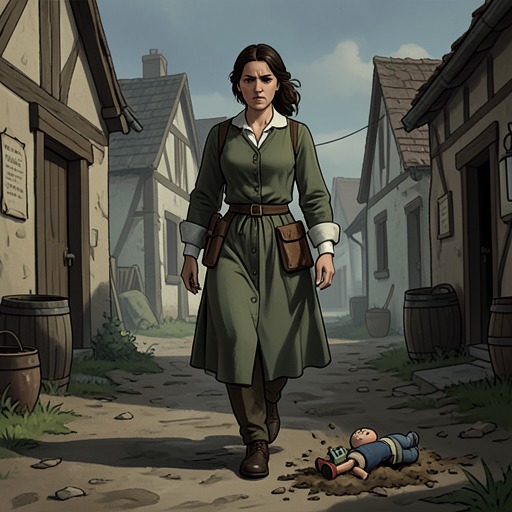
The following morning, Sarah Trafford sees the damage from the pedestrian bridge at Friars Wharf, a familiar shortcut over the Old Lag River. The house is an end-of-terrace building beside the riverside footpath. It has folded inward, leaving its interior exposed to passers-by and to women returning from taking their children to school. The second storey is gone; the ground floor is reduced to smashed furniture and broken walls. A red front door remains upright, an incongruously jaunty fragment at the edge of the destruction.
The blast has made absence visible in the surviving surfaces. Scorched, shrivelled wallpaper bears the shadow of a chair that has been reduced to matchwood. The remnant of the roof sags and continues to shed tiles. Yellow cordons close the footpath and the road-end by the river, while police in dayglo overalls gather on the bank. Women nearby smoke and claim to have witnessed the explosion; one tells Sarah Trafford that three people were carried out on stretchers. The report is presented as a bystander’s account, not as confirmation of who those people were or what became of them. With much of the house gone, its neighbour now seems closest to the river: South Oxford has, in the narrator’s stark phrasing, lost an address.
Cover Story and Consequences
The damage is followed by an effort to control its meaning. Howard assures C that the locals have been pacified and repeats that the incident was a gas leak, adding that the story will hold. His account turns concealment into administrative routine: the false explanation is not merely a public suggestion but the version being maintained for the neighbourhood and the press. C’s response makes clear that the operation has produced a politically dangerous result. He rebukes Howard for the failure and warns that the death of a child in a botched covert operation could attract sustained scrutiny.
The child at the centre of C’s concern is reported to be fine. C asks whether either Crane brother had shot her, and Howard says she is safe; the exchange establishes her survival without explaining her precise circumstances. C’s reference to the possibility of documentaries about dead babies contrasts the intimate stakes of the child’s life with the machinery of public scandal and official responsibility. The conversation also leaves a question open: C demands to know which brother planned the operation and what might follow, but no answer is supplied in this scene.
Narrative Significance
The bombing’s force lies partly in the collision between domestic scale and covert violence. A dinner party is interrupted by an explosion that is close enough to rattle its light fitting, yet the devastated house remains separated from the guests by several hundred yards and, at first, by uncertainty. The next morning, the exposed rooms, the chair-shaped scorch mark, and the roof still dropping tiles make that distance impossible to treat as safety.
The contrast between Gerard Inchon’s recognition of a bomb, Rufus’s gas-main explanation, and Howard’s repeated official gas-leak story traces the transformation of an event into a cover story. The physical evidence remains visible even as the account is managed. The bombing therefore marks both a literal destruction and a break in the apparent normality of South Oxford: the party cannot resume its previous meaning, and the ruined house cannot be made whole by the explanation offered for it.