British Army
Down Cemetery RoadThe British Army’s significance in the novel lies in the contrast between its visible role in war and the secrecy imposed on its own soldiers. Men serving under its authority are sent into lethal operations, exposed to a chemical weapon, and then officially erased from the living; the institution’s public identity and the state’s efforts to conceal its conduct become inseparable.
Military operations and concealed casualties
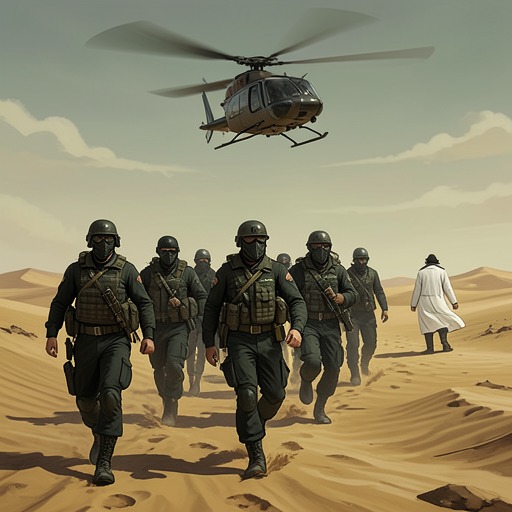
The army’s desert operation begins under a false account of its purpose. Soldiers are driven far from anywhere and told that hostile forces are present and must be captured. The targets are boy soldiers, represented to the men as genuine enemy combatants; the troops are instructed to bring them back alive. The distinction between the stated mission and the people actually encountered is decisive: the targets are children, not soldiers in any meaningful sense.
When a military helicopter arrives, it opens fire. Michael Downey later recalls that he and others had tried to communicate with the boys, whose only English included the word “cigarette”; one boy, wounded by Tommy Singleton, was bandaged in the truck. The attack does not end with the helicopter’s gunfire. The soldiers discover that they themselves have been made test subjects: a bomb releases a chemical agent, while the substance painted on them was supposed to protect them. Downey describes pain that continues rather than killing its victims, and sees the boy soldiers melting as he suffers. The episode makes the army’s operation more than a failed mission: its own personnel have been exposed alongside children in an experiment whose human cost is immediate and visible.
Official death and secret detention
After the desert test, the soldiers learned that the outside world had been told they died in a helicopter crash off Cyprus. The reported crash gave the state a clean public ending to events that had not ended for the men themselves: they were being held on an island off Scotland’s west coast. There, guards presented themselves as ordinary men ensuring the prisoners were all right, while repeatedly promising that they would be sent home once a few matters had been sorted out. One guard eventually told Tommy Singleton that the group had been declared dead in the crash. The men had never been to Cyprus; their official deaths had made their real location and condition disappear from public view.
Their captivity exposed a conflict between military membership and the protection it should have afforded. The survivors were members of the armed forces, yet their status as officially dead left them confined and vulnerable to the institution that had used them. Michael Downey understood the guards’ presence differently once the truth emerged: they were not simply there for the prisoners’ welfare, and the men were not being kept in cells for their protection. He believed their captors would neither release them nor kill them without senior political authorization, since executing serving soldiers would require someone to accept responsibility. The cover story thus did more than conceal a failed operation: it turned the soldiers’ service into a reason to manage the scandal, while their declared deaths stripped them of any visible claim on the country they had served.
Crows’ Hill and the institutional aftermath
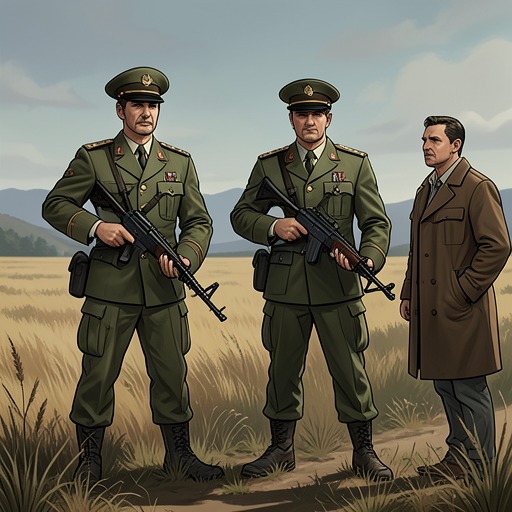
The soldiers’ later treatment was rooted in an earlier episode at Crows’ Hill, where Michael Downey had served for three months as a guard near the end of the Gulf War alongside his friend Tommy Singleton. Among the Iraqi prisoners there was a group captured at a military compound where investigators had found signs of a torture chamber: electric batons, chains fixed to the ceiling, and a blood-streaked bathtub, though no bodies. One night, Downey, Singleton, and several other guards took three prisoners to the wire and shot them. The novel gives the killing a specific context of suspected atrocity, but does not make that context an absolution: the prisoners were shot, and the men responsible could themselves have faced execution.
Instead, the response was concealment. The killing was covered up, and Singleton’s group was kept in close confinement for the remainder of the war. The British Army continued to hold them after the fighting, uncertain what to do with men who had become a potential scandal. Their later recruitment into special services offered a way to put that liability to use; once those operations were over, they passed into the custody of The Department and were officially declared dead. In this sequence, service did not restore them to public or legal protection. It moved them from one form of institutional control to another, while the false death record concealed both their history at Crows’ Hill and their subsequent fate.
The chemical-agent experiment extended that machinery of disposal. The survivors were held at The Farm, a facility left over from the era of germ warfare, while officials observed whether the nerve bomb’s effects would eventually kill them. Immunization had worked for only seventy per cent of the group, but the remaining statistics were still considered worth collecting; the plan was to keep the men until their cancers developed and then discard them. Their escape interrupted that plan and set the later pursuit in motion. The British Army’s role in their story therefore spans combat service, the suppression of a prisoner-killing scandal, and the transfer of compromised soldiers into a secret experiment whose subjects had already been written off as dead.
Public danger and denied responsibility
The British Army’s concealed operations become a political liability once Michael Downey might speak publicly. C warns Howard that the country is prepared to take up arms to prevent Downey from going public, and orders him not even to raise that possibility. The warning makes suppression more than a response to one soldier’s escape: disclosure is treated as a threat serious enough to justify national force, while the military’s own conduct remains outside public scrutiny.
As the war continues, Howard’s argument for preventing Downey from surviving long enough to talk rests on the consequences of exposure. The government would have to answer for using live targets to test a chemical weapon, and the men involved have already been officially declared dead. Howard also invokes the prospect of sanctions and missile attacks, turning the danger of public accountability into a further reason to silence the witness. The logic reverses the ordinary relation between military service and protection: secrecy is defended as protection of the country, while the soldiers harmed by its operation remain expendable.
When Sarah confronts Howard, he tries to shift the moral burden onto Downey and Tommy Singleton, citing their shooting of unarmed prisoners and claiming Downey volunteered for the experiment. He also acknowledges that the institution wanted to make contact with Downey and bring him back into the fold, but blames him for the danger Dinah faced and distances the organization from the attack on Sarah by describing its perpetrator as having gone rogue. These explanations expose a recurring institutional strategy: invoke the soldiers’ own violence when it is useful, claim consent when it can reduce responsibility, and isolate unauthorized violence from the system that enabled the operation. The British Army’s presence in the novel is thus inseparable from a wider state apparatus that treats truth as a security problem and its casualties as liabilities to be managed.