C
Down Cemetery RoadC is an unnamed senior official who supervises Howard and intervenes decisively in the covert operation involving Michael Downey, the Crane brothers, and Dinah Singleton. He is introduced as a man who appears to be in his late fifties but has recently entered his eighth decade; by the later meeting, his orders have shifted from reprimanding Howard over an unauthorized operation to trying to contain its consequences and control who can leave the island alive.
Identity and Position
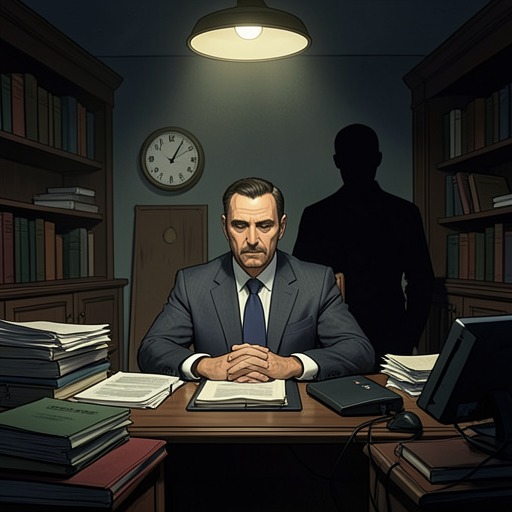
C occupies the top floor of a 1920s office block, whose other floors accommodate overflow from the Ministry for Urban Development. He stands at the office window looking down at traffic below, removed from its noise and rendered, at that height, as a moving line of metal. His appearance is carefully ordered: steel-grey hair swept back, a discreet grey suit, a lean frame, long fingers, and neatly clipped nails. The contrast between his apparent age and his actual age pleases him. Although he publicly credits good genes for his physical condition, he privately believes character is the key—and recognizes how rarely others possess it.
Howard has never discovered C’s name. He thinks of his employer as C not because that is a customary designation in their line of work, but because the single letter stands for a very short word that seems to fit. Their hierarchy needs no formal introduction: C summons Howard, makes him wait, and expects him to receive criticism without answering. The later scene returns them to the same floor and the same positions, with C’s silver hair and repressed fury unchanged and Howard again standing before the desk. A mark on the wall, like a spider crushed halfway up, is one visible alteration to the room; otherwise the repetition makes the office feel like the fixed centre of a crisis that has spun out of its control.
The First Reprimand
C’s first confrontation with Howard begins with an accusation that Howard has made a mess of the operation and a reminder that he never authorized a war. The rebuke establishes the central limit of C’s authority: covert action may be part of the work, but Howard and the Crane brothers cannot turn it into an uncontrolled conflict. C presses Howard on whether journalists are likely to uncover the truth. Howard insists that the gas-leak explanation will hold, but C’s attention moves immediately to the child. He demands to know whether Axel Crane has harmed her; Howard says she is fine, and C makes clear that this is not a matter he will tolerate being wrong about.
C’s concern is practical as well as human. He warns that a dead child could turn a botched covert operation into a sustained public scandal, and demands to know which Crane brother planned the bombing and what he intends to do next. He is not satisfied by the prospect that the story can be concealed: the safety of Dinah Singleton and the risk of exposure are both part of his reckoning with the operation. His anger at Howard’s handling of events is sharpened by the possibility that an unauthorized campaign could become a war whose political consequences extend far beyond the people directly targeted.
That boundary becomes explicit when C tells Howard that the country is prepared to take up arms to prevent Michael Downey from going public, but that Howard must not mention this as an option. C frames the possibility as a threat to Howard’s career and insists that he concentrate on the child. He then asks whether Axel is remaining in the open. Told that he is, C expresses the hope that Axel will be hit by a truck after dealing with Downey. The remark is grimly revealing: C wants the problem removed, but his preferred outcome is one that can pass for an accident rather than an order openly traceable to him.
Recounting the Damage
When C and Howard meet again, C forces the situation into a blunt recap. Howard let Axel, whom C calls dangerously unstable, conduct an operation requiring finesse. Axel blew up a suburban house and succeeded in eliminating only one of the two intended targets, Downey and Thomas Singleton. The bombing killed Singleton’s wife and nearly killed their young daughter. Amos Crane has since taken Dinah to use as bait for Downey; Downey has killed Axel, apparently to stop him murdering a local woman who had become interested in the girl’s whereabouts; and Axel had also murdered the private detective that woman hired. C’s summary turns the operation’s separate disasters into one accumulating chain of responsibility, with Howard at its centre.
C dismisses Howard’s suggestion that Downey can simply be exposed as a war criminal. Downey is, as C points out, technically dead as well, a contradiction that makes the official account a liability rather than a safeguard. C connects the danger to the ongoing war and to the government’s allies: if Downey speaks, the public could learn that the government was responsible for using live targets in a chemical-weapons experiment. The scandal would undermine the government’s claims to be defending democracy and could expose the country to sanctions and further retaliation. C’s urgency is therefore not only about a fugitive soldier; it is about preventing the government’s own role from becoming public knowledge.
Howard argues that Downey has already had time to talk and would have done so if he intended to. C counters that Downey was previously with Singleton under combat conditions, whereas he is now accompanied by a woman. C treats that difference as a reason the risk has changed, then asks where Amos is. When Howard says he does not know but thinks Amos has gone after Downey, C’s focus shifts from blame for the past to preventing another civilian death.
Orders and Limits
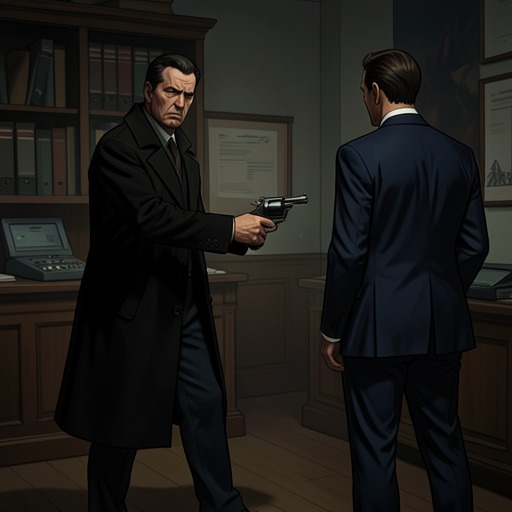
C declares that Amos is off the job and orders Howard to bring him back. He specifically fears that Amos will kill Sarah Trafford in a manner impossible to disguise as accidental. The command is not a general appeal for restraint: C tells Howard to remove Amos from the operation, says he can be pensioned off, and insists that this be handled properly. He also says he does not want Amos’s body to turn up anywhere. The order therefore contains its own contradiction. C objects to uncontrolled violence and the likelihood of exposure, yet accepts the disappearance of a dangerous operative as an intended solution, provided professionals manage it.
The same mixture of pragmatism and brutality governs his instructions about the island. C expects Amos to pursue Downey and warns that if Amos reaches the fugitives before they reach the island, he will leave a trail of destruction across the landscape. On the island, by contrast, the damage can be hosed away and forgotten. C tells Howard to stop Amos from reaching them first, but allows him to carry out his assignment if he arrives on the island first—and then orders that Amos must not be allowed to leave. The island is treated as a place where violence can be contained and erased, not as a place where the violence ceases to matter.
C also asks whether Mark Trafford has been secured, extending his concern to Sarah’s husband as the operation’s human perimeter widens. His exchanges with Howard show how he exercises authority: he uses ridicule, threats to Howard’s career, and contemptuous imagery, while withholding the written authorization Howard requests. C ends the meeting by ordering Howard out, having made the limits of his expectations clear without leaving a paper trail.
Narrative Role
C’s recurring office scenes provide a view of the crisis from the level of institutional management. The first meeting presents the bombing as an unauthorized escalation and foregrounds Dinah’s safety; the second reveals the accumulated deaths, the false official status of Downey, and the chemical experiment beneath the government’s public story. The repetition of the room and the sharpness of C’s recaps make the consequences legible as a sequence of failed attempts at control.
C is neither simply indifferent to casualties nor a reliable moral check on the operation. His alarm over Dinah and Sarah coexists with his readiness to threaten war, erase evidence, and prevent Amos from returning from the island. What distinguishes him from Howard and the Crane brothers is less an opposition to violence than an insistence that violence remain governable and deniable. His polished office, clipped authority, and repeated demand for control stand against the messy consequences he is trying to contain: dead civilians, a missing child, a fugitive witness, and a government exposed by its own covert experiment.