Copy of the letter sent to the Ministry of Defence
Down Cemetery RoadThe copy of the letter sent to the Ministry of Defence is both a carefully framed request for answers and a vulnerable physical trace of Sarah Trafford’s search for Dinah Singleton. Joe Silvermann encloses it with a personal letter to Sarah: its typed account sets the reported dates of Thomas Singleton’s deaths against one another, while Sarah’s red notation and the copy’s later appearance in hostile hands reveal how quickly an inquiry can become evidence of persistence—and a source of danger.
The letter and its claim
Joe’s enclosure is a formal letter addressed to the Ministry of Defence. It lays out the bare facts of Thomas Singleton’s death and his daughter’s disappearance in neat typing, with every spelling correct and Joe’s own reference number included. Its central question is a chronological contradiction: according to the Ministry’s press release, Thomas died four years earlier, so why was he reported to have died again only recently? The letter does not resolve the discrepancy; it makes the discrepancy explicit and asks the institution to help explain it.
Joe presents the inquiry as practical as well as personal. In his accompanying letter to Sarah, he reasons that answers about Thomas’s death may also lead to his daughter. If the Ministry already knows what happened, a few discreet answers now might prevent the matter becoming a larger public problem later. The copy therefore carries two forms of pressure: it asks officials to account for an apparent inconsistency, and it points to the consequences of leaving Sarah’s search unanswered. Joe’s appeal is measured and formally presented, but its underlying implication is that the issue will not simply disappear.
From enclosure to marked intention
The copy reaches Sarah as an enclosure in Joe’s letter. She reads his personal message twice before considering its attachment, so the bureaucratic document arrives within a relationship of disagreement and renewed cooperation. Joe acknowledges that he had become angry and accepts that he should help her, even if investigating the matter means driving to Surrey on what he had previously considered a futile errand. His formal letter is the concrete form that help takes: rather than merely agreeing to continue the search, he has already sent an inquiry to the Ministry.
Sarah turns the document into a working instrument of her own. On an impulse, she calls Directory Enquiries and obtains the telephone number corresponding to the address to which Joe sent the letter. She writes the number directly on the letter in large red marker, the only kind of pen close at hand. The mark makes the next step possible, but it also changes what the paper reveals: it now records Sarah’s intention to contact the Ministry herself. She considers calling, then decides to wait rather than act on an impulse that might fade. Her pause does not protect the document. The address, number, and conspicuous red writing make her intended follow-up legible to anyone who gets hold of it.
A paper trail becomes a threat
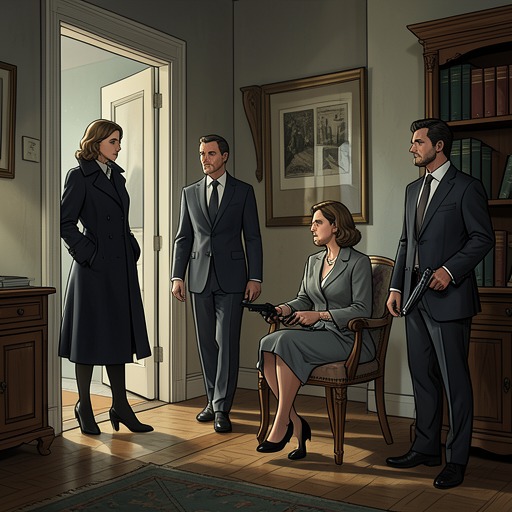
That vulnerability becomes immediate when Axel, using his cover identity as Rufus, confronts Sarah and produces her copy of Joe’s letter. He points to the red marker as evidence of what she plans to do and reminds her that Joe is dead, that his death has been covered up, and that the police are already watching Sarah over drugs. Sarah says she has given up the inquiry, but the marked page contradicts her claim in a way Axel can exploit. The copy has ceased to be only a request for information: in his hands it is leverage, a visible record of the action Sarah has not yet taken.
A related copy then surfaces in the account involving Amos Crane and Howard. Howard hands Amos a crumpled sheet bearing a London number and identifies it as the copy of the letter he had shown Amos two weeks earlier. Amos recognizes it as the letter sent by the detective Sarah hired. He understands that the detective’s persistence led him to allow Axel to deal with Joe, and he regards the letter as part of the chain that brought about Joe’s death. Its recovery also shows that the inquiry’s paper trail has traveled beyond Sarah and Joe: Howard has the sheet, and Amos can read its connection to the Ministry and to Sarah’s continuing search.
Documentary order against secrecy
The letter’s force depends on ordinary documentary details: dates, a press release, a typed account, a reference number, an address, and a telephone number written in red. Those details contrast with the secrecy surrounding Thomas Singleton’s reported death and Dinah’s disappearance. Joe’s document cannot establish what the Ministry knows, and its neatness offers no guarantee that officials will answer. It can, however, preserve the contradiction in a form that can be sent, copied, marked, found, and used against the people pursuing it.
The copy also links two kinds of communication without making them equivalent. Joe’s personal letter to Sarah expresses regret and renewed willingness to help; the enclosed Ministry letter turns that intention into a formal inquiry. Sarah’s red annotation extends the document’s path beyond Joe’s original act, while its later circulation among the people trying to silence the investigation turns that same trace into a liability. The paper’s significance lies in this reversal: created to make an unanswered question harder to ignore, it also makes Sarah’s next move easier for her opponents to anticipate.