Dinah Singleton
Down Cemetery RoadDinah Singleton is a four-year-old girl whose survival of the bombing that destroys her family’s home becomes the starting point for a wider search, a hidden-custody operation, and a dangerous pursuit. She is introduced not as an agent in the adult conflict but as its most vulnerable survivor: a child who slept through an explosion and is left without her mother. Her disappearance draws Sarah Trafford into the story, while the effort to reach her gives Michael Downey a destination and his pursuers a way to anticipate him.
Identity and Introduction
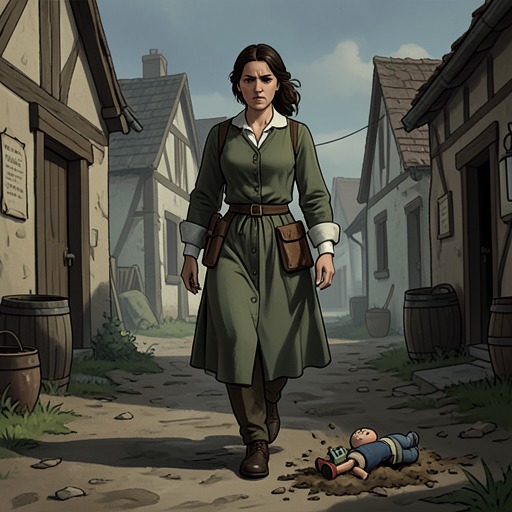
Dinah is identified as Maddie Singleton’s daughter, a very small child whose parents’ home has been blown up. In an early recollection, Wigwam first has to supply the name of the woman who died, then describes her daughter as a little one who might have been any child. The uncertainty in that exchange gives way to a more particular image: Maddie was tall and blonde, and her daughter was tiny. Sarah Trafford remembers only a fleeting shape, a head of hair, and an outline without a voice; she asks whether the child wore red overalls. Dinah’s first presence in the narrative is therefore both vivid and incomplete, held in other people’s fragmentary memories.
The bombing leaves Dinah the sole surviving member of her immediate family. Sarah tells Father Sullivan that the others are dead and names Dinah as the one left. The child’s survival is at first mistaken for death: Sarah says she thought Dinah had been killed, and learns that she was not. The correction changes the meaning of the search. Dinah is not merely an absence to be explained but a living child whose condition remains unknown.
Survival and Sarah Trafford’s Search
Sarah’s concern for Dinah grows from a recognition of shared survival. She thinks of the child sleeping through an explosion and imagines how surviving such an event might make ordinary dangers seem remote, as though a life had been tested and protected. Sarah has also lived through an explosion. The circumstances are different, but that resemblance becomes, for her, a bond strong enough to make the child’s fate feel personal. She decides she must follow Dinah’s story to its conclusion and learn not only whether she survived but whether she would continue to do so.
That resolve affects how Sarah moves through her own life. She does not tell Mark Trafford that she is pursuing the matter, reasoning that he might use any weakening in their disagreement about children as leverage. At a reception, she gives her maiden name rather than her usual name. Her investigation is thus also something she keeps apart from her marriage: a private commitment that she anticipates Mark would exploit if he knew its emotional force.
The search is not sustained by certainty. Sarah’s later description of Dinah as the invisible girl makes clear that she has come close to the child’s location without seeing her, and she has to keep faith with the possibility that she is on the right track. Even after Michael Downey abandons her, Sarah refuses to give up. Wearing his denim jacket, she sits by the sea and looks toward The island, where she believes Dinah is being held. She has found money in the jacket pocket, enough to pay the bill, but the practical detail matters less to her than the single purpose that has taken over: finding Dinah.
A Child in Custody
Dinah is seen in the care of a nurse named Deedee in a room that had formerly been a cell. Amos Crane comes downstairs to meet the child and has brought a bear for her. Faced with a four-year-old, he has to search for a way to speak to her; Dinah looks at him, while the nurse holds her and Dinah clutches at the nurse’s knee. The scene establishes her dependence on the adult physically present, even as the circumstances around her make that care provisional.
When Crane asks whether Dinah talks, Deedee says she expects the child could speak if she wanted to. Dinah is four, and her mother has disappeared; that, the nurse observes, is all she knows of what has happened. The passage does not diagnose her silence, but places it beside bereavement and dislocation. Crane, by contrast, reduces the child to her usefulness in the conflict: what matters to him is that Downey believes she is alive. He warns Deedee that Dinah will be taken away and instructs the nurse to do her job. His comparison of the child to a parcel exposes the cold logic governing her custody, while the bear and Dinah’s grip on the nurse’s knee preserve the concrete reality that this supposed piece in a game is a small child.
Dinah’s location becomes a strategic fact. Crane expects Downey to go to The island because the child is there. An earlier exchange establishes that the people waiting for Thomas Singleton knew where Maddie and Dinah lived, making the family’s home and whereabouts part of the operation surrounding them. The adults’ knowledge of where the child is does not mean Sarah can reach her: from the beach, Sarah can only look toward the island and hold to her belief that Dinah is there.
Relationships and Conflicting Claims
Dinah’s family relationships are defined by loss and uncertainty. Maddie Singleton is her mother, and the surviving accounts make clear that Maddie is gone; Sarah learns that Dinah herself was not killed in the bombing. Thomas Singleton is identified in Joe Silvermann’s letter as Dinah’s father. Joe points to the contradiction between an official press release saying Thomas died four years earlier and a more recent report of his death, and argues that the answers surrounding Thomas may lead to his daughter. The letter links Dinah’s disappearance to a larger question about what has been concealed, without resolving the discrepancies for Sarah.
Michael Downey’s pursuit gives Dinah another crucial connection. Sarah tells the woman who approaches her that Michael has gone after Dinah, and confirms that he is somewhere on The island. Crane likewise anticipates that Downey will head there. Dinah is consequently at the center of a contest between people trying to reach her and people who use her location to predict or influence their opponents. The available scenes establish the stakes of that pursuit without showing Dinah’s reunion with Downey or the eventual outcome of his attempt.
Sarah’s relation to Dinah develops without direct contact. Sarah remembers the child as a fleeting image, then becomes preoccupied with whether she is alive and what condition she is in. She calls Dinah the one left after the bombing and makes the child’s continued survival her own purpose. Dinah’s importance to Sarah is therefore not based on a shared conversation or established family tie; it grows from Sarah’s recognition of another survivor and from the urgency of a child left exposed to forces she cannot understand.
Narrative Role and Significance
Dinah is at once a person whose needs are visible in small gestures and a figure whom the adult plot repeatedly turns into information. Her age, the nurse’s explanation, the bear, and her grip on Deedee make her vulnerability concrete. In Crane’s calculations, however, the question is whether Downey thinks she is alive; for the pursuers, her location predicts his movements. This contrast shows how the machinery of secrecy and pursuit can translate a human life into a strategic signal.
The narrative also delays direct access to Dinah. Sarah recalls an outline rather than a full encounter, searches for news of the girl’s condition, and finally looks toward an island she cannot see clearly. The repeated gap between knowing that Dinah is alive and being able to reach her gives the search its emotional pressure. By the time Sarah hears that Michael has gone after her, Dinah has become both the destination of the pursuit and its moral measure: the child’s safety is what the competing adult calculations put at risk.