Dinah Singleton’s captivity
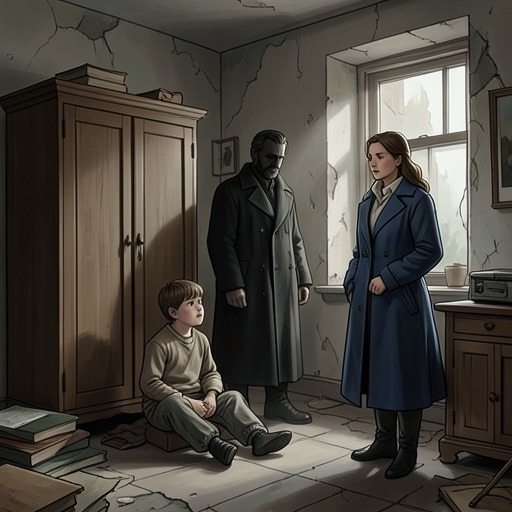
Down Cemetery RoadDinah Singleton’s captivity at The Farm is defined by the collision between a small child’s need for care and the impersonal logic of a secret operation. Confined in a former cell while her mother is missing, Dinah is kept under watch by a nurse who has received no explanation. The room has been given fragments of a nursery, but remains unmistakably a cell; and although Amos Crane brings Dinah a teddy bear, his own calculations make clear that her welfare is not the operation’s governing concern.
Confinement and Setting
Amos Crane finds Dinah Singleton downstairs with Deedee, the nurse, in one of the former cells. The room carries visible attempts to make it suitable for a child: splashes of paint have been added around the walls at Dinah’s height, and the duvet is decorated with cartoon lions. Yet these gestures cannot change its essential character. The cell has no windows, and the walls ripple where drills failed to shear them smooth. The setting makes care feel provisional: a child’s decorations have been placed inside a space built for confinement, not transformed into a genuine nursery.
Dinah is four years old, and her mother has disappeared. Deedee explains that this is all Dinah knows about what has happened. Asked whether the child talks, Deedee does not claim that Dinah cannot speak; she thinks Dinah could speak if she wanted to. Her silence is instead set beside her age and the disappearance of her mother, which Deedee identifies as grounds for trauma. The evidence does not explain the full circumstances of Dinah’s removal or establish how long she has been held, but it presents her captivity as both physical confinement and an unexplained rupture in the care on which a very young child depends.
Amos Crane’s Visit
Crane arrives carrying a teddy bear and is briefly at a loss about how to speak to a four-year-old. The gift gives him a way to approach her: he tells her he has brought it for her, and she looks up at him with wide eyes. When Deedee asks whether he has come to take Dinah away, he says no. She insists that wherever the child goes, she will go too. Crane gives her no account of Dinah’s situation, saying only that circumstances have brought the child there and that he has come to give her a bear.
The visit is not simply an act of kindness, nor does the text reduce it to professional inspection. When Deedee asks why he came, Crane answers that he had to see Dinah. The admission surprises him enough that he repeats it to himself. At his desk, he had already gamed the situation in operational terms: the nurse, the men, and the child were blips on a screen. He did not need to see Dinah’s eyes, untidy hair, or small limbs to assess the arrangement. Yet he has come in person. The scene holds the contradiction open: the child has registered as a strategic marker, but Crane’s need to see her cannot be fully explained by the calculations he had already made.
Care Under Secrecy
Deedee’s questions expose how little the people tasked with looking after Dinah have been told. She does not know why the child is there, and Crane offers no substantive answer. When Deedee asks what will happen after the operation, Crane says arrangements are in place and Dinah will be cared for. That assurance promises a future without describing who will provide it, where Dinah will go, or what protections will exist. Deedee, meanwhile, makes her own commitment explicit: if Dinah is moved, she intends to accompany her.
Crane does not accept that promise as a decision Deedee can make. He tells her to do her job and warns that Dinah will be taken away from her whatever happens. His insistence that the bear is for Dinah sits beside language that reduces her to cargo: she may look like a little girl, he says, but guarding her is no different from guarding a parcel. Deedee calls him a bastard, and he leaves knowing that she would have been close to using a weapon if she had one. The exchange reveals that the nurse’s care for Dinah is real, but takes place inside an arrangement whose authority and destination remain beyond her control.
Strategic Value and Human Cost
Crane’s private calculations make the danger beneath his reassurance plain. He considers the possibility that the operation could go so badly that those involved would have to hose everything down rather than merely clean up. In that case, he recognizes, Dinah’s chances of being among the survivors would not be high. He regards this prospect as a shame and as something that would leave him in poor odour, but he does not allow either thought to become a reason to abandon the operation. The disparity between his awareness of the danger and his limited promise to Deedee sharpens the precariousness of Dinah’s position.
The child’s survival also has strategic value apart from her physical safety. Crane thinks that Dinah could be dead, so long as Downey did not think she was; in this calculus, the blips matter more than the people they represent. His warning that she will be removed from Deedee and his insistence on guarding her like a parcel belong to the same logic: her location and perceived status can matter to the operation independently of her needs or wishes. The passage does not resolve what will ultimately happen to Dinah. It leaves her in a former cell, with a teddy bear on the floor, a nurse willing to follow her, and a promise of care whose practical meaning remains undisclosed.