Dinah held hostage
Down Cemetery RoadDinah Singleton’s hostage status makes her more than a missing child: her confinement on The island is treated by powerful men as leverage to draw Michael Downey into the open. The scheme shapes the movements of Downey, Amos Crane, and Sarah Trafford, while Sarah’s determination to find Dinah gives her flight a single, increasingly costly purpose. The evidence leaves the precise captors and Dinah’s ultimate fate uncertain, but makes clear how her vulnerability is turned into a tactical instrument.
Location and Strategic Use
C tells Howard that Dinah is on The island and that Crane expects Downey to go there. The exchange establishes the island as the known destination in a pursuit whose central pressure is Dinah’s presence: Downey is expected to seek her, and Crane is positioned to intercept him. The child’s confinement is therefore not merely the background to the chase. It is the reason the pursuers can anticipate where Downey will go.
C’s instructions to Howard distinguish between what may happen on the island and what must be prevented elsewhere. If Crane reaches the island first, he may carry out his task there; C’s stated concern is that Crane find Downey before they reach the island and leave destruction across the landscape, or leave the island afterward. C describes the site as a place where evidence can be washed away and forgotten. The bluntness of that calculation places Dinah’s captivity inside an institutional logic that treats both the child and the surrounding violence as manageable liabilities. The conversation does not identify who physically holds her, but it shows senior figures discussing her location and the possible consequences of using it.
Bait and the Pursuit of Downey
Crane’s own reasoning makes the function of Dinah’s captivity explicit. After leaving the encounter with Howard’s men and heading for King’s Cross, he judges that Downey will have worked out where the child is. Dinah is bait, Crane thinks, and the island is the place her pursuers expect Downey to search. Crane intends to be near it when the soldier arrives, unless he can track him down earlier. His plan depends on predicting Downey’s attachment to the missing child and turning that expectation into a trap.
Crane also takes Sarah into account. He knows she is with Downey and recalls Axel’s assessment that she is smart, although he considers her foolish for becoming involved. That calculation makes Sarah part of the pursuit even though Dinah is the bait: Crane sees her as an intelligent companion who may affect Downey’s choices. His confidence in his own reading of the situation is set against a brief glimpse of his reflection in a train window. For a moment he feels cold at the prospect of how short his future may be. The thought does not make him abandon the pursuit, but it places his hunt for Downey under the shadow of his own vulnerability.
Sarah’s Search and the Cost of the Captivity
Sarah reaches the coast and sits watching the waves, with the island somewhere beyond sight in the grey haze. She tells herself that Dinah is being held there, whoever the captors are; she has come too far to accept that she might be mistaken or to give up because Michael has abandoned her. The uncertain identity of the people holding Dinah does not weaken Sarah’s resolve. Instead, the absence of a visible enemy leaves her with one fixed objective: reaching the child.
Sarah is wearing Michael’s denim jacket, and a bundle of notes in its pocket—tens and twenties—gives her enough money to pay the bill. Yet the ordinary obligation feels remote beside the task she has chosen. In retrospect, she recognizes the importance of concentrating on one thing when life is falling apart; that one thing has become Dinah, the invisible girl. The distance between Sarah and the island is both physical and emotional: she is close enough to imagine the place where Dinah is held, but cannot see it or know what is happening there. Her thought that she can go no farther without breaking underscores how the hostage crisis has narrowed her attention and organized her endurance.
A woman warns Sarah that the intelligence people will kill her because she has been in close contact with Downey and may be assumed to know what he knows. Even under that threat, Sarah’s immediate answer is that finding Downey again would be a start. She understands that he has gone after Dinah. Her response links her own survival to the same search that makes her vulnerable: the route to the child runs through the man the authorities are pursuing.
Traces and Unresolved Outcome
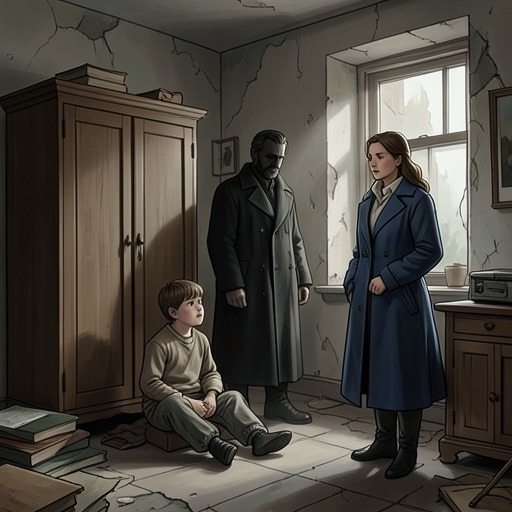
Later, Sarah says Dinah’s name to a badly injured woman and receives only a wet hiccup in reply. She does not dare move the woman and does not know how to do so. Looking around, she notices children’s pictures fixed to the walls: drawings of other children, animals, the sky, the sun, and a house, each with the earth rendered as a strip of green and the sky as a strip of blue. A large blue teddy bear lies by the door, apparently shot. These details connect the scene to Dinah through the child’s drawings and the bear, but the passage does not establish the woman’s identity or confirm Dinah’s fate. The image of a child’s familiar objects amid injury and gunfire gives the captivity a human scale that the strategic language of bait and cleanup suppresses.
The available account does not resolve whether Downey reaches Dinah safely or what ultimately happens to her. It does establish the opposing meanings attached to her confinement: Crane and the officials treat her location as a way to channel a target, while Sarah treats finding her as the one purpose worth continuing toward. That conflict makes Dinah’s hostage status a source of danger and a measure of the characters’ competing loyalties, even while the child herself remains largely unseen.