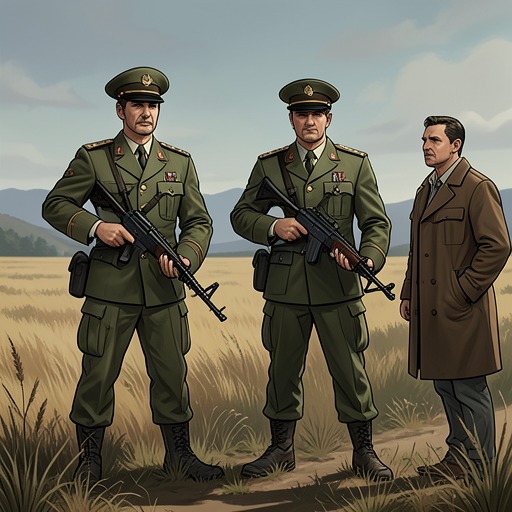
Ethnically selective chemical weapons
Down Cemetery RoadEthnically selective chemical weapons are presented as a military possibility whose technical premise—unequal vulnerability among populations—carries a political consequence: a weapon might incapacitate or kill a selected enemy population disproportionately while sparing friendly forces. In the novel, the concept sits beside revelations of chemical-warfare experiments in The African desert and an official effort to keep those events secret. The text makes the distinction between possibility and proven use important: it supplies evidence of toxic experiments and concealment, but does not establish that an ethnically selective agent was deployed.
Definition and Documentary Context
Near the novel’s conclusion, a quoted 1975 US Army research document describes the theoretical development of weapons designed to exploit naturally occurring differences in vulnerability among population groups. Its stated effect would be to incapacitate or kill a selected enemy population to a greater extent than friendly forces. The definition is chilling partly because it is expressed as a technical capability: human variation becomes a means of selecting who is most likely to suffer.
The passage then invokes a 1982 book by Harris and Paxman, which warns that once chemical or biological warfare has been shown possible, it has generally been done. Placed after the story’s disclosures, this citation does not prove that the specific weapon described in the Army document was made or used. Instead, it sharpens the gap between formal claims about possibility and the fear that secret programs may turn possibility into practice.
The Desert Experiments and Their Concealment
Sarah Trafford names the concealed subject directly when she accuses the men confronting her of covering up toxic warfare experiments involving chemical weapons in The African desert. The charge places the idea within the novel’s history of secret military activity, rather than leaving it as an abstract technical proposition. She also tells Howard that he used Michael Downey as a guinea pig; Howard answers that Downey volunteered. The exchange sets consent against the coercive setting of an experiment whose circumstances and consequences are not openly acknowledged.
The dispute is not merely over who authorized an experiment. Howard argues that events in Downey’s past were crimes, but says that those responsible were punished and that the Department’s work is to clear up what happens in democracy’s margins. When Sarah objects that the public never knew about the boy soldiers who were killed, Howard insists that public ignorance is part of the point. His defense makes secrecy a governing method: the harm is not only committed, but also removed from public knowledge so that the state can present a manageable account of itself.
War, Violence, and the Limits of What Is Revealed
The chemical-warfare issue emerges amid a wider atmosphere of imminent war and official alarm about disclosure. C warns Howard that the country is prepared to take up arms to prevent Downey from speaking publicly. Elsewhere, an official argues that disclosure would reveal the use of live targets for a new chemical weapon and expose the state to political consequences. Together, these statements frame secrecy as protection of national reputation and policy, not simply as a way to protect operational details.
Other episodes establish the story’s wider context of violence, but do not independently prove the use of ethnically selective chemical weapons. Michael Downey recounts a helicopter opening fire after soldiers had tried to communicate with boy soldiers and had bandaged the wounded leg of a child. Amos Crane recalls that Downey and Tommy Singleton, with others, shot three Iraqi prisoners at Crows' Hill; the episode is subsequently concealed, and the soldiers are kept in close confinement before being drawn into secret service. These events show a world in which children, prisoners, and soldiers become subjects of violence and official management. They should remain distinct from the specific claim about a population-selective chemical agent.
Significance
The concept links scientific classification to the novel’s political language of war. A weapon designed around differences between populations would make those differences operational, turning the question of who is vulnerable into a military advantage. The surrounding arguments expose how claims of necessity, volunteering, punishment, and public protection can compete with the evidence of harm—and how official secrecy can keep those claims from being tested openly.
The closing documentary citations leave the reader with both a definition and a warning, rather than a confirmed account of a particular weapon’s deployment. The novel’s evidence supports the existence of concealed chemical-warfare experiments and a struggle to prevent disclosure; the cited discussion of ethnic selectivity broadens the danger those revelations evoke without resolving whether that precise capability was used.