Final confrontation at the chapel
Down Cemetery RoadThe final confrontation at The chapel in the woods is the decisive collision between Sarah Trafford’s effort to protect Dinah Singleton and the men seeking to control or eliminate the people who could expose their secrets. Its immediate danger is personal—Dinah is in Sarah’s arms, and Sarah is threatened at gunpoint—but the history behind it reaches back to a concealed military experiment and the state’s attempt to erase its survivors.
Causes and Background
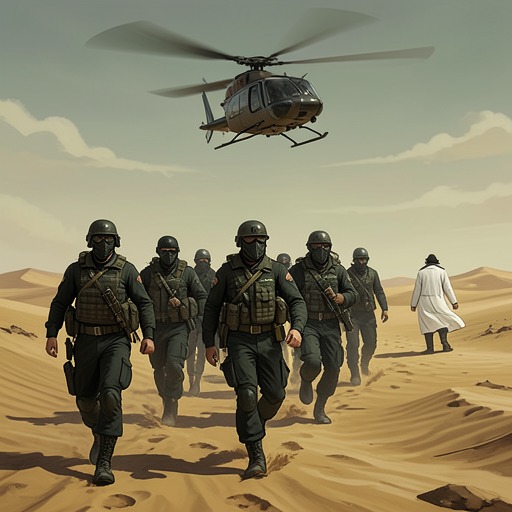
The soldiers’ account begins with an operation presented as a mission against enemy forces. They were driven far into the desert and told that this was no exercise: armed opponents were supposedly waiting, and the soldiers were expected to take them alive. The targets were boy soldiers. The men were told that these children were genuine enemies, but the order to bring them back alive would acquire a different meaning when the soldiers discovered what the operation really was.
The blast was not an ordinary bomb. Downey explained that the men had been taken there to be tested and exposed: they were guinea pigs. He remembered a sound like breaking glass, an air that seemed to turn muzzy, and pain that continued instead of killing him quickly. As he and the others screamed, Tommy Singleton tried to stop him looking toward the children. Downey looked anyway and saw that the boy soldiers were not screaming; they were melting. His inability to describe the experience fully, and the remembered command not to look, mark the episode as both a physical ordeal and a trauma carried into the later confrontation.
Afterward, the surviving soldiers were taken to an island off Scotland’s West Coast. Their captors presented themselves as men keeping them safe, repeatedly promising that they would go home soon. The promise persisted through what Downey remembered as hundreds of tomorrows. The truth emerged when a guard told Tommy that the soldiers were supposed to have died in a helicopter crash near Cyprus. The official account had already made them dead, although they were alive and being held. Downey understood that the authorities could neither release them without exposing the lie nor simply execute members of the armed forces without political protection; their captivity followed from the same cover-up that concealed the desert experiment.
The Threat in the Chapel
In the chapel’s cold, empty worship space, Sarah Trafford recognizes the history in Amos Crane’s smile: the man now before her is the same threat she had known under the identity of Rufus, and she connects that disguise with Axel Crane. The distance Sarah has travelled to reach this scene seems to fold back on itself; the confrontation echoes the danger that began in her kitchen, making the chapel not an escape from the past but its return.
The standoff turns on who can reach a weapon and who is exposed. Zoë Boehm dips for her gun, only to find it already in Amos Crane’s hand. As Michael Downey reaches for his own weapon, Zoë’s little pistol is pressed against Sarah’s ear. Sarah keeps hold of Dinah Singleton, who twists in her arms, and does not let the threat make her drop the child. Amos threatens to shoot Sarah, but Zoë tells him the weapon is not loaded. Amos pulls the trigger, testing the warning and briefly suspending the scene between an apparent execution and the possibility that the threat has no force.
Reversal and Aftermath
Amos Crane’s attention shifts when he tells Zoë Boehm that he has dreamed about her. The admission is strange, but its practical effect is immediate: as his eyes flicker, Amos drops toward the floor and reaches for a gun. He is still intent on killing Zoë and making Michael Downey suffer for his brother’s death, yet Zoë does not hesitate. She shoots, and Amos ceases to be a threat. The moment reverses the balance of the confrontation: the man who had seemed to control the room is stopped by the woman whose attention he has briefly drawn away.
The gunshot carries beyond the chapel. Howard, approaching through the trees, hears it and reaches a clearing where Sarah Trafford is waiting with a shotgun. He has his own gun, but it hangs from his wrist; the scene has already begun to slip beyond the controlled operation he had expected. When he fires, Sarah is momentarily overwhelmed by the noise and a rushing flash of color. Then she draws a deep breath and recognizes that she is still alive.
The man on the ground has lost the greater part of his right arm, and the shotgun lies twisted at his feet. His face, stripped of its bland disguise by pain, appears to Sarah as the darkness beneath it made visible. The violence does not offer a clean victory: Sarah can find no words, while Howard is left gravely wounded and the chapel’s struggle has spilled into the surrounding woods. But the immediate threat to Sarah and Dinah Singleton has been broken, and the final exchange turns survival from a possibility held at gunpoint into a fact Sarah can recognize for herself.
The Motive Behind the Search
Downey’s account of Tommy Singleton complicates the image of the men the final confrontation is meant to protect. Tommy had been a soldier and, in Downey’s judgment, a good one, but not a kind man: he went with prostitutes, picked fights, and sometimes struck an opponent from behind. Downey described having to pull him off a man he was beating, recognizing that stopping him sooner might have meant killing him. This portrait resists turning the survivors into uncomplicated victims; the violence done to them and the violence they themselves could do remain part of the same history.
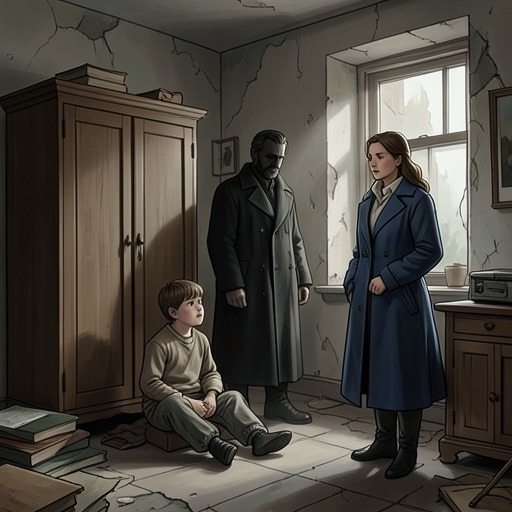
The immediate reason Downey is searching for Dinah is also more complicated than a simple bond between the two. When Sarah asks whether Tommy is the reason, Downey says it is Maddy Singleton. That distinction places Dinah’s peril within the surviving ties to Maddy, and gives the struggle around the child a personal history beyond the armed standoff in the chapel.