Inspector Ruskin
Down Cemetery RoadInspector Ruskin is the police officer who questions Sarah Trafford about Joe Silvermann’s death. He initially treats Joe’s death as suicide, but his questions expose a discrepancy between Sarah’s account and the cheque found in Joe’s wallet. His presence also frames the pressure Sarah faces as she tries to retract a statement she says was made under duress.
Identity and Presence
Ruskin arrives at Sarah Trafford’s house the morning after police have spoken with her at Joe Silvermann’s office. During that earlier visit, a police pathologist was examining Joe’s body inside the office while Sarah waited outside; afterwards, officers gave her a lift home. Ruskin has called to say that he has more questions. At first, they seem to be the same questions as before, but the repetition leads to a new point of pressure.
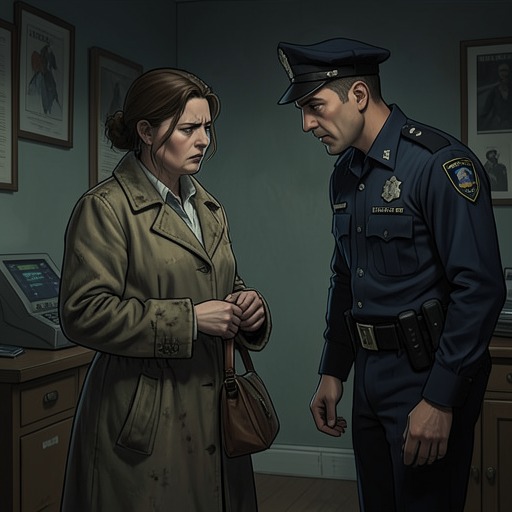
The narration gives Ruskin a distinct physical presence: his sandy moustache curls around his mouth, and his hair is arranged around a pronounced parting. Sarah reads his expression as one of deep unhappiness, and the description carries a dry, wry tone. Two uniformed officers accompany him, one man and one woman, and sit silently on the sofa while Ruskin takes his own notes. The extra officers strike Sarah as unnecessary. His note-taking, company, and appearance make the interview feel controlled, though the narration does not establish that the officers speak or take any action themselves.
Investigation of Joe Silvermann’s Death
Ruskin tells Sarah that there are oddities in the case, but he does not initially present Joe’s death as a murder investigation. He believes Joe killed himself and considers that explanation compatible with the circumstances: Joe had good reason, in his view. The absence of a note is one detail the police checked; Sarah says she did not see one, and Ruskin confirms that no note was found. His working conclusion is therefore not based on finding a suicide note, but the exchange shows that he regards suicide as plausible without one.
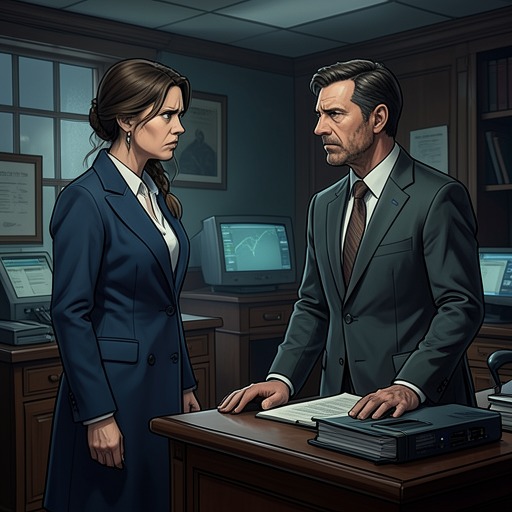
The questioning becomes more pointed when Ruskin says there is no file on Sarah, although he would have expected a note of an appointment. He then produces a folded slip of paper and states that Sarah never actually met Joe. The object makes the gap in her account concrete: Joe had a cheque from her in his wallet. Ruskin asks how he could have obtained it if the two had never met. The cheque connects Sarah to the dead man despite the missing file and the claimed absence of a meeting, giving Ruskin a specific inconsistency to press rather than relying only on general suspicion.
Sarah’s account of his manner remains her own interpretation, not an established description of his investigative methods. She suspects that the police already know why she hired Joe and that Joe would have kept records; she also imagines that the questioning is buying time while someone fetches handcuffs. The narration identifies this as her fear as she recognizes that one of Ruskin’s remarks was not really a question. Ruskin’s evidence in the scene is narrower: the missing file, the absent appointment note, the lack of a suicide note, and the cheque in Joe’s possession.
Sarah’s Retraction
Ruskin reappears when Sarah calls the police and learns that he is available. She tells him that her earlier statement was not true. By then, Sarah has seen a news report about the man who sold ecstasy to Lizbeth Moss and reads the coverage as part of the reason Ruskin is coming at her aggressively. The comparison to a shark belongs to Sarah’s perception of him; the scene does not establish what Ruskin knows beyond the questions he has already asked.
Sarah then insists that she made the statement under duress and says she will go to the station the following day to make a fresh one. She adds that, if that does not happen, she will call a press conference. The challenge reverses the interview’s earlier balance: instead of merely answering Ruskin’s questions, Sarah sets out a public consequence and makes the next step conditional on his response. She is left trembling and unable to move for several minutes, uncertain what she has done and what consequences will follow. The passage does not reveal Ruskin’s reply or establish whether he accepts her retraction.
Narrative Role and Limits
Ruskin functions as the point where the police inquiry turns Sarah’s private connection to Joe into a matter of evidence. The cheque is small but decisive in the questioning: it contradicts the claim that Sarah never met Joe and draws attention to the absence of an appointment record. At the same time, Ruskin’s stated belief in suicide keeps the scene from resolving the mystery of Joe’s death. His questions raise suspicion and sharpen the conflict without confirming either murder or the full circumstances of Sarah’s earlier statement.
The scenes also distinguish what Ruskin says from what Sarah fears. He is direct about the oddities, the missing file, the cheque, and his belief that Joe had reason to kill himself; Sarah supplies the sense of impending arrest and interprets his manner through the news coverage and her own unease. Later, she tries to reclaim control by naming duress and threatening publicity. Ruskin remains consequential but only partly known: the narrative shows his questioning and the pressure it creates, while withholding his reaction to Sarah’s challenge and the ultimate effect of her promised fresh statement.