Joe Silvermann and Zoë Boehm
Down Cemetery RoadJoe Silvermann and Zoë Boehm were young lovers who married and remained bound by a relationship that Zoë describes in terms of both estrangement and enduring affection. Their marriage is revealed through grief rather than a shared scene: after Joe’s death, Zoë condemns his weaknesses, recalls that he was still in love with her, and insists that he was murdered. Her account makes their bond difficult to reduce to either a failed marriage or uncomplicated devotion; the distance between them coexists with her anger, loyalty, and bereavement.
Marriage and Distance
Zoë tells Sarah Trafford that she and Joe married young and were in love when they did so. She recalls them as children themselves, a description that gives their early marriage a quality of youthful attachment rather than settled maturity. When Sarah asks whether the marriage lasted, Zoë initially answers that it did not. She then corrects the implication: it did for Joe. In her telling, the marriage had become unequal in its emotional persistence. Zoë says they were growing apart, but Joe continued to love her until the day he died.
Her dry joke about their separation—separate prescriptions and everything—makes the distance sound domestic and practical. It punctures any romantic account of the marriage without cancelling the history behind it. Zoë’s bitterness and comic precision are part of how she speaks about Joe, but the exchange does not end in detachment: she begins to cry and calls him a stupid bugger. The abrupt movement from a wry remark to tears shows how little her sharpness can contain the loss.
Joe as Zoë Remembers Him
Zoë’s portrait of Joe is affectionate but unsparing. She says he imagined himself a detective and kept track of where she was, including where her credit card was; his mistake, she says, was assuming that she was with it. The joke presents a marriage in which Joe watched over Zoë, while also making clear that he could mistake knowledge of her belongings for knowledge of her whereabouts.
She judges his detective work as limited. Joe had a good telephone manner, and his Oxbridge manner impressed middle-class clients, Zoë says, but his successes were modest: he could find someone who did not want to remain lost, or investigate petty-cash theft by cleaning staff. She describes his emotional age as twelve and calls him a fool, a liar, and an exceptionally soft touch. These criticisms do not make him a fraud in every respect. Sarah objects that Joe was good at what he did, while Zoë’s account distinguishes his professional ability from his emotional immaturity and trustfulness.
Zoë’s harshest assessment also clarifies the danger she believes Joe failed to recognize. He had no notion, she says, that people might harm him, and his daydreaming could get him killed. The criticism is spoken after his death, when that lack of caution can no longer be corrected. It therefore functions as both an indictment of his naivety and an expression of grief for the man who, in Zoë’s view, never understood the risk around him.
Grief, Loyalty, and the Murder
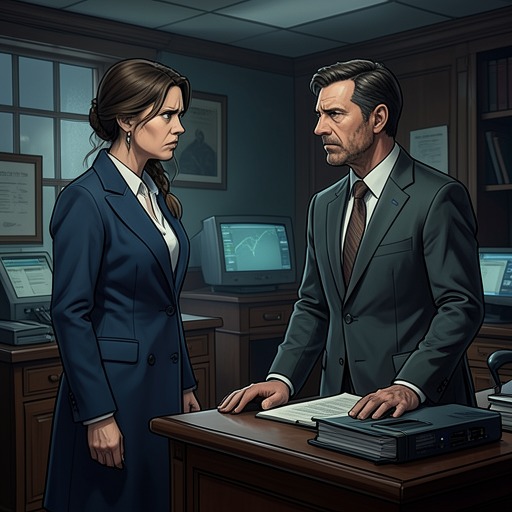
Zoë first approaches Sarah as someone connected to Joe’s death. She says she believes Sarah got her husband killed and challenges her to remember their earlier meeting. Her accusation makes the personal history explicit: Joe was not simply the detective Sarah knew, but Zoë’s husband. Sarah had not known that, and the revelation changes the terms of their conversation.
Yet Zoë’s suspicion of Sarah does not lead her to accept the apparent case against Joe. She insists that Joe did not use or sell drugs and that someone killed him and planted drugs on him. She vows to find the person responsible, threatening violent revenge against whoever it proves to be. The threat is not detached investigative language: it comes from a widow who believes the evidence against her husband is false and that his death has not been accounted for.
Her later recollection of their marriage complicates the fury of that opening. Zoë can accuse Sarah, disparage Joe’s judgment, and joke about their separation, but when she speaks of how he remained in love with her, she breaks down. She says he never had the slightest idea that anyone might do him harm. The movement between accusation, mockery, and tears gives her remembrance its force: Joe’s death exposes not a simple reconciliation but the persistence of attachment inside a marriage that Zoë says was already coming apart.
The Relationship’s Significance
The account is shaped by contrasting testimony. Zoë emphasizes Joe’s soft-heartedness, daydreaming, and limitations; Sarah insists that he was good at his work. Neither view erases the other. Zoë’s insistence that Joe was innocent of the drug allegations is compatible with her belief that his own carelessness left him vulnerable, while Sarah’s defense of his ability challenges the obituary-like quality of Zoë’s criticisms without undoing her grief.
Their marriage is therefore disclosed in fragments and through a survivor’s mixed register: an intimate joke about credit cards, the practical image of separate prescriptions, a blunt assessment of his character, and an involuntary cry over the man who loved her. Zoë does not present the couple as happily reconciled, nor does she treat their estrangement as proof that Joe no longer mattered to her. Her account leaves both facts in view: they were growing apart, and she mourns him as her husband while pursuing the person she believes killed him.