Joe Silvermann's murder and framing
Down Cemetery RoadJoe Silvermann’s murder is presented not as an isolated death but as the hinge of a coordinated effort to erase his work with Sarah Trafford and redirect suspicion onto her. The razor in Joe’s own hand offers a misleadingly simple account of what happened; the missing file and planted drugs reveal a second purpose: to warn Sarah away from the truth while making her vulnerable to accusation.
The Office and the Discovery
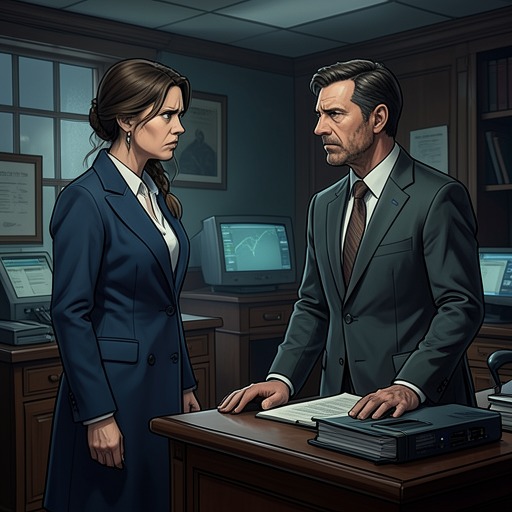
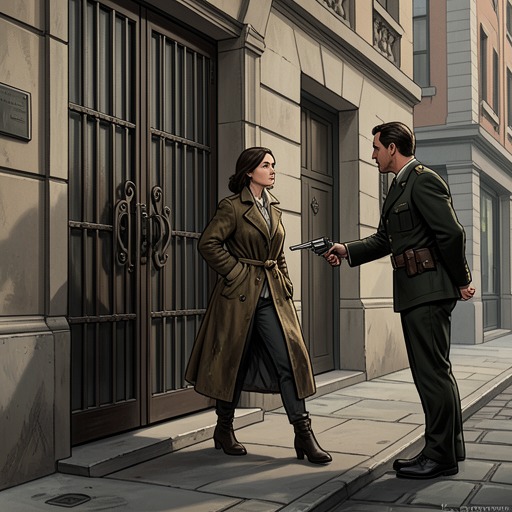
Sarah arrives at Joe’s office intending to leave him a cheque, an act she hopes will resolve the unease between them. The street is quiet, the outer door is unlocked, and no one answers when she calls for Joe. She hesitates at the empty premises, knocks, and then finds the inner office door open too. The ordinary details of the visit matter because there is no dramatic confrontation or explanation waiting for her: she enters a place that appears merely unattended and encounters the crime alone.
In trying afterward to remember what she saw, Sarah catches herself replacing the scene with a more comforting image. For a moment, she thinks Joe was wearing a bright red tie. She recognizes this as a fiction almost as soon as she forms it. The more difficult truth is that Joe’s own hand held the razor. Sarah does not mistake that detail for an innocent explanation; she understands that the appearance of self-infliction cannot account for what happened. Her later reasoning identifies the razor as the instrument used to slit his throat, connecting the object in his hand to the murder rather than accepting it as proof of suicide.
The Missing File
The strongest evidence that someone has manipulated the aftermath is not the razor but the absence of Sarah’s file. Joe’s office contains no record of her, although Sarah believes he would have opened a file for their work together. She knows his habits well enough to distinguish an uncompleted task from an undocumented one: he had not banked her cheque, but that did not mean he would have neglected to record that he was supposed to do so. The missing paperwork therefore points to deliberate removal, not ordinary disorganization.
Zoë Boehm independently reinforces the importance of that absence. She describes Joe as meticulous about his lists, to the point of keeping a list of the lists he maintained, and judges it far more plausible that he might forget his trousers than that he would fail to keep a record. The detail makes the erased file a concrete breach in Joe’s established routine. Sarah and Zoë reach the same central conclusion from different positions: someone removed the evidence of Sarah’s connection to Joe after he was killed.
The Frame and the Warning
The missing record is only one part of the staging. Sarah recognizes that traces of the search she conducted with Joe have also been erased, while she herself has been set up as a link in a drugs ring. The arrangement can harm her in two ways at once: it discredits her account of Joe’s murder and gives others a reason to treat her as a criminal suspect. Sarah reads the combination as a warning that the people behind the intervention can alter the record and can reach her as well.
Zoë rejects the drug accusation as incompatible with what she knew of Joe. In her account, Joe neither used nor sold drugs; someone killed him and planted the drugs. Her anger makes the distinction explicit: the evidence against Joe is not merely untrustworthy but manufactured, and the person responsible is the target of her search. The murder thus produces two competing narratives. One is the apparent story offered by the scene and the planted evidence; the other is the account reconstructed from Joe’s habits, the missing file, and the deliberate falsification around Sarah.
Recognition and Consequences
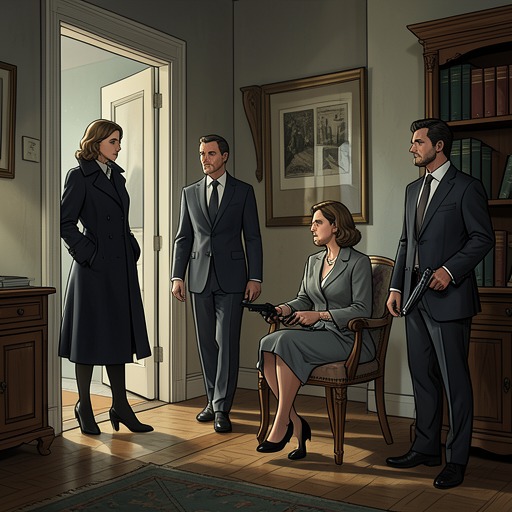
Sarah’s first attempt to identify the people responsible is uncertain. Exhausted, she provisionally suspects Gerard Inchon, but she cannot make the logic of that suspicion hold together: she cannot imagine him personally entering her home to plant drugs or using Joe’s razor to kill Joe. She therefore considers the possibility of accomplices rather than treating her suspicion as established fact. She also connects the concealment of Dinah Singleton to the same network of secrecy, while acknowledging that she does not know whether Dinah is alive. The murder opens onto a wider disappearance without resolving it.
What Sarah does conclude is that Joe’s death carries a threat directed at her. She believes the perpetrators will kill her too if she continues to make trouble, and considers whether accepting the imposed version of events might let her return to normal life. Zoë, by contrast, commits herself to finding the killer. She also confronts Sarah with a separate inconsistency: Sarah told the police that the day she found Joe was her first time in his office, although Zoë knows there was an earlier visit. The reason for Sarah’s lie is left open, but the question shows how the cover-up has made even the survivors’ accounts suspect. Joe’s murder does not simply remove an investigator; it forces Sarah to choose between the safety of silence and the evidence that someone has deliberately erased.