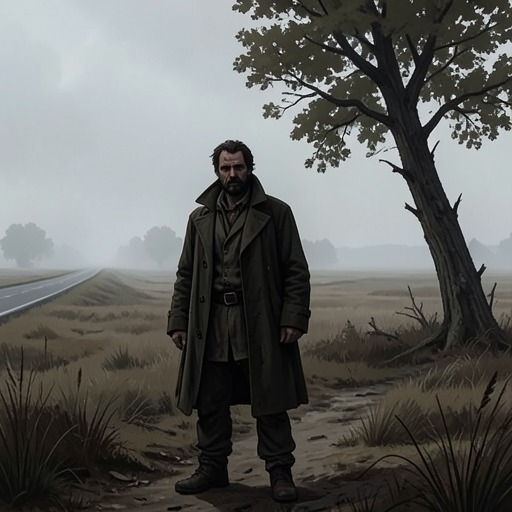
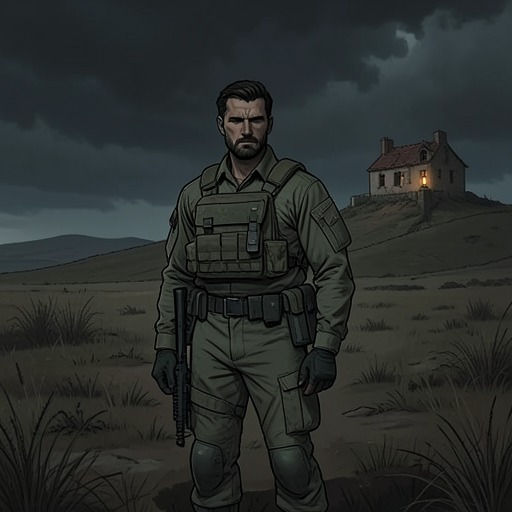
Michael Downey’s fatal illness
Down Cemetery RoadMichael Downey’s fatal illness is the long-delayed consequence of a secret chemical-weapons test in the desert. The exposure that he survived as a soldier continues to damage him years later, turning his escape from official death into a more precarious survival and casting a physical cost over his search for Dinah Singleton.
Origin and Recognition
The illness begins with the soldiers’ deployment into the sands, where they were told they were hunting enemy fighters and were ordered to bring the boy soldiers back alive. The mission was a deception: the soldiers themselves were being tested, exposed to a weapon that Downey later described as unlike a conventional bomb. He recalled a sound like breaking glass, air that went “muzzy,” and pain that seemed to scorch his skin while he and the others screamed. His memory fixes the experiment’s violence in bodily sensation rather than in any technical account of the weapon.
The horror was not confined to the soldiers’ own suffering. When Downey looked up despite Tommy Singleton’s repeated warning not to, he saw that the boy soldiers were not screaming: “They were melting.” The image connects his later illness to a scene of mass injury that the mission’s cover story had hidden from its participants. The surviving soldiers were subsequently kept on an island off Scotland’s west coast and told they would soon be going home. Only when a guard disclosed that the men were officially presumed dead in a helicopter crash near Cyprus did they understand that their confinement was part of a larger effort to conceal their survival and the events in the desert. The illness thus outlasts both the test and the state’s false account of what happened: the men escaped the immediate experiment, but not its continuing effects.
Delayed Effects and Disclosure
The illness becomes explicit much later, when Howard tells Zoë that Michael Downey is dying. He attributes it to something Downey caught in the desert and calls it “Long term, but definitely fatal.” The brevity of the explanation is part of its force: the weapon’s continuing effect has no diagnosis or remedy in this exchange, only a delayed certainty of death. Howard’s remark that “we’re all doing that” broadens the moment into a grim acknowledgment of mortality, but he singles out Downey’s desert exposure as a particular, known cause. What began as a concealed experiment has become an injury that can no longer be contained by the official fiction that the soldiers died in a helicopter crash near Cyprus.
At the chapel, Zoë makes the consequence immediate for Sarah by asking, “He’s sick. Did you know that?” Sarah is already confronting the danger around Dinah and the armed men arriving at the chapel; the news forces Downey’s condition into that crisis. When Sarah sees him, he looks ill and drawn, with blood sprayed around his T-shirt collar after another coughing attack. He appears to be fading just as his search for Dinah has ended. His brief claim that he “didn’t kill anybody. Not this time” belongs to the chapel’s immediate danger, not to an explanation of his illness, but it makes the reunion inseparable from the violence that has shaped his survival.
The Body as an Unfinished Cover-Up
The illness does not remain a private medical fact; it becomes part of how Sarah Trafford understands the aftermath of the desert experiment. Watching the wake erase its white scar from the sea, she thinks of the invisible pollutants that leave no such clean surface behind. Michael Downey, she realizes, carries an unseen injury too: not only the toxic explosion, but a damage to the soul that has allowed him to kill whoever stands in his way. The thought darkens the meaning of his survival. The desert exposure has persisted in his body, while the violence of his past has persisted in his conduct; neither can be made to disappear simply because the immediate crisis has passed.
Sarah later names the buried cause directly in confronting Howard, accusing him of covering up toxic wargames and asking whether chemical weapons in the African desert ring any bells. Howard denies that any of it had anything to do with him. The exchange leaves the institutional explanation contested, but not the physical consequence: Downey is dying from what happened there. His fatal illness is therefore both delayed bodily harm and evidence of a crime that officials can still deny, even after its victim has survived long enough to reach the people and places the cover-up was meant to erase.
The Cost of Survival
The illness sharpens the difference between being kept alive and being allowed to live: the soldiers were exposed to a weapon under false pretenses, then officially declared dead, while the damage continued in the body of the man who survived. Howard’s casual description of the condition as “like life” makes that delay sound ordinary, but the novel has shown its cause to be neither natural nor inevitable. Downey’s survival therefore carries no clean victory. The concealed test has left a consequence that official denial cannot reverse, and his reunion with Dinah arrives under the pressure of a future already closing.