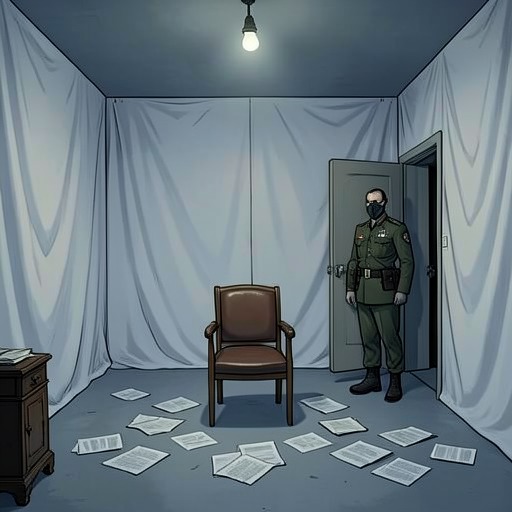
Ministry of Defence
Down Cemetery RoadThe Ministry of Defence is the official body Joe Silvermann approaches when his investigation uncovers conflicting reports about Thomas Singleton’s death. In the novel, the Ministry matters less as a fully depicted organization than as a possible keeper of information: a press release attributes an earlier death to Thomas, while a later report appears to say that he died again. Joe’s letter makes this discrepancy a formal question and connects it to the disappearance of Thomas’s daughter, Dinah. The Ministry’s response is not shown, but the attempt to reach it changes the stakes of the search and draws the attention of people determined to stop it.
The Ministry as an Official Source
The basis for Joe’s approach is a contradiction in the public account of Thomas Singleton. According to the Ministry’s press release, Thomas had died four years earlier; Joe asks how that account can be reconciled with a more recent report of his death. He does not present the discrepancy as proof of what happened. Instead, he treats it as a reason to ask questions and suggests that the Ministry may know nothing about the newer report. This distinction matters: the institution is both a potential source of answers and a body whose knowledge remains uncertain.
Joe links the unresolved death to Dinah’s disappearance. In his view, wherever the answer to Thomas’s death lies, Dinah may be found there too. The letter therefore asks the Ministry to consider two connected matters, not merely an inconsistency in a death report. It also offers a practical argument for responding: a few discreet answers might avert damaging press coverage later. Joe is appealing to institutional pragmatism, presenting cooperation as a way for officials to limit a larger public problem rather than as a moral obligation.
The Letter and Its Circulation
Joe sends the Ministry a formal letter laying out the bare facts about Thomas’s death and Dinah’s disappearance. The document is neatly typed, correctly spelled, and marked with Joe’s own reference number. Its plain, orderly presentation contrasts with the uncertainty of the case: the letter can establish what has been reported and what remains unexplained, but it cannot resolve either question. By putting the facts into an official communication, Joe gives his inquiry a traceable form and directs it beyond the private exchange between himself and Sarah Trafford.
Sarah receives both Joe’s personal letter and a copy of the communication he has sent. She recognizes Joe’s characteristic willingness to keep helping even after he has doubted whether her search is on the right track. The enclosed copy confirms that he has acted on that willingness, while the reference number carries a further complication: Sarah reflects that it has also been removed from Joe’s office files, or Zoë Boehm would have found it. The documents thus travel through several hands, and their circulation is not simply a route toward an answer; it also creates a record that others can discover.
Sarah obtains the telephone number associated with the address on Joe’s letter and writes it directly on the document in red marker. For a moment, calling the Ministry seems like a possible next step. She decides not to do so immediately, recognizing that this impulse may be better reconsidered after sleep. The scene leaves the contact unmade. The Ministry is therefore a reachable destination, but not yet a participant in a conversation: the physical number and the formal letter mark an opening Sarah has not crossed.
Surveillance and Consequences
The letter’s existence reaches Amos Crane through Howard, who produces a crumpled sheet bearing a London number and identifies it as the Ministry. Amos recognizes it as a copy of the letter Howard had shown him two weeks earlier. He understands that it came from the detective hired by Sarah Trafford and regards the detective’s persistence as the reason he had allowed Axel Crane to deal with him. The Ministry-bound document has consequently become visible not only to its sender and intended recipient but also to powerful opponents monitoring the investigation.
Amos treats the detective’s approach to the Ministry as an unwelcome escalation. In his account, the letter demonstrates the persistence that prompted Axel’s intervention; he approves the earlier decision and measures it against a rule about avoiding harm to civilians, while also acknowledging that Axel has not always observed that rule. His judgment turns the attempt to solicit official answers into evidence in a separate calculation about risk and violence. The institution itself need not take any action for contact with it to have consequences: the act of addressing it is enough to expose the inquiry to scrutiny.
Narrative Significance
The Ministry’s role is defined by the distance between official documentation and unresolved reality. Its press release supplies a date and a version of Thomas Singleton’s death, but the conflicting report makes that account unstable. Joe’s letter does not claim access to the truth; it asks whether the Ministry can clarify the record and whether that clarification might lead to Dinah. That restrained approach gives the correspondence its force: a carefully prepared question presses against an official account without yet proving who knows what.
The episode also makes information itself vulnerable. A formal letter, a reference number, and a telephone contact might seem to offer Sarah and Joe a route into official channels, but the copy in Amos’s possession shows that the same paper can reveal their movements to those seeking to suppress them. The Ministry remains silent within the episode, and no answer or investigation by it is confirmed. Its narrative significance lies instead in the hope attached to official knowledge and the danger incurred when that hope is converted into a document that can circulate beyond its intended destination.