Official cover-up and erasure of events
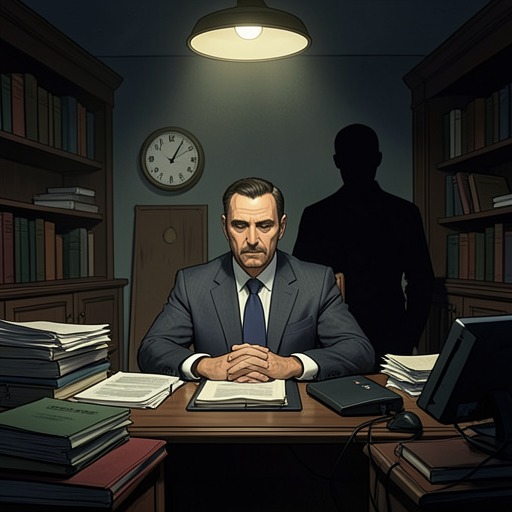
Down Cemetery RoadOfficial cover-up and erasure of events is the method Howard uses to explain—and defend—the suppression of politically dangerous truths. In his account, concealment is not an aberration but a professional task: crimes may be acknowledged within the secret apparatus, yet kept outside public knowledge, while witnesses are offered a choice between silence and the destruction of their lives. His language of repair and reasonableness makes erasure sound administrative; the threats behind it show its coercive force.
The work of making events disappear
The idea first enters the confrontation through Sarah Trafford’s prior experience as a witness. Howard’s side argues that she has already witnessed a death whose aftermath was so thoroughly managed that, by the time the spies had finished, the death had effectively never happened. The claim does not identify that earlier case in this exchange, but it establishes the method’s defining result: an event can be witnessed and still be removed from the public account. The people who know what occurred are left carrying knowledge that the official world refuses to recognize.
Howard later gives that method a name of sorts when he describes his speciality as fixing things so they never happened. The phrase joins two distinct operations. One is practical containment: clearing up after an event, controlling what can be known, and dealing with those who might expose it. The other is retrospective erasure: making the event seem absent from the record and from ordinary life. His offer to Sarah makes clear that this is not merely an abstract capacity. He proposes that she put down her gun, come with him, sign official-secrets papers, and start again as though the events had not occurred.
The deaths that must remain unknown
The most explicit example Howard discusses is the killing of boy soldiers. Sarah objects that they were killed and that nobody ever knew. Howard accepts the absence of public knowledge as the point, not as a regrettable failure. He argues that people do not necessarily want to know everything that happens at the margins of democracy, and casts the concealment of such events as his job: what he means by clearing up.
That defence makes the cover-up’s moral logic visible. Howard distinguishes between the crime itself and the handling of its consequences. He tells Sarah that what happened to her friend was a crime, that those responsible were, as far as he knows, punished, and that they crossed a line. Yet he also insists that such things cannot always be prevented and that someone must clear up afterwards. The distinction allows him to condemn an act while preserving the institution’s authority to conceal it. Punishment, in this formulation, can occur without public knowledge or public reckoning; the secret system claims the power to decide both what justice means and who is permitted to know that it was done.
Containment through offers and threats
Howard applies the same reasoning to more recent violence. He acknowledges that his side wanted to make contact with Michael Downey and bring him back into the fold, but assigns responsibility for what happened on The island to Downey, whom he says they did not expect to go haywire. He also acknowledges the bombing of a house and an attempt on Sarah’s life, attributing both to the same agent. Howard expresses regret, especially for the attempt against Sarah, and says the agent went rogue and paid the price. His account admits the events while narrowing responsibility: the institution’s intentions are separated from the actions of an operative it now disowns.
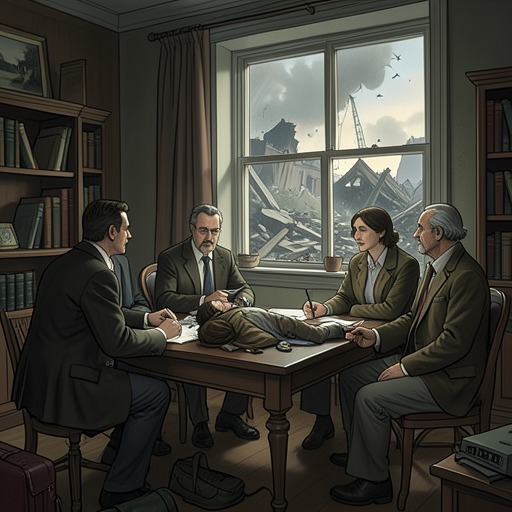
The bargain offered to Sarah translates that account into a personal demand. If she cooperates, Howard says, her life can be restored; the required official-secrets papers will put the matter behind her, and the difficulties involving her husband, Mark Trafford, can also be worked out. The offer presents silence as a route back to normality, even though that normality depends on accepting an officially managed version of events. Sarah asks about the alternative, and Howard initially evades it before describing what would follow if she kept the gun and used it.
The answer exposes the threat beneath the offer. Howard warns that even if he himself is killed, the department will remain and will go into overdrive. Sarah, Michael Downey, the child, Mark Trafford, her old friend Wigwam, and anyone else she has had contact with could all meet major accidents. He presents the predicted violence as an institutional consequence, not a personal threat that ends with him. The promise of erasure therefore includes a second, brutal possibility: if a witness will not be contained by secrecy, the apparatus may remove the witness instead.
Democracy, secrecy, and power
Howard’s appeal to democracy turns concealment into a claim of public service. He argues that people do not want to know what takes place beyond the visible margins of democratic life, and casts himself as the person who manages that unwanted knowledge. But the scale of his threats undermines the reassurance. He warns that a full-scale emergency could make what is happening in the Gulf War look like teatime, framing resistance not as a legitimate demand for truth but as a danger that might justify overwhelming force.
The concept thus rests on a contradiction the confrontation refuses to resolve. Howard says that a crime remains a crime and that lines have been crossed, but he also claims the authority to hide the crime, decide whether its perpetrators have been dealt with, and threaten further harm to protect the secret. His offer to restore Sarah’s life and his warning that everyone she loves may suffer are two faces of the same policy. Official cover-up and erasure do not simply delete events; they determine which events can enter public memory, which witnesses may speak, and what coercion will follow when the official account is rejected.