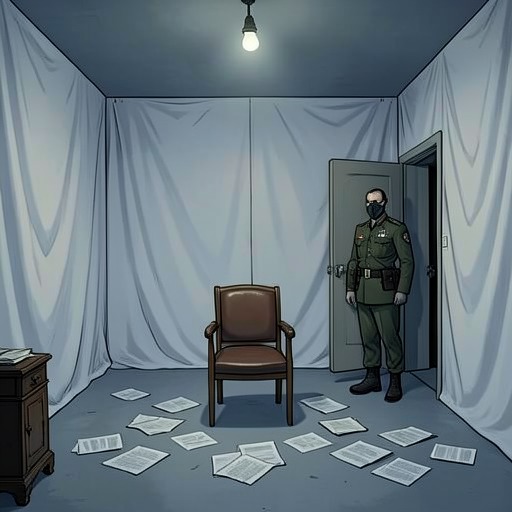
Official erasure of identity
Down Cemetery RoadOfficial erasure of identity in Down Cemetery Road is more than a false death record: it is a system that declares soldiers dead, strips their testimony of public standing, and keeps their living bodies under secret control. The contradiction allows the state to deny responsibility while continuing to govern those it has removed from the world of recognized persons. The soldiers’ disappearance conceals both an experiment in the desert and the violence that preceded their detention; Michael Downey’s survival makes that manufactured silence unstable.
Death as an administrative fiction
The lie is exposed when Sarah Trafford tells Michael Downey that he has been dead for four years, killed in a helicopter crash off Cyprus. Downey has never been to Cyprus. His startled recognition of the date sharpens the discrepancy: the public account is not a mistaken version of an event he remembers, but a story imposed on a man who was elsewhere and remained alive. The false crash gives the state a neat ending for people whose real fate would demand questions.
Downey explains that he and the others were first treated as experimental subjects in the desert. Six men were held, subjected to blood tests and a whole-body scan, and never told what was being done to them. He describes becoming an un-person: to the people conducting the tests, he was a result rather than a human being. The language makes the removal of identity tangible. The men’s bodies remained available to institutional scrutiny, but their understanding, consent, and ordinary status as persons were disregarded.
Afterward they were moved to an island off Scotland’s west coast. The guards presented themselves as ordinary men ensuring the prisoners’ welfare, while repeatedly promising that the men would soon go home. That reassurance lasted through an uncounted succession of tomorrows. Only when a guard told Tommy Singleton that the group had officially died in the helicopter crash did the prisoners understand the purpose of their captivity. The fiction did not merely hide them from the public; it made their continued confinement possible without acknowledging that anyone was being confined.
The violence beneath the cover story
The official death story also conceals the earlier killing of three Iraqi prisoners at Crows’ Hill. In Amos Crane’s account, Michael Downey and Tommy Singleton, serving as guards during the Gulf War, took the prisoners out to the wire with several others and shot them. The prisoners had been captured at a military compound where a torture chamber had been found, but no bodies had been discovered. That context helps explain the perpetrators’ rationalization without settling the moral question: the killings remained killings, and the cover-up prevented public scrutiny of them.
After the shootings, the soldiers were removed from Crows’ Hill and kept in close confinement. They were later recruited together for special services, and, once that work was over, handed to The Department as officially dead. Amos Crane regards the death story as crude but effective: it hid people who had become liabilities and avoided the loose ends their survival would create. Official erasure thus works in stages—first concealment of a crime, then confinement of witnesses, and finally a public identity that forecloses their return.
The soldiers’ situation is a stark contradiction. They belong to the British Army, yet they are treated as though no recognized institution owes them protection or an explanation. Their captors can keep them under guard and subject them to testing while the official record denies that they exist as living men. Erasure excludes them from public life without releasing them from state power; the declared absence of the prisoners becomes a condition of their continued control.
Secrecy defended as public protection
The Department’s defense of secrecy rests on the claim that the public should not know what happens at the margins of democracy. Howard describes concealment as a form of cleanup: the events are presented not as continuing crimes that require exposure, but as untidy consequences that officials must manage. He says the people responsible for what happened to Downey were punished, while also insisting that nobody ever knew about the killings. The assurances coexist uneasily with the men’s prolonged imprisonment and the ongoing concealment of the experiment.
That secrecy becomes an international and political calculation when Downey may speak. C warns Howard that the country is prepared to take up arms to stop Downey from going public, and that the possibility must not be discussed as a matter of policy. Later, the danger is stated more fully: Downey is technically dead, but public proof that the state used living soldiers as targets for a chemical weapon could expose the government to consequences abroad and at home. In this logic, the false death record is not a clerical convenience. It is part of a larger defense of the government’s account of its conduct in wartime.
Howard also explains the threat that sustains the cover-up. If Sarah Trafford uses her gun against him, he says, The Department will remain and will cause major accidents to Downey, the child, her husband, Wigwam, and others who have been in contact with her. The euphemism turns prospective violence into a bland administrative outcome. The same system that denies the soldiers’ real identities can threaten to erase the lives around anyone who might restore their story to public view.
Narrative significance
The concept links the novel’s military history to its immediate danger: the men’s official deaths are not a closed chapter but the mechanism by which the present remains governed by the past. Downey’s account breaks through the official story with details of tests, confinement, and the island’s false promises; Amos Crane’s account supplies the earlier shootings and the subsequent institutional handling of the soldiers. Read together, these disclosures show how secrecy depends on controlling both what happened and who is permitted to say that it happened.
The novel’s sharpest indictment lies in the gap between a person’s continued physical existence and the state’s public declaration that he is dead. The men are neither free nor acknowledged; they are kept within reach of institutional power while excluded from the protections and visibility that recognition would bring. When Howard insists that ordinary people do not want to know what happens beyond democracy’s margins, the euphemism exposes its own cost: those margins are populated by real people, and official forgetting does not end the violence done to them.