Rufus
Down Cemetery RoadRufus is Wigwam’s husband, an orphan whom she describes as wanting the ready-made family their marriage offered. At a dinner party, he makes little effort to command attention: his unkempt appearance and silence leave others to define him, while his false claim to teach adult literacy briefly conceals the fact that his present work is something he does not want anyone to know.
Identity and Public Presentation
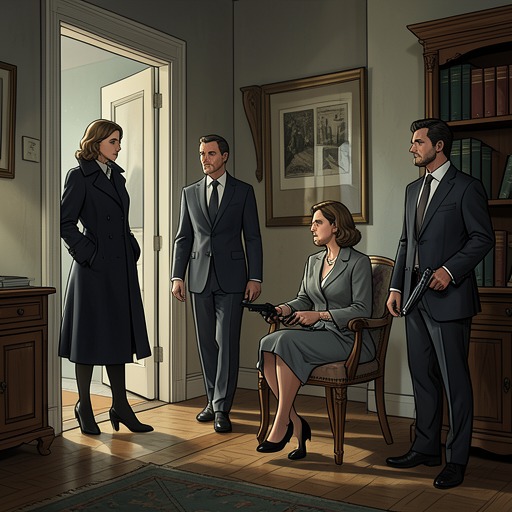
When Rufus arrives at the party, Sarah Trafford has been extending her time in the kitchen by making salad dressing. His arrival brings little lift to the gathering, though he has washed his hair. Its grubby-blond strands lie in untidy clumps over his collar, and several days’ stubble gives him, in the narrator’s wry description, the appearance of someone making a show of proletarian toughness in a middle-class setting. The conspicuous scraps of tissue on his sweatshirt tell a less deliberate story: he has been sneezing into toilet paper, a visible sign of the hay fever he endures.
The contrast between the cultivated impression of the stubble and the accidental tissue scraps gives Rufus’s entrance its comic precision. His appearance is described in detail, but he does not use it to take over the room. Instead, the narration presents him as someone who is present without adding much to the party’s atmosphere. The other guests’ talk continues around him, and his unobtrusiveness becomes a defining part of how Sarah reads him.
Marriage and Family Background
Wigwam supplies the essential account of Rufus’s past: he was an orphan, and, as she sees it, a ready-made family was just what he wanted. Rufus does not deny this explanation. The exchange links his childhood loss with his adult place in Wigwam’s household, but the information comes through her account rather than a fuller statement from him. His silence permits her version to stand without showing how he might describe the same history himself.
Sarah finds him irritating in the party conversation, where he seems to let talk wash over him, like a small rock in a stream. She wonders how he came to charm Wigwam and considers that he may simply have been available. The thought is explicitly presented as Sarah’s unkind speculation, not as an established explanation of their relationship. What is established is the contrast between Wigwam’s warm account of the family he joined and Sarah’s impression of a man who rarely pushes himself into conversation.
Work and Concealment
When Gerard Inchon presses Rufus about what he does, Rufus says that he teaches adult literacy. The answer sounds like a straightforward description of his occupation, but Wigwam later reveals that it was meant to shut Gerard up. Rufus did try adult-literacy teaching once; he disliked it and stopped. Thus the claim draws on something he actually attempted, while disguising the more important fact that he no longer does it.
Asked what Rufus is doing now, Wigwam does not provide an occupation. She says that he does not want anybody to know. The scene therefore distinguishes between a public answer that is plausible enough to end an intrusive exchange and a private circumstance that remains withheld. The evidence does not disclose his current work or explain why he keeps it secret; its emphasis is on the boundary he maintains around that part of his life.
Narrative Role
Rufus is characterized through a marked imbalance between external observation and self-disclosure. The narration gives his hair, stubble, and tissue-strewn sweatshirt a vivid physical specificity, while his own account of his life remains sparse. Other people fill that space: Wigwam explains his orphanhood and his supposed desire for a ready-made family; Sarah interprets his quietness and privately guesses at the source of his appeal; Gerard’s questioning prompts Rufus’s misleading answer about teaching.
The result is not a resolved portrait but a carefully limited one. The party reveals that Rufus has a history he does not dispute, a failed attempt at adult-literacy work, and a present occupation kept from public view. It also shows how readily he can recede from social attention, even while Sarah’s close scrutiny makes him a subject of interest. The account leaves the nature of his hidden work open, preserving the difference between what the gathering thinks it has learned and what Wigwam says Rufus actually prefers to conceal.