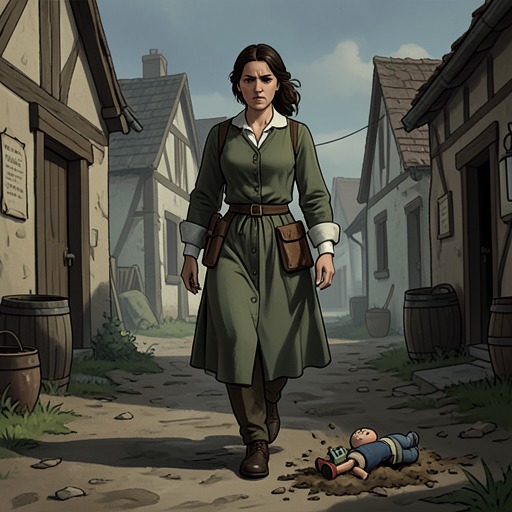
Sarah Trafford
Down Cemetery RoadSarah Trafford is a wife, former worker at The Bank With No Name, and increasingly determined seeker of Dinah Singleton. Her search begins in a life where other people appear to have decided what she should want; it becomes the means by which she claims an agenda of her own. The story tests that resolve through police suspicion, betrayal, physical violence, and separation from Dinah, then brings Sarah back to the child whose survival has come to represent her own.
Identity and Background
Sarah is introduced within the strained domestic life she shares with Mark Trafford. At a dinner for his clients, she watches him apply the crisis-management habits he has made into a professional creed, while the guests’ boorishness goes unclassified as an unavoidable fact of life. Sarah is close to openly rejecting the performance expected of her. The scene makes her frustration concrete: she is not simply bored by marriage, but alert to the way Mark’s priorities and social ambitions have come to organize their home.
Her dissatisfaction is sharpened by an unequal division of purpose. Mark works for a discreet City merchant bank and has adopted the language of being targeted; Sarah sees his career fixation as another version of his long-standing habit of cataloguing his record collection. She has talents and ambitions of her own, but they are dormant, and she feels Mark treats her employment as a hobby. Her salary at The Bank With No Name is less than her age in thousands, a measure of how little standing she feels she has in the marketplace. Gerard Inchon calls her condition Bored Housewife Syndrome, a label Sarah recognizes as patronizing even while it names something real.
The book gives her dissatisfaction an interior counterpart in the Other Sarah Tucker, the imagined ideal against whom she has measured herself since childhood. That version of Sarah ate what was served, studied hard, passed exams, made friends easily, and seemed effortlessly gifted at cooking, singing, dancing, and rollerskating. When Sarah once confided in someone about this imagined companion, the story circulated at school as evidence that she was strange; the Other Sarah became less a comforting friend than an enemy who seemed to excel at everything. As an adult, Sarah still uses the figure to express the distance between who she is and who she thinks she ought to be.
The Search for Dinah and a Chosen Agenda
Sarah’s concern for Dinah Singleton turns an investigation into a personal commitment. The connection is not simply that she has seen a blonde child in yellow jelly shoes. Sarah recognizes in Dinah another survivor of an explosion and imagines that surviving such an event can make ordinary danger seem inadequate by comparison. The resemblance between their experiences gives Sarah a reason to keep following Dinah’s story: she needs to know the girl’s condition and whether she will remain safe.
That commitment also brings Sarah into conflict with the expectations of her marriage. She does not tell Mark that she is searching, gives her maiden name at reception, and understands that he might use any uncertainty about having children as leverage. When people around her tell her to stop looking, she decides that continuing is the only way to prove she can set her own agenda. She resolves to pay Joe Silvermann’s bill herself, even if that means taking bar work, and leaves open the possibility of having a child later, on her own timetable.
The conflict with Mark has a broader meaning for Sarah because she sees marriage as a form of shaping and restriction. She compares it to a psychological bonsai: a tree that might grow tall, deliberately kept small and ornamental by the punishment of its roots. In her account, this pruning is often instinctive rather than consciously planned. Gerard Inchon’s belief that women should be kept barefoot and pregnant represents its bluntest expression; Mark’s pressure for a baby now, while treating Sarah’s career as negligible because it is not yet established, is a quieter version. Sarah’s resistance is not a rejection of children altogether. It is a refusal to let someone else decide the timing and meaning of her life.
Investigation, Suspicion, and Flight
The search draws Sarah into the aftermath of Joe Silvermann’s death. Inspector Ruskin questions her at Joe’s office, where a police pathologist has been working, and later at Sarah’s home. The questioning brings into focus how little she has told Mark: she had hired Joe to find Dinah, though she had not mentioned either the detective or the girl to her husband. When Joe’s death and his criminal connections become part of the picture, Mark confronts Sarah with the apparent contradictions, including the cocaine beneath the bathroom sink and money connected with Joe’s bank account. The domestic role in which Mark had placed her gives way to his view of her as a public enemy.
Zoë Boehm’s arrival makes the personal cost of the investigation still more direct. She tells Sarah that she believes Sarah got her husband killed. Sarah does not initially recognize Zoë, and the accusation forces Joe’s death into the same intimate world Sarah had tried to keep separate from her marriage. Later, Sarah receives Joe’s letter. Its tone acknowledges that he had been wrong to resist her search and reaffirms his willingness to help. More practically, it includes a copy of a letter he sent to the Ministry of Defence: official reports say Thomas Singleton died four years earlier, so Joe asks why there has been a more recent report of his death. Sarah’s search for Dinah thus opens onto a discrepancy that may be more than a private mystery.
Sarah’s position becomes physically dangerous when Axel Crane, maintaining his cover as Rufus, attacks her with dental floss. The cord leaves a narrow mark around her throat, which Sarah studies as a lasting reminder of how close the assault came. Michael Downey has her keep away from the windows at their hotel and orders food left outside their room. Sarah knows he saved her life partly because she might possess information about Dinah; she cannot dismiss the possibility that, under different circumstances, he might be willing to kill her for the same purpose. Her anger at being kept in the dark surfaces when she insists that she is involved because she is there. The alliance offers protection, but not uncomplicated trust.
Becoming a Fugitive and Continuing the Search
Sarah leaves home with nothing, but flight quickly accumulates its own possessions and history. In a red compact Volkswagen, Michael puts his new rucksack beside the canvas bag Sarah has inherited from him. Sarah dyes her mouse-brown hair raven black with a packet bought at Boots. When she checks her reflection, she sees that she no longer resembles the Other Sarah Tucker; the change gives visible form to her effort to become her own person. Michael tells her the new look is fine, but its importance lies in what Sarah sees in it: not an improved imitation of an ideal, but a departure from that ideal.
The search continues to govern her attention when Michael leaves her behind near the coast. Sarah sits on a bench facing the sea, wearing his denim jacket, with banknotes in its pocket sufficient to pay the bill. The island where Dinah is held remains invisible in the grey distance, and Sarah admits to herself that she has no certainty about who holds the child. Yet she has come too far to accept that uncertainty as a reason to give up. Fixing on Dinah is how she makes the surrounding disorder bearable; getting close and then going no further feels impossible to endure.
Sarah’s return to action comes amid another death. She kneels beside a dying woman and, for the first time in what seems like hours, feels in control of her own thoughts and movements. That control does not make her powerful enough to stop the woman’s suffering. The scene recalls the helplessness threaded through her search: Sarah can choose to remain present and respond, but she cannot guarantee that care will save anyone. When someone identifies her as Sarah Trafford, née Tucker, late of Oxford, her former identity is spoken aloud in the midst of the danger she has entered.
Survival, Judgment, and Return
Near the end, Sarah confronts Michael after he has killed people. She tells him he did not have to kill them. He turns his head aside, puts down his gun, and folds his arm around Dinah. Sarah’s rebuke matters because her bond with the child has not erased her capacity to judge the means by which Dinah is protected. Her loyalty is not simple allegiance to Michael: the reunion gives her what she came for, but it also forces her to face the violence surrounding it.
Sarah also names the larger wrongdoing behind the pursuit. She accuses her opponents of covering up toxic war games and chemical weapons experiments in the African desert; one of them denies involvement. The exchange makes clear that her personal search has carried her into a political crime, even as Sarah speaks from the immediate, practical knowledge of what the cover-up has cost. She is no longer merely a housewife asking after a missing child, or a client following a private detective’s lead.
An explosion and its aftermath bring Sarah back to the language of survival. After the flash and noise, she takes a deep breath and knows she is alive. A man lies nearby with his right arm catastrophically injured, clutching it with his left; the shotgun at his feet is twisted metal. Sarah asks God to forgive him, scatters the remaining shells from Michael’s jacket, and runs through the trees, afraid for Zoë, Michael, and above all Dinah. The movement from the wreckage back toward the chapel turns survival into an obligation to return.
At the chapel, Sarah reaches the blue 2CV and sees Dinah looking up at her through its window. The recognition completes the purpose that has sustained her through the investigation, estrangement, and flight. Sarah understands their shared survival not as protection from further danger, but as the reason she must keep going. Her arc ends not with danger abolished, but with her alive and back beside the child she refused to abandon.