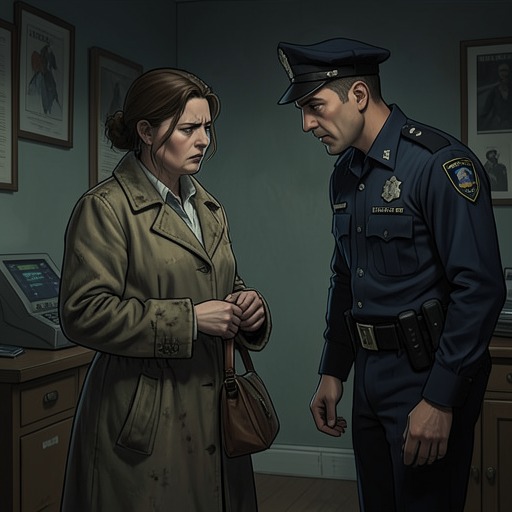
Sarah investigated by police over drugs and pressured to frame Joe
Down Cemetery RoadSarah Trafford’s investigation over drugs becomes an attempt to turn her into a useful witness against Joe Silvermann. After police search her home and question her about a dead man, a concealed bag of cocaine, and the death of a thirteen-year-old girl, her lawyer advises her to accept a false account that would help police claim a result. Sarah first goes along with it, then risks renewed official pressure by withdrawing her statement and insisting that it was made under duress.
Causes and Background
The police investigation follows Sarah’s traumatic fall from a roof. When officers arrive, the people from a party have reached the top too late to save her; the experience leaves her with a recurring image of city lights cartwheeling. During the police search, that image returns when an officer displays a bag of white powder. The narrative links the investigation’s sudden threat to the earlier fall without suggesting that the police know what she experienced.
Inspector Ruskin justifies the search by pointing to Sarah’s record of involvement with drugs and her connection to a dead man who, he says, has turned out to be a dealer. Sarah is too numb to reach for the phone and call Mark Trafford, her lawyer. A female officer stays beside her and repeatedly asks whether she is all right, while other officers search the kitchen and upstairs rooms. To Sarah, the intrusion is not simply a search for evidence: the police have already ransacked her history as well as her home, treating her past as relevant to Joe’s death.
Search and Interrogation
The search produces a bag of powder carried by a uniformed officer in a gloved hand. Sarah recognizes that it is not an innocent substance, but the discovery does not establish that she put it there or even knows what it is. The officers later tell her that the bag had been hidden behind a loose bathroom tile, inside a small purse she remembers using for coins destined for weekly charity envelopes. She had never noticed the loose tile; the purse’s unexplained contents leave her unable to account for the powder. The officers, too, do not know what it is.
At the station, questioning circles relentlessly around drugs and Joe. Officers use the language of making a clean breast of things, and Sarah becomes persuaded that anything she is hiding will eventually emerge. She tells them about Dinah Singleton and a man in a car park, then mentions the bomb at the house up the road. The officers treat these disclosures as beside the point and turn back to drugs. They ask whether she knows Lizbeth Moss; Sarah says she does not. They also ask whether Ecstasy means anything to her.
The inquiry then supplies its own possible connection: Lizbeth was thirteen and died after taking Ecstasy, and police believe the substance she took may match the powder found in Joe’s office. Sarah responds not with an account implicating Joe but with a detail she remembers from entering his office: he had been wearing a bright red tie. She had not been deceived by the fact that his hand still held his own razor. When the officers ask why she mentions the tie, she stares at the ceiling rather than answer. They move on to the money she gave a man she had said she had never met, treating the payment as another reason to ask whether she was buying drugs.
Pressure to Frame Joe
Simon Smith advises Sarah to say that the cocaine was hers, identify Joe as its source, and describe it as for personal use. In his proposed version, she would be Joe’s victim, as Lizbeth was, but luckier; therapy and a story of depression would make the account easier to present. His advice rests on his reading of the police’s immediate aim: they want a person they can display to the press as responsible for Lizbeth’s death, allowing the case to appear resolved.
Simon argues that Joe is dead and that the police can make his apparent suicide look like a signed confession. He warns Sarah that directly contesting the search and the possession allegation could antagonize the officers, even if a later legal challenge might succeed. His strategy is therefore a bargain: give the police a version that lets them feel victorious, and Sarah may avoid becoming their continuing target. The proposal would protect her, in his view, by making her appear to have been exploited by Joe. But it would do so by making her name him as a drug source when, as she says, he did not do it.
Sarah’s response is not simply fear of being charged. She tells Simon she cannot do that to Joe. He answers that Joe is dead and cannot be helped, while the false account could help her. The disagreement exposes the moral cost beneath the apparently practical advice: police pressure has made a lie seem like the safest route, while Sarah’s loyalty to the dead man prevents her from accepting that safety without resistance.
Retraction and Consequences
After Simon’s advice, Sarah calls Wigwam or someone else for company, though she resents the assumption that Wigwam is always available to her. She then telephones the police. When she tells Inspector Ruskin that what she said was not true, he begins an angry response, breaks off, and checks whether she is still on the line. The interruption does not settle the matter; it marks the start of a renewed confrontation.
Sarah tells Ruskin that her statement was made under duress and that she will come to the station the next day to make a fresh one. If he does not accept that, she threatens to call a press conference. She is left trembling and unable to move, wondering what she has just done and what consequences will follow. Her retraction does not undo the search or the false statement, but it refuses to let the police account stand unchallenged. The episode turns the language of confession against the pressure that produced it: Sarah identifies the statement not as a clean breast, but as something made under duress.