Sarah wounds Howard in the woods
Down Cemetery RoadSarah’s confrontation with Howard reverses the power he appears to hold over her: he threatens her into considering surrender, then admits he lied and raises a gun, but she survives his shot and leaves him gravely wounded. The encounter sends her back through the woods toward the chapel, where Dinah is waiting.
The confrontation and its reversal
Howard warns Sarah that people she loves will be hurt unless she puts down her gun. To his relief, she seems ready to comply. But when she drops it, he retrieves it, steps back, and points it at her. He says he had offered her the chance to sign papers, then admits that offer was a lie; apologizing, he fires. Sarah experiences the shot as a sudden rush of light and sound, but takes a deep breath and realizes she is alive. Howard lies nearby with his right arm catastrophically injured, while the shotgun is twisted at his feet. Sarah uses her belt as a tourniquet, presses him to lie still, and tells him she will bring help. Before leaving, she scatters the remaining shotgun shells from Michael Downey’s jacket, then runs back through the trees, frightened for Zoë Boehm, Michael, and especially Dinah. She reaches the old stone chapel and finds Dinah looking up at her through the window of the blue 2CV.
Survival and the return to Dinah
The encounter leaves Sarah with no certainty about Howard’s fate, but it sharpens the meaning she gives to her own survival. As she runs back through the trees, the thought that she and Dinah are survivors returns with the refrain, “We survive.” At the chapel, Dinah is waiting in the blue 2CV, looking up through its window. She is not crying; Sarah privately wonders whether the child has become tougher than she is. A jagged memory of a cat seen through glass briefly intrudes, then passes. The ending thus turns from the violence in the woods to a fragile reunion, with Sarah’s immediate purpose restored: she has come to find Dinah, and has not lost her.
The concealed history behind the confrontation
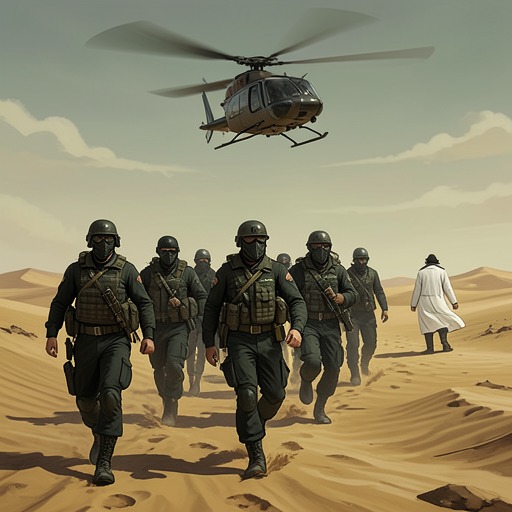
Howard’s violence in the woods belongs to a larger history of violence the state had hidden. In recounting the desert to Sarah, he described soldiers being driven miles into the sands and told they were facing real enemies, although the mission was a test: they were to bring the supposed opponents home alive. The targets were boy soldiers. Howard said the soldiers themselves were exposed to a nonconventional weapon, and recalled the pain of its effects before seeing that the children were not screaming but melting. That memory gives the confrontation a grim moral context: the man who now threatens Sarah is also a witness to an experiment that treated both soldiers and children as expendable.
The survivors’ later confinement extended the deception. On an island off Scotland’s west coast, guards presented themselves as men looking after the soldiers and repeatedly promised that they would soon go home. The truth emerged when one guard told Tommy Singleton that the men were already supposed to be dead in the helicopter crash near Cyprus. Their official deaths had made release as dangerous to their captors as continued imprisonment; Howard speculated that those holding them would neither let them go nor kill them without political protection. His account makes the encounter with Sarah more than a private threat: it brings her into direct conflict with the machinery of concealment that had erased the soldiers and buried the desert experiment.
The weapon, instruction, and survival
The confrontation also gives practical force to an earlier lesson from Michael Downey. He had shown Sarah Trafford how to load and fire a shotgun, then explained that a handgun might be taken from someone who pointed it at a soldier, whereas a shotgun would make the soldier keep his distance. His warning framed the weapon as a means of buying space against a trained opponent, not as proof that Sarah had become a soldier herself. In the woods, her survival depends on the violent encounter ending with Howard gravely injured rather than her dead; the shotgun lies twisted beside him, and she turns immediately from defense to trying to limit his bleeding.
Sarah’s response does not settle the moral account between them. She binds Howard’s arm with her belt and tells him to lie still, even while recognizing that the wound may be beyond her ability to treat. Her promise to fetch help stands beside her accusation that the responsibility for what has happened is his. The scene thus refuses an easy division between mercy and retaliation: she gives the man who tried to kill her what aid she can, but does not stay to risk the people she has returned to protect.
That urgency governs the final movement of the encounter. Sarah runs back through the trees afraid for Zoë Boehm and Michael Downey, and most of all for Dinah Singleton. Reaching the blue 2CV at the chapel, she sees Dinah looking up through the window and finds the child alive and not crying. The brief intrusion of a memory of a cat seen through glass breaks off as Sarah opens the door. After the coercion and gunfire, the decisive outcome is not Howard’s condition but Sarah’s return to the child she feared she might lose.