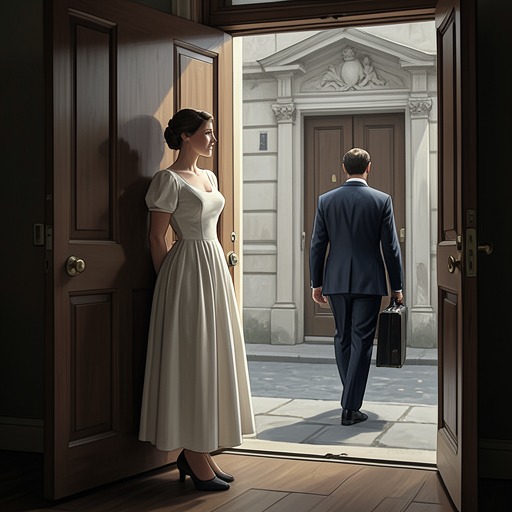
Sarah’s fugitive status
Down Cemetery RoadSarah Trafford’s fugitive status takes shape as an improvised flight from a home and marriage that have become dangerous, not as a planned escape with money, shelter, or a clear route ahead. After Michael Downey kills the man who attacked her, Sarah leaves with little more than her wallet and twenty-odd pounds. Her journey carries her through the railway station and on to Malvern, where Downey disappears; there, alone and frightened, she begins to turn flight into a decision to continue searching for Dinah Singleton.
Flight from the house
The immediate cause of Sarah’s flight is the violence in her home. Her best friend’s husband has tried to kill her, and Michael Downey, a stranger she has seen kill without hesitation, has intervened. Downey disposes of the murder weapon on the way to the railway station, dropping the gun, silencer, and ammunition into three separate drains with such smoothness that the act could pass for a mime. Sarah, by contrast, experiences events as something happening to her: she has taken only her wallet, containing just over twenty pounds, and has little sense of control over what comes next.
The journey out of the house passes from a dark route beside the river, over the old railway bridge and a meadow, into the brighter city streets. The ordinary signs of night life—skaters visible through the ice rink windows, passing teenagers, and neon reflected in oily puddles—make the escape feel less like a passage to safety than a sudden collision with a world continuing around her. At the station, fluorescent light initially seems to promise protection. Inside, however, the shuttered windows and cold, tiled space offer no real refuge. Downey checks the departure boards and tells Sarah to wait on the platform while he buys tickets.
A flight without a plan
Sarah’s compliance is tied to her condition as well as to the danger around her. She later wonders whether drugs, the numbing effects of the attack, and shock at seeing her attacker’s body thrown across the room left her unable to make decisions. The first plan presented itself, and she accepted it; the first exit opened, and she took it. Her escape is therefore not a prepared strategy: it lacks forethought, supplies, and a definite objective. Downey, at least, takes practical steps to conceal their movements, buying two one-way tickets to Birmingham and changing his appearance by removing the band from his ponytail.
Sarah’s thoughts on the train place this sudden flight against her marriage to Mark Trafford. She recalls how he had tried to keep her tame and domesticated through medication and sexual coercion. The means used to constrain her have, ironically, helped propel her out of that life: she imagines escaping her tower by climbing down the very chains that had bound her. Yet escape does not immediately restore autonomy. She remains aware that she is following a man whose violence frightens her, and that her own choices still feel compromised by drugs and shock.
The route is deliberately hard to read as a secure partnership. Downey says they will leave the train at Malvern and explains that they should not be seen together when tickets are collected. Sarah gets off there, waits until the train has departed, and sees neither sign nor hears anything from him. With little money, light clothing, and no familiarity with the town, she is stranded in the dark. The departing train makes the loss of an escape route visible; the neat, shadowed platform offers no substitute. Her fear is physical as well as practical, sharpened by the memory of a noose tightening around her throat.
From flight to pursuit
Sarah’s separation from Downey does not send her back toward home. She recognizes that he owes her nothing: he is a stranger who saved her life, and his leaving her in Malvern is a small betrayal beside what has already happened. She tries to picture where he might have gone, but cannot know whether he has changed trains or headed toward a city. The uncertainty leaves her alone with the consequences of the escape, rather than with an explanation or reassurance.
As the shock recedes, Sarah examines why she followed him. Her reason, she understands, is not simply dependence on a capable armed man. Downey faked his death four years earlier, a fact she sees as lying at the heart of the recent events. Joe Silvermann will not return, her own life will not return to its former shape, and Dinah Singleton remains entangled in the situation. Sarah admits that the child had initially served as little more than an excuse for action: she might have followed a treasure map with equal concern. What drove her was the urge to do something—anything—to break a terrible boredom. The boredom has now been broken, but at the cost of the safe routine she once took for granted.
Choosing the next direction
The fugitive condition thus becomes a turning point rather than merely a state of hiding. Sarah expects the police, and perhaps whoever sent the man she knew as Rufus, to come looking for her. She sees two broad possibilities: give up, or begin again and continue. Her choice is to find Dinah, not as revenge or reconciliation, but as the unfinished task she has already begun. Since pursuing that purpose requires understanding what Downey knows, she asks what they are looking for. He answers that they need a hotel.
The contrast between Sarah’s early passivity and this final decision defines the movement of her escape. At first, her feet carry her onto the platform before the distant voice in her head can object; later, she names a purpose for continuing. The journey has not made her safe, nor has it resolved the danger or her dependence on Downey’s knowledge. It has, however, changed flight from an action imposed by immediate events into a course Sarah elects to pursue, with Dinah’s disappearance and Downey’s concealed past now guiding what she does next.