The Other Sarah Tucker
Down Cemetery RoadThe Other Sarah Tucker is the idealized counterpart Sarah Trafford creates to measure herself against: a capable, admired girl who seems to possess every quality Sarah lacks. First a childhood fantasy and then a recurring presence in Sarah’s inner life, she gives form to self-division, shame, and the pressure to become an imagined version of oneself. Her significance changes over time: what begins as Sarah’s private enemy eventually becomes a name through which she challenges Mark’s understanding of who she was.
Identity and Childhood
The Other Sarah Tucker is not introduced as a separate person with an independent life, but as Sarah’s imagined double. Sarah remembers her as having once seemed always present, racing ahead while the real Sarah struggled to keep pace. The double is less a simple wish to be different than a rival occupying the same mental space: Sarah grows to hate her, yet cannot stop comparing herself with her.
The imagined girl’s competence is broad and almost impossibly smooth. She eats what is put before her, never answers back, works hard at school, and passes her exams. She makes friends easily, cooks beautifully, and can sing, dance, and rollerskate. The catalogue makes her resemble a complete, self-sufficient heroine, while Sarah describes the experience as sharing headroom with Supergirl. The comparison turns ordinary differences in temperament or skill into a contest that Sarah cannot win, because the rival is assembled from every quality Sarah thinks she ought to have.
The fantasy also becomes a liability when Sarah tells somebody about it. Her moment of confidence spreads around school and is transformed into ridicule: instead of being understood as an imaginary friend, the Other Sarah is recast by her classmates as an imaginary enemy and evidence that Sarah is strange. The imagined companion thus marks both Sarah’s private effort to explain herself and the social cost of disclosing that inner life. Sarah’s actual progress is modest by comparison: she scrapes through school and reaches the sixth form with a handful of O-levels, while her double remains the effortless standard against which that achievement is judged.
The Ideal and Its Costs
As Sarah elaborates the Other Sarah, the figure comes to represent more than academic success. She has a boy for every day of the week, never gets spots, and has hair that does not hang limp. Her friendships and periods are imagined as painless; even the way she wears school uniform makes her an embodiment of style. These details make the double a composite ideal of popularity, beauty, ease, and femininity, not merely a cleverer or more diligent version of Sarah.
The difference between them is also moralized. The imagined girl eats obediently and does not answer back, while Sarah’s own identity is defined partly through the distance between her and that compliant ideal. At the same time, the double is credited with domestic and social gifts: she cooks like a saint and makes friends without effort. The fantasy therefore compresses several standards into one figure, so that Sarah’s sense of failure can attach to school, appearance, relationships, and domestic competence at once.
Years later, Sarah’s private appraisal of herself still invokes this rival. Watching a cat outside the kitchen door, she imagines it judging whether she could survive beyond the glass and concludes that the Other Sarah Tucker would have done better. Sarah measures herself as too old, slow, and heavy, then sets against that judgment the obligations and emotional expenditure of keeping house and enduring a dinner party for her mate’s awful client. The scene makes the double’s apparent fitness for survival ironic: her imagined superiority is inseparable from the burdens Sarah associates with ordinary domestic life. The cat is only a cat, but its imagined scrutiny gives Sarah a momentary stage on which to rehearse her own harsh verdict.
The Rooftop Vision
At moments of crisis, the Other Sarah is connected to a recurring image of Sarah herself falling from the roof of a high terraced house. In the vision, Sarah turns over above the city lights but never reaches the ground. She identifies the scene as a private ghost that no exorcism can lay, and distinguishes it from what she says has happened to the Other Sarah. The image is therefore not simply a memory recounted in ordinary terms: it returns as a persistent, unrealized descent, attached to Sarah’s efforts to separate her own experience from that of her imagined counterpart.
The rooftop sequence expands this division into a dreamlike contest over choice. At the top of the fire escape, Sarah finds a playpen that contains the whole world; Jesus and the holy devil call from different corners. For a moment she believes the world’s fate rests on her decision, but the Other Sarah appears beside her, smiling with apparent benevolence. The Other Sarah runs toward one corner as the Real Sarah, the Only Sarah, rushes toward the crooning deity. The vision makes their opposition active: rather than simply comparing herself with a better girl, Sarah sees the two selves making different choices within the same impossible scene.
The imagined freedom of flight ends in pain and survival. Sarah lets go with a sense of release, the city lights cartwheel and disappear, and she learns the secret of staying alive. The sequence does not erase the fall from the story of her inner life; afterward, her nightmares still leave her suspended, never hitting the ground. The contrast is central to the figure’s role: the Other Sarah belongs to the unrealized alternative, while Sarah’s own story includes the bodily consequence of falling and the continued work of surviving it.
Reversal and Meaning
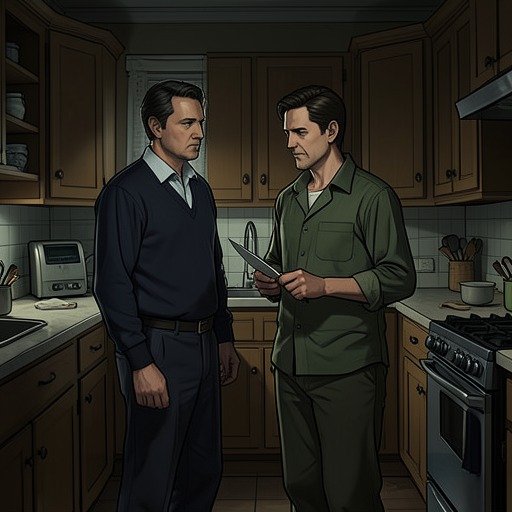
The name returns in a later conversation with Mark. He says he does not want Sarah to turn back into the girl she was when they first met, and explains that he thought the drugs business meant she was becoming that earlier girl, whom he calls the Other Sarah Tucker. Sarah remembers the period, but her internal response reverses his naming: that was not the Other Sarah; this is the other one, and that girl was her.
The exchange does not provide a simple final definition of the two selves. Instead, it exposes how the label depends on who is speaking and which version of Sarah is being treated as authentic. Mark’s account preserves a contrast between the woman he knows and a former girl he fears she might become again. Sarah rejects the placement of her past self outside her identity. In doing so, she unsettles the childhood arrangement in which the idealized double was the real rival and Sarah herself the deficient remainder.
Across these scenes, the Other Sarah Tucker shifts from a fantasy of effortless success into a recurring image through which Sarah experiences comparison, crisis, and disagreement over her own past. The figure gives visible shape to the distance Sarah feels between who she is and who she believes she should have been. By reclaiming the earlier girl as herself, Sarah does not make the double disappear; she changes the terms of the rivalry, refusing to let another person decide which Sarah counts as real.