The agency’s cover-up policy
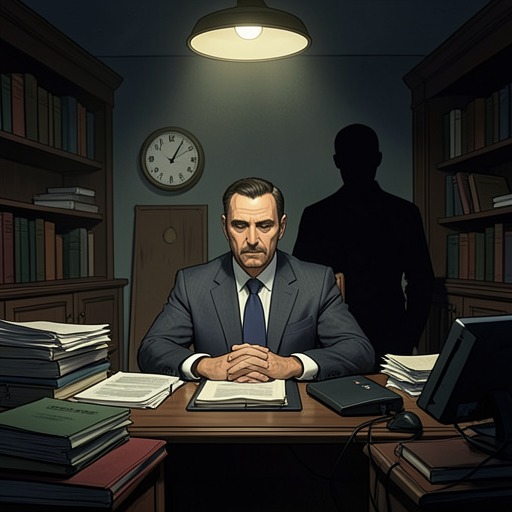
Down Cemetery RoadThe Department’s cover-up policy is the machinery by which secret violence is made to disappear—and by which those who witness it are pressured to disappear with it. It works through a revealing contradiction: field agents receive broad authority to act, while superiors later deny or narrow responsibility; police, press, and inquests supply an official version; and anyone who might carry the truth beyond the institution is offered a way back to ordinary life or threatened with elimination.
Authority and field decisions
The policy begins not with perfect central control but with delegated power and its consequences. C rebukes Howard for allowing a war to begin without permission, despite Howard’s defense that The Department had been given carte blanche. The explosion was in a densely populated suburban area, and the language of authorization cannot make that scale of danger acceptable. Howard says Amos Crane is holding the reins, but identifies the bombing itself as Axel Crane’s field decision. Responsibility is already being divided between the officer overseeing the operation and the agent who chose the method.
Howard later admits that he learned of the explosion only after it was over. Amos Crane, fiercely protective of his younger brother, also acknowledges that he would not have chosen Axel’s method in a field situation: it allowed too little control and would require too much work to cover up. Yet Amos interprets the girl’s survival as an opportunity. She remains on the board, in his formulation, and can be used carefully in a plan. Howard is less persuaded. An infant’s disappearance is harder to explain away than an adult’s, because people are less likely to imagine that a child simply changed course and left. The possibility that someone might come looking makes the surviving child both a risk to the cover story and a potential lure.
This is the policy’s first weakness: field autonomy can produce an outcome that the institution did not plan and cannot fully manage. Howard describes the after-the-fact repair as difficult, and thinks of Axel as a cowboy whose improvisations leave others to prevent further curiosity. Concealment is therefore not a clean procedure imposed after a controlled operation. It becomes a second operation, improvised to contain the first.
Making violence look as if it never happened
The immediate repair is an official account supported by the police and local press, with an inquest expected to close the matter. Howard regards the arrangement as solid, while recognizing that national security is the justification under which people are expected to accept what would otherwise provoke questions. The desired outcome is not merely that evidence be hidden: the public is to have a story that makes the missing child and the explosion seem explicable enough to stop investigating.
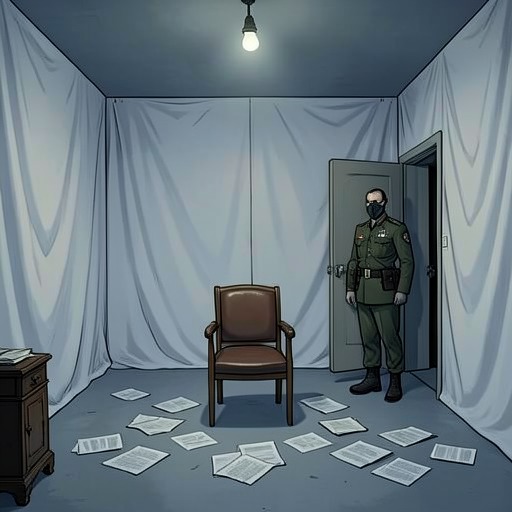
The policy also extends to deaths. A staged corpse is made to look convincingly dead, down to a kitchen scene designed to discourage close examination. When a witness notices movement, the body’s twitch is explained away as rigor mortis or something similar. The performance succeeds because the observer is encouraged to accept the appearance rather than inspect it. A false death becomes a practical instrument: if the dead seem sufficiently dead, scrutiny may end before the underlying events become legible.
Sarah Trafford names the larger pattern when she points out that she has already witnessed a death that, after the spies were finished with it, supposedly never happened. Howard’s side fears the reverse consequence as well: if the people caught up in the present events tell their story, their testimony will be damaged by their having witnessed deaths officially recorded as non-events. The fabricated account does more than deny the past; it is arranged to make future witnesses sound unreliable. In this system, concealment reaches forward, shaping how a truthful account will be received.
Discipline, disposal, and the island
The Department’s response to Axel’s violence is not a simple repudiation of secret force. A superior tells Howard that the brothers’ actions have put another civilian on the dead list and orders him to take Amos off the job and bring him home. Amos’s pursuit of Michael Downey threatens to produce another conspicuous death, one too messy to pass off as accidental. The superior demands professional control, but also insists that Amos’s body must never turn up. The stated concern is that the operation has gone too far; the proposed remedy still includes a death that must itself be concealed.
The instructions become even more stark when the pursuit approaches the island. If Amos reaches Michael Downey before the island, he will leave a mess across the landscape; on the island, the superior says, the aftermath can be hosed down and forgotten. Howard is ordered to stop Amos from reaching them first, but if Amos gets to the island, he may do his job—provided he does not leave. The distinction is not between violence and restraint. It is between violence that risks public visibility and violence that can be contained in a remote place. Amos is compared to a pit bull that has tasted blood: the institution’s concern is that an agent who has become uncontrollable cannot safely be allowed back into the world.
Howard is also instructed to use the people in his custody as bait, expecting that they will lead Amos to Downey. He hopes to bring the relevant parties together and gain the advantage over whoever remains, while recognizing the danger that Amos may be among them. The people being managed are thus simultaneously witnesses, leverage, and potential casualties. A cover-up designed to suppress the story also arranges events that could produce further deaths—and therefore require further concealment.
Howard’s offer and the threat behind it
In his confrontation with Sarah, Howard presents the institution’s account of earlier crimes as both admission and limitation. He acknowledges that what happened to Michael Downey was a crime and says those responsible were punished for crossing a line. He concedes that the boy soldiers were killed, but argues that the public did not know because people do not necessarily want to know what occurs in the margins of democracy. In Howard’s view, keeping such knowledge from the public is his job; clearing up is what can be done after the harm, not a guarantee that it will never occur.
He applies the same division of responsibility to the present danger. Howard apologizes for what Axel tried to do to Sarah, says Axel went rogue and paid the price, and denies that The Department can be held responsible for his actions. His explanation allows the institution to acknowledge an individual agent’s misconduct while disowning the conditions and chain of authority that made it possible. The contrast with the earlier dispute over carte blanche is pointed: the organization can grant broad freedom before an operation, then describe the resulting violence as a rogue act when it becomes inconvenient.
Howard’s preferred solution is that Sarah put down the gun, accompany him, sign official-secrets papers, and begin again as if the events had never occurred. He offers to help resolve Mark Trafford’s difficulties, presenting the bargain as restoration: Sarah’s former life can be returned if she agrees to silence. But when she asks about the alternative, Howard explains that resistance would make Michael Downey’s story impossible to contain. He warns that, if he is killed or the matter becomes a full emergency, the department will continue without him and everyone Sarah has contacted—including Downey, Dinah Singleton, Mark, and Wigwam—could meet with “major accidents.”
That threat reveals the full reach of the policy. Official erasure is not only a retrospective account, a staged body, or an inquest that closes a file. It is an ongoing capacity to punish disclosure by extending danger to a witness’s associates, and to make that punishment resemble coincidence. Howard frames the choice as a return to normality or catastrophe, but the normality he offers depends on Sarah surrendering the right to describe what happened. The policy protects secrecy by making truth costly, then treats the resulting silence as evidence that the concealed events are over.