The assassination attempt against Amos Crane
Down Cemetery RoadThe assassination attempt against Amos Crane is a failed operation arranged by Howard, whose effort to remove a dangerous former colleague instead leaves three hired operatives dead and turns Crane openly against him. The episode is shaped by the gap between Howard’s expectation of a manageable covert job and the evidence that he has sent inexperienced men against a professional. By the time Howard reaches Crane’s flat, the attack has become a warning: Crane is alive, on his way to Scotland, and still pursuing Michael Downey.
Background and commission
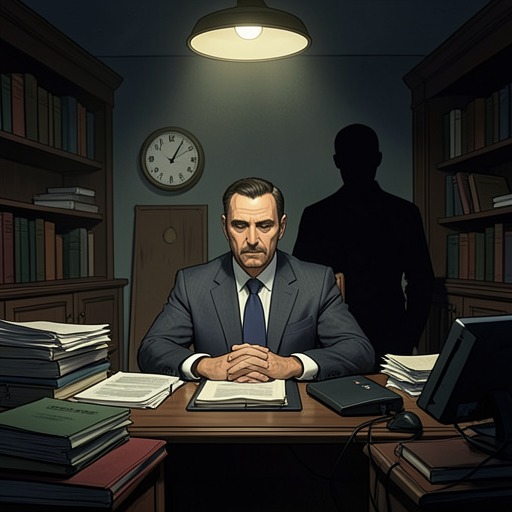
Howard has Crane’s written apology on his desk, a carefully phrased document that acknowledges an incident without naming it as a violent assault. The letter is evidence of a strained departmental relationship, but Howard’s attention has moved from its language to Crane’s movements. He has had Crane’s flat watched and arranged for three freelance operatives to be sent there. Howard tells himself that using outsiders is a considerate choice: he could not send colleagues to see Crane off. The more troubling explanation is that people who have worked with Crane would be too afraid to take him on.
The surveillance is mundane enough to make the danger seem, at first, administratively controlled. Two watchers sit in a van marked The Fabulous Bakin’ Brothers, decorated with a rabbit eating a cookie; a third waits in a nearby launderette as the same load of washing turns repeatedly. The operatives are not departmental colleagues but freelancers, and Howard’s account of why he chose them masks his fear of involving anyone who knows Crane. The contrast between the comic van and the lethal assignment captures the operation’s shabby concealment without making its stakes any less serious.
The silence after dispatch
Three hours before Howard goes to Crane’s flat, the watchers report that the “product” has arrived and will be sent out as soon as possible. After that, there is no further call. Howard repeatedly buttons and unbuttons his jacket, catches himself, and forces his hands onto the desk; the tremor is severe enough that his own effort to describe it as slight cannot hold. The delay turns a covert operation into a test of what he has set in motion. He picks up the apology and puts it down again, with nothing from the men he has sent to resolve the uncertainty.
Howard tries to imagine explanations that would leave the operation intact. Crane is older; perhaps the freelancers have finished and gone to supper without reporting in. But Howard knows the silence does not mean they have simply forgotten to call: they are beyond the reach of any mobile. His assessment of the assignment shifts as he waits. An “accident” arranged for an overweight minister, he reflects, is not the same as preparing an early grave for a professional like Crane. The distinction exposes the mistake in Howard’s calculation: the men may be willing and confident, but their confidence does not make them a match for their target.
The flat and the reversal
Howard eventually goes to see for himself. He takes the tube a few stops through Central London and walks to the block above a dying record shop, where Crane has kept a flat for several months. Crane moves several times a year, though Howard has never decided whether this is professional caution or an inability to settle. On the way upstairs, Howard notices the dark, damp stairs and the first-floor door marked with ornate cigarette-burn lettering. He tells himself that the strain in his breathing comes from the climb, even as he unbuttons his jacket again and imagines Crane confronting him for sending amateurs after a professional.
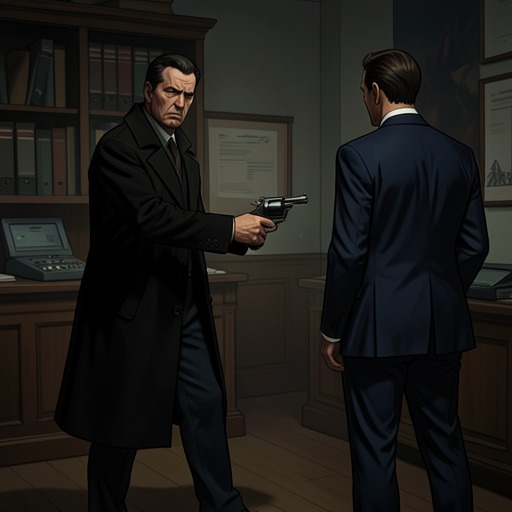
For a moment, Howard pictures a grisly scene: Crane, bloody-handed and bloody-toothed, with the would-be assassins hanging from the fixtures. That image is explicitly his fearful expectation, not what he finds. The flat is empty. An open window lets street noise pass through rooms that give no sign of Crane’s presence, and Howard has to sit down. The anticipated confrontation has been replaced by absence; he has arrived too late to control either the operation or the account of what happened.
On the glass-topped coffee table, Howard finds Crane’s note. Crane treats the afternoon’s events as constructive dismissal, says he is leaving for Scotland, and remarks that some jobs cannot be let go. He identifies Michael Downey as his quarry and tells Howard, “Downey is mine. Remember that.” The note also warns Howard that Crane will attend to him on his return. Its businesslike references to pay and notice turn a failed killing into a resignation delivered on Crane’s terms, while its threat makes clear that Howard has become part of the conflict.
Aftermath and significance
Howard finishes his wine before going to the bathroom, where he finds the three operatives left in the bath. Their bodies confirm what the unanswered calls and empty flat had already implied: Crane overcame the men sent to kill him, then left the scene. The note’s apology for the mess is an understated counterpoint to the violence, and the bodies reveal how badly Howard misjudged the man he had targeted.
The failure also exposes the limits of Howard’s institutional power. He had chosen freelancers partly because colleagues feared Crane, yet that choice put the job in the hands of men Howard himself recognizes as amateurs. He had wanted to be the first to learn what happened so that he could choose how to present it; instead, Crane has left a written account that names Howard’s action as the reason for his departure and announces his own next objective. The attempt therefore changes the balance between them: Crane survives, pursues Michael Downey toward Scotland, and leaves Howard with both a warning and the consequences of his decision.