The blue and red pills in Mark's name
Down Cemetery RoadThe blue and red pills in Mark's name become part of Sarah Trafford’s daily life after Joe Silvermann’s death and the police questioning that follows. First offered as relief for acute distress, they settle into a prescribed rhythm: blue at night, red on waking. Their effects are not presented as a simple recovery. The tablets calm Sarah, but also help make the surrounding crisis feel less urgent, until the routine itself becomes a reminder of the world she has already felt herself fall out of. The discovery that both containers carry Mark Trafford’s name, not hers, makes that dependence newly visible and unsettles the apparent reassurance of treatment.
First dose and immediate relief
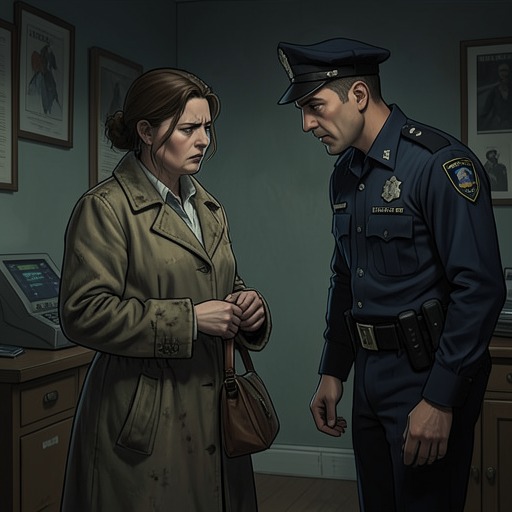
After the doorbell rings, Sarah breaks down. A man she has never met gently guides her to a seat and listens as she recounts what she can of a day shaped by custody, harsh questioning, and the unmarked hours of a room full of ringing phones. She is exhausted by the time she runs out of words. The visitor, whom she suspects is a doctor, makes her tea and offers a small blue tablet, placing a glass of water in front of her after removing the teacup.
Sarah asks what the tablet is. The man does not answer directly; instead, he says it will relax her and is ninety-eight per cent herbal. The exact percentage provokes a flare of scepticism in the part of her that has not been worn down by the day. Her hand curls, her nails bite into her palm, and yet she takes the pill. She swallows it without the water, her mouth still full of the taste of her tears. The scene holds relief and resistance together: the tablet is accepted, but not with trust.
The man leaves to speak with Mark. Sarah waits for the promised calm, unsure that anything is happening, before feeling her panic recede and her stress settle. Mark then ushers her upstairs with little conversation and tells her to take a bath and rest. The first pill thus arrives within a sequence of other people managing Sarah’s immediate condition: the visitor supplies and explains the tablet, while Mark conveys the instructions for what she should do next.
A regimen that makes distress manageable
Sarah sleeps deeply and without dreams. On waking, she finds Mark beside the bed with coffee and a small red capsule, identical in all other respects to the blue pill from the previous evening. His explanation is that she has been under considerable stress; he says he wishes he could stay, but work is demanding, and tells her that Simon Smith is coming at eleven and that he has reset the alarm. He asks her to take the capsule before he leaves. Sarah does so because of the kindness in his voice, even though her attempt to ask what it is barely emerges from her throat.
She wakes again before the alarm and feels better, but the circumstances that caused her anxiety remain. What has diminished is the sense of urgency: the previous day’s fear seems to have been siphoned away during the night. The change does not restore her appetite. The muesli she had anticipated tastes like gravel, and she cannot remember her last meal. The pills therefore accompany a partial easing, not a return to ordinary well-being.
The pattern becomes recurrent. Sarah thinks of the blue tablets as the nighttime dose and the red ones as the morning dose; both work, though their function as reminders gradually matters more to her than the relief itself. They point toward the world awaiting her if she stops taking them, a world she feels she has already fallen away from. As the days pass, that world grows indistinct at its edges. Sarah attributes this either to the aftereffects of shock or to a tranquillised stupor, and the calm provided by the tablets makes it easier for her to accept the less alarming explanation. A surviving, sceptical part of her sometimes objects that anything the pills help her believe may not be trustworthy, but that doubt surfaces only intermittently, often in the early hours or as she wakes from an afternoon nap. Mostly, she ignores it and gets by.
The pills within Sarah’s altered routine
The tablets coincide with a wider narrowing of Sarah’s daily life. Simon Smith resolves her problems with the police, whose contact with her is minimal. Sarah signs a statement saying that the cocaine found in her possession came from Joe Silvermann, that she bought drugs from him twice, and that she met him in a pub. Simon tells her this cooperation effectively ends official interest in her. Sarah does not thank him; Mark does so with the exasperated patience that has become characteristic of him. In this period, the pills’ calm exists alongside an account of events that Sarah has signed and an official inquiry she is told has effectively ended.
Her nights are long and dreamless, often beginning with Mark making love to her. She cannot remember him being so ardent since their early days together, and even then he often needed encouragement. Meanwhile, her waking attention turns increasingly toward her student years and the aftermath of her accident. The first hours after the accident remain inaccessible, but her time in hospital feels unusually fresh, as if the current regimen has opened doors in her memory. She replays those days on waking, and sometimes they feel like the first days of her life. The text places the pills beside this return to earlier memories without establishing that they cause it.
A practical anxiety eventually makes the regimen’s hold concrete. On the twelfth morning after the crash, fourteen days after Joe’s death, Mark warns that he will be late home. Sarah worries that he will be so late that she will lack her nighttime blue pill. This prospect is enough to prompt her to look for the supply. She knows Mark’s informal name for the blue tablets, bluey, but has not previously thought to search for them or question whether they are helping her in every sense.
Discovery and changed significance
Sarah finds two plastic tubs in Mark’s bedside cabinet. Each is labelled with Mark’s name, not hers, above a doctor’s signature she cannot decipher and medical wording she cannot understand. The mismatch turns the containers into more than a supply she fears running out of: the treatment has been organized under her husband’s identity. Sarah means to consult a medical dictionary, but cannot find it where it should be. By then the immediate urgency has passed, and she decides she is not about to run out soon.
She leaves the tubs on the sitting-room floor and makes coffee, not from desire but because it is eleven o’clock and keeping to a routine comforts her. Returning five minutes later, she stares at the containers. They are so light that she opens them to count their contents. The lid’s small plastic arrow aligns with its counterpart, but she still has to prise it open; when it releases with a jerk, red pills scatter across the floor like little marbles. The second tub opens more easily. She gathers the blue pills into a neat pile, then notices that the red pile is smaller, suggesting that some may have escaped beneath the sofa or into corners.
Counting proves difficult: Sarah keeps losing her place, so she arranges the pills in rows. They look to her like little soldiers, or perhaps small bombs, images that bring soldiers and bombs back into her thoughts after a period in which she had not been thinking of them. The small tablets thus connect a household task to memories and associations beyond the medical routine. When the doorbell rings, the episode breaks off abruptly; the next moment Sarah is bent over the kitchen sink, vomiting, with someone holding her from behind. The account does not identify the pills as the cause of this attack, but the interruption gives the act of counting a sharp, bodily end.
Later, when Sarah is confronted by the man she knows as Rufus, the absence of a blue pill becomes part of her awareness that a stretch of her life has closed. She notes that this is about the time she would have taken one, if she were ever going to take one again. The decisive change is not simply that the tablet is missing: its absence marks the end of the pill-governed period. Across these episodes, the pills move from offered comfort to daily dependency, from unexamined routine to objects Sarah can inspect and count, and finally to a measure of the life she has left behind.