The desert nerve-agent experiment
Down Cemetery RoadThe desert nerve-agent experiment was a secret test disguised as a military operation: British soldiers were ordered to confront six Iraqi child conscripts, then exposed to a chemical agent while supposedly protected by an experimental coating. Michael Downey’s account to Sarah Trafford reveals the betrayal at the heart of the episode: the men had not simply survived a dangerous mission but had been used as test subjects by the institution they served.
Deployment and Cover Story
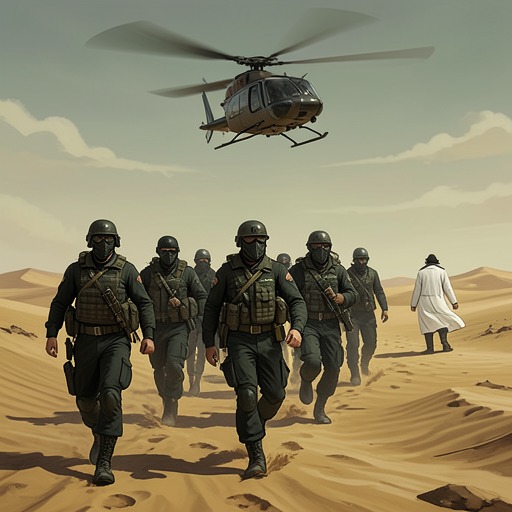
Michael recounts the operation while a television reporter speaks urgently beside an all-terrain vehicle. His attention shifts from the broadcast to the memory of being driven miles into the desert, where the soldiers were told that this was no exercise and that real enemies were waiting. Their orders were to capture those enemies and bring them back alive. The language of a live mission gave the deployment an ordinary military purpose, concealing what the soldiers would later understand as the real reason they had been taken there.
The targets were six Iraqi conscripts, but Michael rejects the idea that they were meaningful combatants. He remembers them as children who knew nothing and were not soldiers in any real sense. The contrast between the command to bring them home alive and their vulnerability makes the operation’s official framing morally unstable even before its experimental purpose is disclosed: the supposed enemy consisted of six boys placed in the path of a mission presented to the British troops as genuine.
The incident had already entered public dispute. Sarah recalls fragments of news bulletins and forceful denials in the press; the six Iraqi conscripts were reported to have died in a storm on the Syrian border twenty months earlier. Iraqi ministers, by contrast, claimed that Western troops had captured and murdered them. Michael confirms that the dead were Iraqi, connecting the public controversy to the soldiers’ concealed experience in the desert. The competing accounts turn the boys’ fate into more than battlefield rumor: what the official story obscures is bound up with the same operation that made the British soldiers victims of a secret test.
Exposure and Immediate Effects
Michael explains that the detonation exposed the operation’s concealed purpose: it was not an ordinary bomb attack, but a test of the soldiers and of the substance applied to them. The agent had been released on a force sent into the desert under the pretext of a live mission. Michael recalls a sound like glass breaking and an air that seemed to turn muzzy; then came an intense burning pain that continued instead of killing him. He thought he should have died from a bomb, and believed he and the others were screaming. His account makes the experiment’s violence bodily and immediate: the soldiers were not merely told afterward that they had been exposed, but endured an injury they could not understand while it was happening.
As Michael suffered, Tommy Singleton grabbed him and kept warning him not to look. The warning made no sense to Michael until he looked up and saw the Iraqi boys. They were not screaming; they were melting. That image joins the two parts of the experiment in a single scene: the men’s prolonged pain and the children’s catastrophic exposure. The soldiers had been told to bring the boys back alive, yet the agent turned the supposed targets into victims before their eyes, while the men themselves were being used to test what had been applied to them.
Aftermath, Erasure, and Confinement
The coating that was supposed to protect the soldiers did not spare them from the chemical agent. Michael later understood that the blast had been a test of both the men and the substance painted onto them. He connects that experiment to the idea of a Patriot Bomb, a weapon imagined to kill an enemy without harming its own troops: a goal he calls the Holy Grail, but one he does not believe has yet been achieved. The soldiers’ suffering exposes the gap between that ambition and its human cost. Michael’s stomach bears ugly red weals in blotchy stripes, a physical trace of what the experiment did to him.
For an unknown period, the six men were kept together and subjected to blood tests and a machine that scanned the whole body. No one explained the procedures or spoke to Michael as a person; he felt treated as an object of study, as though he had arrived from another planet and his body were evidence about it. He describes becoming an un-person in the desert, reduced to an experimental result. The injury was therefore not only chemical: the people conducting the tests withheld recognition and explanation from the very soldiers whose bodies they were examining.
A glimpse through a window eventually told Michael that he was in England. The men were then moved to the Island off Scotland's West Coast. By the time they reached it, he had recovered as far as he ever would, but he still could not understand why they had not been killed. Their captors presented themselves as ordinary men keeping the soldiers safe, and repeatedly promised that they would go home soon, once a few matters had been sorted out. The promise was renewed so often that Michael remembers waiting through what felt like hundreds of tomorrows.
The deception ended when a guard whom Tommy Singleton had befriended told him that the six soldiers were supposed to be dead, having been officially lost in the helicopter crash. Michael had never been to Cyprus, despite the death story attached to him. In retrospect, he understood that the reassuring men were guards and that the confinement was not protection. The soldiers were already erased from the public record; whether their captors wanted further tests, expected long-term effects to kill them, or were waiting for authorization to execute them, Michael could only speculate. He believed they would neither release the men nor kill them without political cover, because the soldiers belonged to Her Majesty’s forces and their deaths had already been announced. The experiment thus continued beyond the blast: secrecy turned survival into an unofficial captivity, with the false report of death helping to make the survivors disappear.
Testimony Against the Official Story
The experiment reaches the reader as a recollection Michael Downey is trying to give Sarah Trafford, not as an immediate battlefield scene. A television reporter’s urgent broadcast brings the disputed deaths of the Iraqi conscripts into the room, but Sarah does not want to keep looking at the screen or know that a war is happening. She asks Michael to continue anyway. Her recoil makes the act of recounting part of the episode’s consequence: the account is difficult to hear, yet without it the public denials and the survivors’ experience remain separate, irreconcilable versions of events.
The exchange also refuses the clean distance of a news report. The broadcast offers a public controversy; Michael’s testimony supplies the pain, the boys’ fate, and the soldiers’ treatment as experimental subjects. Sarah cannot make that knowledge less disturbing by turning away, and her request to hear more allows the concealed history to be spoken. The scene’s force lies in that movement from mediated report to personal witness: the official account is no longer the only account available, even though the truth it reveals offers no comfort.