The desert nerve-agent experiment on Iraqi child soldiers
Down Cemetery RoadThe desert nerve-agent experiment on Iraqi child soldiers was a covert military test in which British troops were exposed to a chemical agent alongside six Iraqi children. Recounted by Michael Downey to Sarah, the episode turns the soldiers’ supposed mission into a deliberate experiment: the troops were not merely caught in an attack, but used as guinea pigs, while the children they had been told to capture died in agony.
Mission and Deception
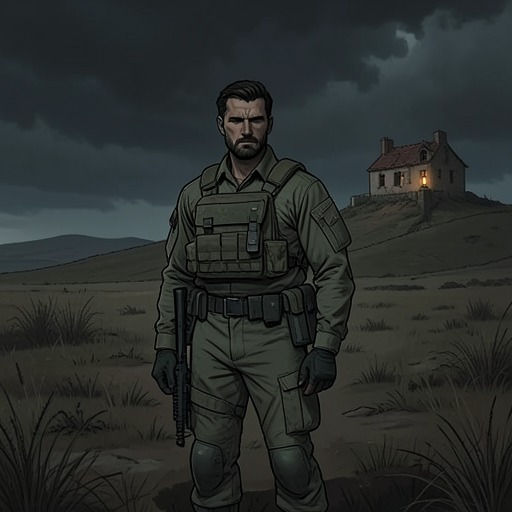
Downey’s account begins with a journey into the desert, miles from anywhere. The soldiers were told that this was no exercise: hostile forces were supposedly in the area, and the troops were expected to take them. They were also instructed to bring the targets back alive. The language of a rescue or capture mission concealed the circumstances of what followed; the soldiers believed they were confronting a real enemy, not entering a test site prepared by their own side.
The supposed enemy consisted of six children, whom Downey insisted were not soldiers. One could not speak English beyond a few words, including “cigarette.” Tommy Singleton had shot one of them, whose leg was badly wounded; the soldiers bandaged him in the truck. Their attempt to communicate with the children was interrupted by a helicopter that opened fire. Only later did Downey understand that the children were Iraqi, and that the scene had been organized around the soldiers as well as their intended captives.
Exposure and Immediate Aftermath
Downey later understood that the helicopter belonged to his own side. At the time, after it opened fire, he could not be certain what was happening. He recalled that the soldiers had been deliberately exposed: they were painted with a substance intended to protect them, while the weapon used against them carried some kind of chemical agent. The mission had not simply gone wrong; the troops themselves were part of the test.
The agent’s effects arrived as a sound like glass breaking, followed by air that seemed to turn muzzy. Downey struggled to describe what came next except through the body: burning, extreme pain that continued rather than killing him, and the sense that his skin was being scorched away. Tommy Singleton was screaming too and tried to stop Downey from looking toward the children. When Downey looked, he saw that the six Iraqi children were not screaming. They were melting. The difference between the soldiers’ suffering and the children’s silent destruction makes the experiment’s supposed distinction between protected troops and targeted enemy brutally visible.
Downey later connected the test to the pursuit of a weapon that could kill an enemy without harming one’s own forces. He remembered hearing of the Patriot Bomb, described as a hoped-for weapon rather than a confirmed capability, and said that not everyone had stopped trying to develop it. The protection applied to the soldiers did not make the experiment humane: they were unwitting test subjects, and the children had been treated as targets despite the order to bring them back alive.
Concealment and Responsibility
The experiment’s aftermath extended from the desert to an island off Scotland’s west coast, where Downey and the surviving soldiers were kept under guard. Their captors presented themselves as men ensuring the soldiers’ welfare, repeatedly promising that they would soon be sent home. Only after one guard confided in Tommy Singleton did they learn that the outside world had been told they were dead in the reported helicopter crash near Cyprus. Downey had never been to Cyprus. The false death report turned confinement into a trap: the men could not return to ordinary life without exposing the lie, while their keepers, he believed, could not kill serving soldiers without political authorization. They were neither released nor openly executed; they remained in limbo, waiting through what felt like hundreds of promised tomorrows.
The episode also belongs to a longer history of violence and official concealment, rather than presenting Downey as untouched by the system he condemns. Before the experiment, he and Tommy Singleton had served at Crows’ Hill, a camp for Iraqi prisoners. One night, they and other soldiers took three prisoners to the perimeter and shot them. The killings were covered up; the men were kept in close confinement, later drawn into special services, and eventually delivered to The Department as officially dead. This history makes the experiment’s moral terrain more difficult: Downey had participated in the killing of unarmed prisoners, yet was subsequently exposed to a secret weapon by the same state apparatus that could erase both its victims and its own actions.
When Howard later tried to discredit Downey to Sarah Trafford, he invoked those killings and called him a maniac, then defended the desert test by claiming Downey had volunteered. Sarah rejected the justification directly, identifying him as a guinea pig. Howard’s account shifted again: he said the agency had wanted to make contact with Downey and bring him back into the fold, and blamed the danger on Downey going rogue. His explanations place the experiment inside the Department’s wider habit of recasting deliberate violence as a regrettable exception, a necessary operation, or someone else’s fault. The soldiers’ secret survival and the children’s deaths expose the cost of that language: concealment did not undo the harm, but made the people subjected to it harder to name and hold anyone responsible for.
War, Publicity, and the Cost of Disclosure
The experiment’s political context is marked by a rhetoric of certainty that sits uneasily beside its human consequences. In an earlier discussion of war, one speaker dismissed the opposing conscripts as technologically backward and treated Western military superiority as decisive; Wigwam countered that nobody would win a nuclear war. The exchange exposes a public language in which conflict could be made to sound both profitable and safely winnable, while the desert test revealed what that confidence concealed: soldiers and children could become expendable within military planning.
The threat of disclosure later made that concealment explicit. C challenged Howard over the prospect of war and warned that the country was prepared to take up arms to prevent Downey from speaking publicly. The threat did not establish that the desert experiment itself would cause a war; it showed how far the state was prepared to go to contain what Downey knew. In that reversal, the danger to national authority was not only the chemical weapon or the deaths it caused, but the testimony that could connect them to official action. The episode’s central contradiction therefore extends beyond the desert: a government capable of describing military violence as controlled and necessary treats the telling of its consequences as a threat requiring force.