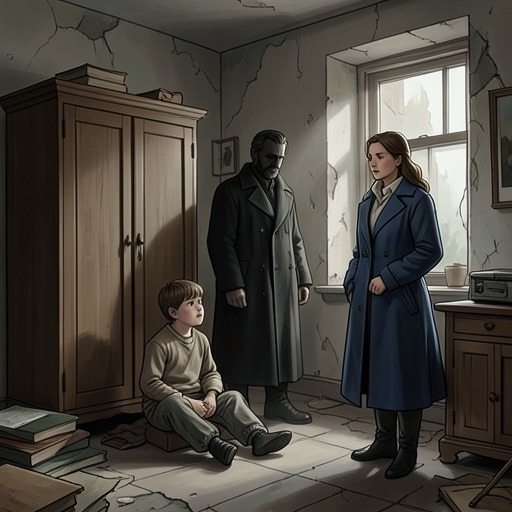
The plan to secretly move Dinah and use her to lure out Michael Downey
Down Cemetery RoadThe plan to secretly move Dinah and use her to lure out Michael Downey turns Dinah Singleton’s survival into both a responsibility and a weapon. In the aftermath of Axel Crane’s bombing of the Singleton home, Amos Crane and Howard discuss keeping the child under their control and making Michael Downey come looking for her. Their intended trap rests on a contradiction they recognize but do not resolve: Dinah is not to be harmed, yet her safety is made the instrument by which they hope to expose and kill Downey.
Background: A child after the bombing
Axel Crane’s explosion has left Howard to manage the consequences after the fact. The official story is a gas leak, and Howard insists that the story will hold. But the exchange with C makes clear that Dinah’s survival matters not merely as a personal concern: a dead child could attract sustained press attention and public scrutiny, especially if the death were connected to a covert operation. C presses Howard on whether she has been given her shot; Howard answers that she is fine. The child’s condition and the cover story are already bound together, because any further harm could turn an operation they are trying to conceal into a conspicuous scandal.
The problem is larger than the explosion’s immediate aftermath. Michael Downey is still at large, and C doubts that he will accept the gas-leak explanation. Amos Crane’s expectation is that Downey will prioritize Dinah: if the Cranes have the child, Downey will come looking for her. The plan therefore converts a concealed custody arrangement into bait. Dinah’s presumed importance to Downey is the lever; his predictable response is supposed to bring him within reach of the Cranes.
Disappearance and the pressure to control the story
The uncertainty surrounding Dinah’s whereabouts is already visible in the account Sarah Trafford receives. A hospital record places the child’s check-in at 2:37 a.m. on the fourth, yet the person speaking to Sarah says that no one knows where she went after disappearing in the middle of the night. The precision of the hospital’s ordinary records sharpens the anomaly: routine details are documented, while the child’s departure has left no usable explanation. The speaker distinguishes this from a simple favor arranged with money, suggesting that the disappearance required organization and that someone may have exerted pressure.
Howard’s response to the bombing follows the same logic of managing information rather than repairing what happened. He regards the police, local press, and an inquest as a seemingly solid fix, one that should bring the matter to a close; he also recognizes that national security can persuade people to accept what they would otherwise question. Yet he worries that infants are harder to explain away as having chosen a new life or simply vanished. Their vulnerability invites people to look for them. That concern makes Dinah both an unusually difficult secret to keep and, in the Cranes’ calculation, a particularly effective means of drawing Downey out.
The trap takes shape
Amos Crane supplies the strategic interpretation of Axel’s uncontrolled act. Although he is fiercely protective of his younger brother, he admits that Axel’s method would not have been his choice in a field situation: it surrendered too much control and created too much work for those left to contain the aftermath. Nevertheless, Amos reads Dinah’s survival as an opportunity. She remains on the board, and he believes she can be used carefully as part of a larger plan. Howard is less convinced. He sees the risks of making an infant central to a scheme whose consequences cannot be neatly confined to the intended target.
The two men’s later exchange makes the proposed bait-and-trap arrangement explicit. Howard asks where the child is; Amos says she is tucked up in bed. He assures Howard that she is not to be harmed and describes her as safe. The reassurance comes against the recent image of a house destroyed by violence, giving the assurance an uneasy edge without cancelling its stated terms. Howard repeats that Dinah must not be hurt, and Amos answers with an open-palmed gesture rather than a detailed account of safeguards.
Amos also promises that Downey will look for Dinah and says that they will make it easy for him to find her. The intended sequence is therefore more than passive waiting: Dinah’s location is to be arranged so that Downey can follow the trail, while the Cranes wait to spring a trap. Amos describes the desired ending in brutally final terms, imagining Downey entering their box and being killed. His confidence depends on treating Downey’s attachment to the child as a predictable constraint: until he finds her, Amos believes, Downey will put her first and will not turn to other possibilities.
Control, risk, and the limits of the plan
Howard’s role is to keep the operation within limits and contain the damage, not to initiate the explosion that has made the plan necessary. He resents having to defend an outcome he did not know about until it was over. His private response is practical: check on Dinah, arrange warning signals in case events go wrong, and remind Amos that he cannot let Axel conduct a private war. These tasks expose the plan’s dependence on supervision. Axel has already acted without adequate control; now Howard must try to ensure that the child is protected and that the next stage does not attract further attention.
Amos, by contrast, treats the crisis as a strategic opening. His confidence that Downey will come for Dinah is the foundation of the trap, while the instruction that she must remain unharmed is its stated boundary. Howard sees why the calculation might work but remains alert to what it could unleash: another person might take the bait, and Axel’s tendency to treat a shallow grave as the quickest solution makes any loss of control dangerous. The plan is thus not presented as a clean operation but as a dangerous attempt to impose order on violence that has already escaped its authors’ preferred shape.
The available account establishes the intended use of Dinah and Amos’s disclosure that she is in bed, but does not describe a completed transfer, Downey’s arrival at the trap, or its outcome. What it does establish is the moral structure of the scheme: Dinah is promised protection in the same conversation in which her captivity is made leverage. The child’s disappearance, the official gas-leak story, and the proposed invitation to Downey all belong to one effort to control who can find her, what the public will believe, and where Downey will go next.