Thomas Singleton
Down Cemetery RoadThomas Singleton is a soldier remembered through competing accounts of his death: the public story places him in a helicopter crash near Cyprus, while Michael Downey’s testimony connects him to a secret desert operation and a later killing. His absence does not make him peripheral. The gap between what was reported about his death and what those who knew him reveal makes Thomas a hinge between a military cover story, Dinah Singleton’s family history, and Sarah Trafford’s search for the truth.
Identity and Family
Thomas was married and had a daughter, Dinah. Sarah first learns about him from Wigwam, who describes Dinah’s father as a soldier killed several years earlier. The detail that Dinah was only four, and had not yet been born when the reported death occurred, gives the family story an immediate point of chronology: Thomas’s death precedes Dinah’s birth, so she cannot remember him for herself.
Wigwam’s account is imprecise about the circumstances. She recalls an accident involving a helicopter, probably in Cyprus, and says several soldiers died. Later, Joe Silvermann supplies a more definite version: Thomas died in a helicopter crash off Cyprus about four years earlier, with six soldiers and the crew reported killed altogether. The difference between Wigwam’s uncertain recollection and Joe’s more specific account shows how the official story has circulated as a fact even when its details are not firmly held by everyone repeating it.
Thomas’s marriage and fatherhood matter not only as biographical details but as the human stakes of the search. Dinah’s missing status draws Sarah into the Singleton story; the question of where Thomas’s death really belongs then becomes inseparable from the question of what happened to his daughter. The book gives no account of Thomas’s life at home, and his family relationship is therefore conveyed through the consequences of his absence rather than through domestic scenes.
The Reported Death and Its Contradiction
The helicopter-crash account is challenged by a discrepancy in official information. In a letter to Sarah, Joe says that the Ministry of Defence’s press release records Thomas as having died four years earlier, and asks why he appears to have died again more recently. Joe has sent the department a copy of his letter, reasoning that it may know the answers—or may need to be pressed into asking the questions. His observation turns Thomas’s death from settled background into an investigative problem: the issue is no longer simply how he died, but why accounts of his death do not agree.
Joe also connects the answer to Thomas’s daughter. He tells Sarah that wherever the truth about Thomas’s death lies, Dinah will be found there too. This is a practical inference within the investigation, but it also defines Thomas’s importance to the plot: his history is a route into the circumstances of Dinah’s disappearance. The apparent neatness of a military accident cannot contain what follows. A death recorded in a press release becomes the trace of a story that official records may have concealed or misrepresented.
Military History and Michael Downey
Michael Downey identifies Thomas as a fellow soldier with whom he trained. Their association predates Sarah’s investigation: they did not merely meet during its events, but shared military preparation and, later, a disastrous experience in the desert. Michael’s account is spare, and Sarah has to recognize how much remains unsaid. The narrative therefore makes their comradeship legible through fragments of action rather than a full history of their service.
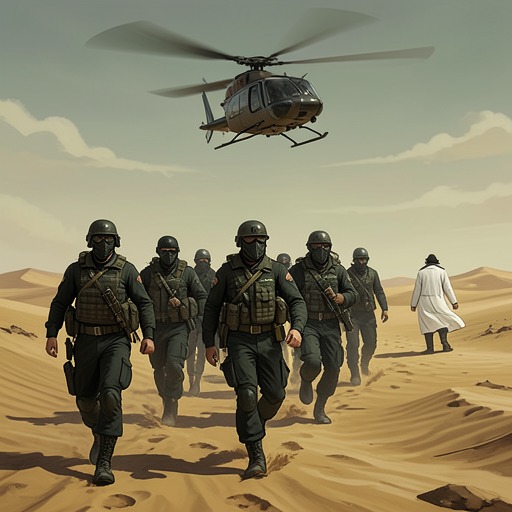
In the desert, Michael recalls six soldiers alongside a group they called the boy soldiers. He describes a day of fighting in which the boys fired a few shots, then tried to dig in at the top of a dune. They were terrified; one stood with his arms raised and prayed. Thomas shot him in the knee. Michael’s account does not present this as a conventional battle against a dangerous force. The boys were frightened, and Michael says they had been kidnapped and brought there for the soldiers to practise on. When asked whether that was the purpose, he answers that he thinks so. The episode places Thomas inside an operation whose victims were children and whose nature Michael himself describes with uncertainty.
The account also establishes a sharp limit to the soldiers’ survival. When Sarah asks what happened to the others, Michael says that he and Thomas left, but not easily or alone in the broader sense: the other men were dead. The terse exchange does not explain every step between the desert and the later events, but it makes the scale of the loss unmistakable. Thomas and Michael are bound by shared training, the desert operation, and their escape from a group in which the remaining soldiers did not survive.
Death, Secrecy, and Narrative Role
Sarah recalls being on the bridge after Thomas was killed, and Michael confirms that she was there. This reference places his death within the events Sarah has witnessed, while sharply complicating the earlier account of a helicopter crash. The book does not make the discrepancy a minor correction to a biography: it sets the public version beside the testimony of people entangled in the concealed military history. The accounts cannot simply be treated as one uncomplicated sequence, and the unresolved difference sustains the investigation.
Thomas’s story is consequently told in layers. Wigwam offers a remembered family version; Joe checks it against the Ministry of Defence’s press release and notices the contradiction; Michael supplies the soldier’s connection to the desert and to the deaths of the other men. Sarah’s questions draw these accounts together, but no single early explanation gives her the whole history. The repeated return to how Thomas died marks the difference between a death that institutions announce and the death that witnesses remember.
His narrative role also gives the search for Dinah a history extending beyond the immediate disappearance. Thomas’s reported death predates her birth, but his military past continues to shape the danger and uncertainty surrounding his family. The gap between the official record and Michael’s account is not resolved in the evidence presented here; what is established is that Thomas trained with Michael, took part in the desert episode, left with Michael while the other soldiers were dead, and was later killed. In that unresolved passage from public explanation to personal testimony, Thomas becomes a central absence: a husband and father known through loss, and a soldier whose hidden past exposes the limits of the official story.