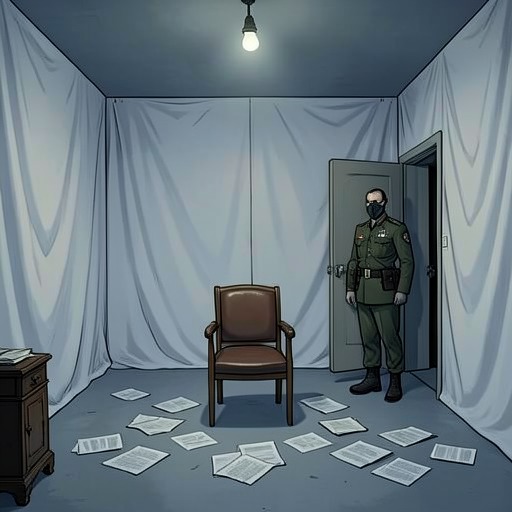
Thomas Singleton reported dead in a helicopter crash
Down Cemetery RoadThomas Singleton reported dead in a helicopter crash is an event defined by conflicting accounts of Thomas Singleton’s death. A Ministry of Defence press release placed his death four years before a more recent report, while Sarah Trafford was later present after Thomas was killed on a bridge. The discrepancy turns an official announcement into a clue: if Thomas had already been declared dead, the newer account raises questions not only about the circumstances of his death but also about the truth behind the official record.
The Official Account and Its Contradiction
The earlier account reaches Sarah through a letter from Joe Silvermann. He encloses a copy of a letter he has sent to the Ministry of Defence, pointing out that its press release says Thomas died four years earlier. Joe contrasts that announcement with the more recent report of Thomas’s death and asks how Thomas could have died twice. The question is not a claim that the helicopter crash did not happen; rather, it exposes a contradiction between the official chronology and the later news.
The evidence gives no details of the crash itself, nor does it explain how the two reports came to differ. What it does establish is that the discrepancy is consequential enough for Joe to contact the Ministry of Defence. The official statement, instead of closing the matter, becomes the reason to reopen it. Thomas’s recorded death is therefore both an asserted fact and an unresolved problem.
Joe’s Letter and the Search for Answers
Sarah reads Joe’s letter in the sitting room, holding it in her lap. She recognizes it as his despite not knowing the handwriting, because he has sent it to the wrong address; what would be a nuisance from someone else feels like a private joke from the detective. That familiar, slightly comic detail frames a letter whose contents are more serious: Joe acknowledges that he had become angry, accepts that Sarah should continue looking for the girl, and says he will help even if it means driving to Surrey on what he had thought was a fool’s errand.
Joe treats the contradiction in Thomas’s reported death as a practical opening. He suggests that the Ministry of Defence may know nothing about the more recent report; if it does know, he reasons, discreet answers now could spare it greater press attention later. His letter presents the department as pragmatic and appeals to that pragmatism, while also recognizing Sarah’s capacity to cause trouble if she persists. For Joe, questioning the death record is not an abstract exercise: he believes the answer to Thomas’s death will lead to Thomas’s daughter, whose disappearance has become the focus of Sarah’s search.
Sarah’s Presence at the Bridge
The later account is grounded in Sarah’s own presence. As she and Michael Downey flee, Michael recalls that she was on the bridge after Thomas was killed. Sarah confirms that she was there. This exchange places her close to the event and gives her knowledge a different weight from the Ministry of Defence press release: the official record speaks in terms of a death announcement, while Michael identifies Sarah as a witness to the aftermath of Thomas’s killing.
The scene does not explain the bridge killing or reconcile it with the report of a helicopter crash. It does, however, make clear that the recent death is not merely a newspaper item to Sarah. Michael knows she was present, and her brief confirmation establishes a shared point of reference between them. Her reply that he frightened her also preserves the personal unease surrounding the encounter, rather than turning her presence into a detached piece of investigation.
Consequences and Narrative Significance
The incompatible timelines make Thomas’s death a hinge between the search for Dinah Singleton and the hidden history surrounding her family. Joe’s letter links the question of how Thomas died to where his daughter might be found, while Sarah’s presence after the bridge killing supplies a personal connection to the newer account. The two strands do not yet provide a complete explanation; instead, they prevent either the press release or the recent report from serving as a final answer.
The event’s significance lies in the gap between official record and witnessed experience. A death announced by the Ministry of Defence four years earlier should be conclusive, yet a later death report and Sarah’s presence after Thomas was killed unsettle that certainty. The contradiction makes the official chronology itself an object of investigation, and keeps Thomas’s fate bound to the continuing search for his daughter.