Zoë Boehm
Down Cemetery RoadZoë Boehm first appears as a sharp-eyed, sardonic presence at Oxford Investigations, where her partnership with Joe Silvermann is more substantial than the office door suggests. She is introduced through the collision of humor and grief: she mocks Joe’s weaknesses, then becomes one of the people most determined to expose the truth of his death. Her attention to Sarah Trafford’s account, her insistence that Sarah retract a false statement, and her later efforts to find Dinah Singleton make her a practical ally whose bluntness does not cancel her care.
Identity and Introduction
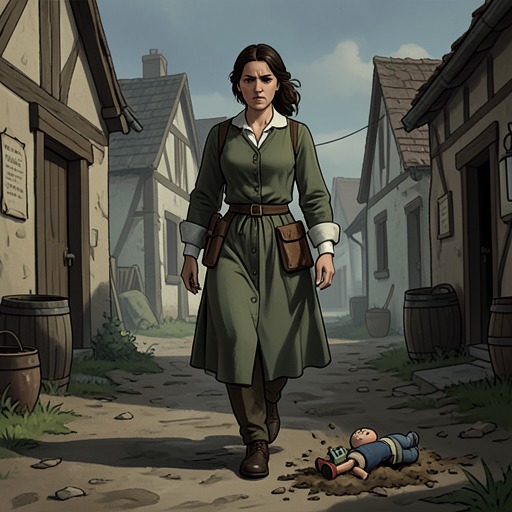
Sarah Trafford jumps when Zoë enters the office unexpectedly. Zoë is taller and older than Sarah, with very dark, tightly cropped curly hair and almost-black eyes. Laughter lines mark her face, but she is not laughing when she finds a visitor in the room. Her sardonic greeting immediately establishes a manner that mixes comic provocation with watchfulness.
Zoë has known Joe Silvermann for twenty years, first as a boy and then as a man. She describes him as a hopeless romantic and an unreliable investigator, prone to believing what he wants and liable to bring back the wrong end of whatever clue he has been sent to find. Her teasing is unsparing, but it is not simple contempt: she warns Sarah not to be too hard on him, because when Joe acts hurt, he usually is hurt. Even in their first meeting, Zoë’s jokes carry an understanding of his vulnerability.
Partner at Oxford Investigations
Zoë is not merely Joe Silvermann’s assistant. When Sarah asks about the office computer, Joe clarifies that Zoë Boehm is his partner. Yet her name is absent from the office door. Joe attributes the omission to a painter having misunderstood his instructions, leaving a small but telling mismatch between her stated role and the public sign of the business. The text gives no independent explanation for the discrepancy, but it makes her equal standing less visible than his.
Her knowledge of Joe’s work is intimate and unsentimental. She recalls his good telephone manner and the effect his Oxbridge background had on middle-class clients, while also distinguishing the cases he could handle from the ones he could not. He could find someone who did not want to remain lost, or investigate a petty-cash theft, but his emotional immaturity and softness left him open to deception. Zoë’s account makes her his sharpest critic and a witness to the habits that shaped their shared work.
Joe Silvermann’s Death and Sarah’s False Statement
When Zoë confronts Sarah again, she identifies her as the woman who became involved with Joe shortly before he died. She does not treat the death as an unfortunate end to a compromised investigation. In Zoë’s view, Joe did not use or sell drugs, and the drugs found on him were planted by whoever killed him. She is prepared to pursue that person herself, and her anger gives the investigation a personal urgency.
Zoë’s suspicion of Sarah is built from concrete inconsistencies. Joe kept extensive lists, she says, even keeping a list of the lists; it would be more plausible for him to forget his trousers than to neglect his paperwork. Yet Sarah has no file in the office. Zoë concludes that somebody removed it and connects its absence to Sarah’s claim that she had never been to the office before finding Joe. She presses Sarah to explain the lie rather than accepting the police account at face value.
Her suspicion does not make her indifferent to Sarah’s danger. Zoë tells her to call the police and withdraw the statement that Joe sold drugs, describing the correction as simply telling the truth. When Sarah objects that the person threatening her does not want her to do so, Zoë argues that killing Sarah would bring the police’s attention onto the killer. Her reasoning is hard-edged, but it turns her demand into practical advice rather than a test of Sarah’s character. She also tells Sarah that, in the same position, she might have done what Sarah did.
Sarah asks why Zoë is pursuing the case if she loved Joe but had repeatedly disappeared from his life. Zoë answers that the love ended years earlier. The distinction matters: her commitment after his death does not depend on pretending their former relationship remained a romance. She can acknowledge its ending and still insist that Joe was murdered, that he did not deserve to be framed as a drug user, and that the truth should be corrected.
From Accusation to Alliance
By the time Sarah and Zoë meet again beside the sea, Sarah expects her. Zoë says that missing persons are her specialty; Sarah replies that she had tried to call her. The quiet pause before they speak contrasts with Zoë’s earlier office-room confrontations. Their shared attention to the sea gives way to the urgent information Sarah has been carrying: she tells Zoë that Rufus killed Joe, tried to kill her, and was a spook. Zoë listens as Sarah finally gives her the facts she needs to understand the danger and Joe’s death.
Sarah’s memory of Zoë’s earlier help gives their renewed contact another dimension. A few days before, Zoë had pumped Sarah full of salt water and emptied her of drugs. Sarah recalls this care without softening Zoë into a gentle figure: she remains a woman who acts decisively, not sentimentally. At the inn, Sarah’s thoughts turn to Joe and to Zoë, and she considers calling the office to let Zoë know that she is alive. The unanswered telephone instead confronts her with the absence Joe has left behind. When the two women reconnect, the call Sarah could not complete has become an encounter in person.
Their alliance develops through a shared search for Dinah Singleton. When Sarah’s resolve falters, Zoë rebukes her for considering walking away and then spreads out a map. It shows no islands. Zoë does not pretend that the map settles the question: Michael Downey may have been mistaken about the location, she allows, but if he was right, the island is simply not marked. The map becomes a compact expression of their uncertainty—evidence of what they cannot see, not proof that there is nothing to find.
Action and Narrative Role
Zoë’s humor is a constant, but it does not make her function merely comic. She uses it to puncture Joe’s self-importance, to meet Sarah’s hostility without surrendering her position, and to keep a conversation moving when grief or danger might otherwise stop it. Her bluntness can sound accusatory, yet the same directness underwrites her refusal to accept a false account of Joe’s death and her insistence that Sarah tell the truth.
At the island, Zoë’s response to danger is abruptly redirected by the discovery of someone wounded. A wet, hiccup-like sound comes from behind a closed door; Zoë follows it into a corridor lined with heavy wooden doors. When movement draws her attention, she drops into a crouch and almost loses hold of her gun in her haste. The figure she finds is not an armed attacker but a frightened, hurting woman curled against the wall. Zoë puts the gun back into her bag and approaches her cautiously, as she might approach an injured cat. That choice completes a recurring pattern: suspicion and readiness give way, when the facts change, to attention and aid. Zoë’s loyalty is not confined to the dead or to the people she already knows; it remains responsive to whoever is actually in front of her.