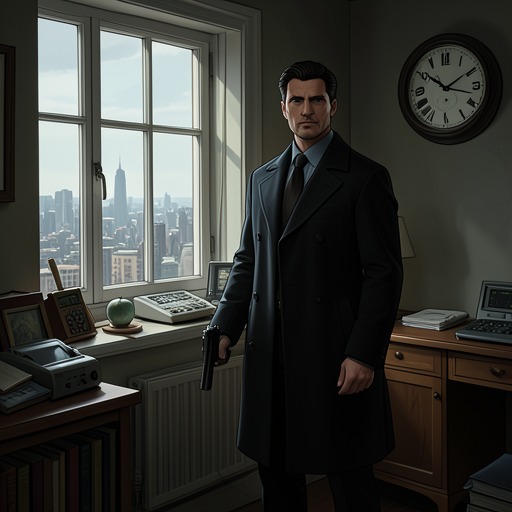
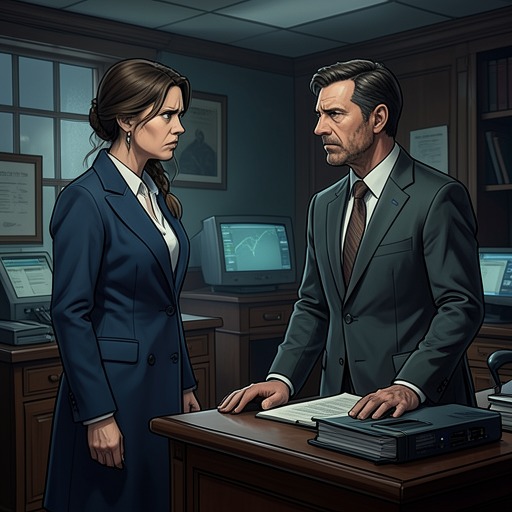
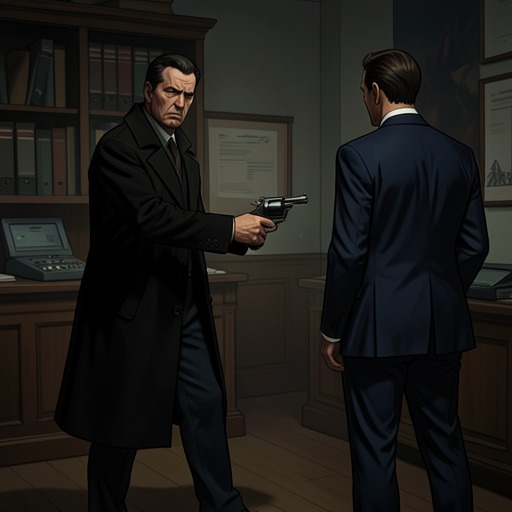
Zoë shoots Amos Crane at the chapel
Down Cemetery RoadZoë shoots Amos Crane at the chapel, where a standoff turns on the difference between a threat and a loaded gun. Amos takes Zoë’s pistol, puts Sarah in danger while she holds Dinah, and pulls the trigger after Zoë warns him that the chamber is empty. The failed shot gives Zoë the opening to shoot him; Sarah leaves with Dinah, while the confrontation continues outside with Howard.
The Standoff in the Chapel
The confrontation takes place in a disused chapel, a chilled, empty space built for worship. Amos has already killed David Keller, whose car and identity he needed; Sarah and Zoë have also relied on Keller for a lift. His practical indifference to Keller’s death follows him into the chapel, where he crouches beside the others and smiles kindly. For Sarah, the smile carries the history of the attack in her kitchen: she recognizes the same menace she associated with Rufus, and remembers that Rufus was Axel in disguise. The distance she and her companions have travelled seems to close into a circle, returning her to the beginning of the violence.
Zoë reaches for her gun, but Amos has it first. When Michael reaches for his own weapon, Zoë’s little pistol is pressed against Sarah’s ear. Sarah is forced to live through the possibility that this will be her last moment, yet she does not drop Dinah, who twists in her arms. Amos orders Michael to pass over his gun. Michael slides Gerard’s gun across the floor; Zoë stands on it, preventing Amos from taking it. With Sarah still held at gunpoint, Amos threatens to blow a hole in her head. Zoë answers that he cannot do so with the pistol he has taken, then states the reason: “It isn’t loaded.”
The Empty Chamber and the Countershot
Amos pulls the trigger, but the pistol does not fire. Sarah states the immediate fact; Zoë names the rule behind it: “Always leave the chamber empty.” The phrase turns a precaution into the scene’s reversal. Amos has taken control of the weapons and threatened Sarah, but the empty chamber makes his own trigger pull a wasted act and gives Zoë a moment to act. She tells Sarah to leave with Dinah. Sarah hesitates, then obeys Zoë’s repeated command to go, carrying Dinah through the door without looking back. Amos echoes the rule as Sarah goes, registering too late the safeguard that has undone his threat.
The confrontation continues after Sarah leaves. Amos recalls that he dreamed about Zoë; the flicker in her eyes gives him time to drop to his knees and reach for a gun. He intends to shoot Zoë and then make Michael Downey suffer for killing his brother. Zoë does not hesitate: she shoots Amos, and he ceases to be a threat. The narration offers no drawn-out account of the shot; its abruptness contrasts with Amos’s imagined, deliberate violence against Michael.
Outside, Howard hears the shot while walking beneath the trees. He later reaches a clearing, limping and holding his own gun, to find Sarah waiting with a shotgun. The gunfire inside the chapel has therefore changed the balance beyond its walls: Sarah is no longer simply fleeing with Dinah, but stands armed between Howard and whatever he intends to do. His belief that loose ends are being clipped makes the shot sound like part of a larger reckoning, while Sarah’s warning that he has come far enough brings the immediate confrontation to a halt.
Amos Crane’s Last Miscalculation
The scene briefly shifts close to Amos Crane’s own perceptions. He tells Zoë, “I dreamed about you,” and the narration holds the remark in two registers at once: absurd, yet true. The flicker in Zoë’s eyes gives him the instant he needs to drop and reach for a gun. His sudden descent is rendered as almost discontinuous—one moment his feet are on the floor, the next he is on his knees on the dusty stone. The movement hurts him, and the narration makes the cost linger in his injured knees.
That risk was unnecessary even by Amos’s own account: he has a gun strapped beneath his right armpit. He has chosen the more dangerous approach because entering the chapel empty-handed and seeing what happens feels thrilling. His confidence with firearms is habitual, but here it becomes a liability; he reaches for another weapon at the moment Zoë acts without hesitation. Amos’s imagined sequence—shooting Zoë, then taking longer over Michael Downey, the man who killed his brother—never begins. His appetite for controlling the encounter ends in the bodily fall he had not planned for, and the scene cuts short the revenge he meant to carry out.
The Rule as Reversal
The chapel’s decisive reversal rests not on a stronger weapon but on a practiced limit: Zoë’s rule, “Always leave the chamber empty.” In Amos Crane’s hands, the pistol appears to make his threat against Sarah Trafford immediate; its empty chamber turns the pull of the trigger into a failed act and opens the instant in which Zoë can act. The maxim is then repeated by Amos as a question, converting a private safeguard into the words that mark his miscalculation. The shot carries beyond the chapel: Howard hears it among the trees, and the narrative moves from the enclosed standoff to his approach toward Sarah. In that sequence, a rule designed to prevent a gun from firing does not eliminate violence; it changes who can control its timing, and gives Sarah and Dinah Singleton a chance to leave.