Donny Salcido Mate
Dr. DeathDonny Salcido Mate is introduced through an uncertain identity and a troubling criminal record: investigators connect him to the name Eldon Salcido, then consider whether this estranged son might have returned to his father’s life—and possibly killed him. His history makes him a credible suspect, but suspicion remains distinct from proof.
Identity and Criminal Record
A search for Eldon S. Mate produced no record, but a search for Eldon Salcido returned three California convictions. The vital statistics matched, linking the name to Donny and giving the investigation its first concrete account of his recent past. The convictions were for driving under the influence, six years earlier; larceny, two years after that; and assault, eighteen months before the search. The sequence suggested increasing aggression, though that pattern was an interpretation of the record rather than evidence of the murder itself.
Donny had served time in Marin County and had been released six months before the inquiry. He served his full sentence and was released without parole. The investigators also understood that he had spent a year and a half in jail without calling his mother, a detail that sharpened the impression of social isolation. These facts do not explain what happened between Donny and his father, but they make estrangement more than a passing suspicion in the investigation: he had been absent, had a record of escalating offenses, and was now free.
The Artist and the Suspect
The investigation’s suspicion of Donny gathered force from two different kinds of evidence: his possible connection to a homeless man seen around an art exhibition, and the work attributed to Zero Tollrance. The investigators knew that one of Tollrance’s paintings had surfaced, and considered whether a bearded vagrant who had been chased away from the show might have been Donny. The link remained tentative. A man questioned about the exhibition said he had not seen much of a crowd, that nobody bought anything, and that Tollrance never contacted him again; he also claimed not to know what became of the paintings. The possibility that Donny had been drawn to the show, and the question of how he learned about it, therefore remained unresolved.
When the investigator later found Donny in room 405, the setting made him look less like a capable fugitive than a badly injured, confined patient. The room was cell-sized, with a barred window opening onto an air shaft, a single bed, an unused IV bottle, and a switched-off vital-signs monitor. Donny lay bare-chested on his back, shackled with leather cuffs, a sweat-stained sheet pulled over him from the waist down. He was undernourished and bruised; bandages striped his arms, dried blood crusted their edges, and gauze covered his forehead and chin. Bruises darkened both eyes, while his split, swollen lower lip added to the evidence of recent violence.
Across his torso, back, and arms, blue coils of tattooing formed a crowded personal iconography. Among them were a fanged cobra, a naked woman with a sad mouth, and a single tear falling from a wide-open eye; Gothic lettering named Donny, Mamacita, and Big Boy. The tattoos were technically accomplished, but their accumulation gave the investigator the impression of a body crowded with competing images. They offered a visible counterpart to the art investigation without, by themselves, establishing who had made the paintings or who had killed Eldon Mate.
The investigator praised Donny’s talent and invoked The Anatomy Lesson, the other supposed masterpieces, and Zero Tollrance. Donny’s body jerked at the reference, but he said nothing. The reaction connected him, at least in the investigator’s mind, to the disputed artwork; it was not a confession. Asked directly whether he had killed his father, Donny stayed prone and stared at the ceiling. His silence left the central question open even as the suspected artist and the estranged son began to converge in the same figure.
Rejected Art and the Unresolved Motive
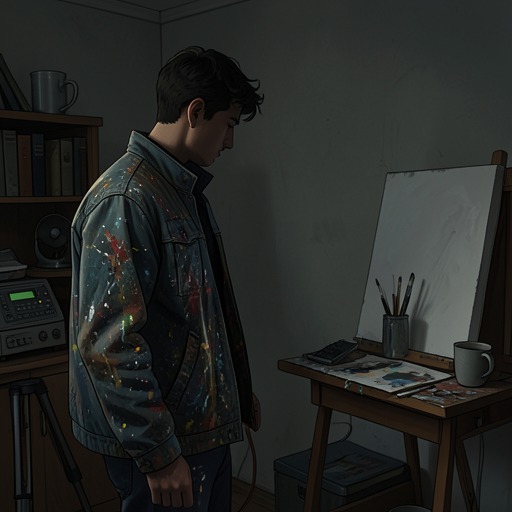
Donny’s artistic ambition was bound to his father long before the investigation joined him to Zero Tollrance. He painted his father’s portrait repeatedly, offering his best work to a man who rejected it again and again. After his father was gone, he tried to offer that work to the wider world, as though recognition from strangers might answer the refusal he had received at home. The repeated portraits make the art more than a clue to authorship: they preserve the son’s insistence on addressing a father who would not accept what he made.
That history gives patricide a clear emotional possibility, but not a proven answer. The investigator judged the cycle of artistic offering and rejection a plausible motive and concluded that Donny had certainly considered killing his father. Consideration, however, is not proof that he acted. Donny’s response to the direct accusation never resolved the distinction; the case leaves his guilt unsettled, with the repeated portrait and rejected gift showing the depth of the conflict but not determining its outcome.
The Investigators’ Speculative Reconstruction
Milo Sturgis revisited his earlier dismissal of the homeless man, reasoning that Donny might have retained enough intelligence to plan despite a possible mental breakdown. The investigation had no confirmation that Donny was the bearded vagrant associated with the art show, and the suggestion that he was a drug user remained conjecture. But his estrangement from Eldon Mate supplied a possible motive: Mate had abandoned and rejected him, and his growing fame might have sharpened Donny’s resentment. Milo imagined that Donny could have returned intending to reclaim a place in the family or its business; this was an investigative theory, not an established account of Donny’s purpose.
Milo also proposed a possible explanation for the meeting on Mulholland. Mate might have agreed to see his son while keeping him out of his apartment, perhaps backing the van in because he feared for his safety. That he went ahead with the meeting could, in Milo’s speculation, have reflected guilt or even a willingness to face danger. None of these possibilities was settled by Donny’s later silence. They frame the case’s central uncertainty: the estranged son had a plausible reason for anger, but the circumstances and outcome of any encounter with his father remained unconfirmed.