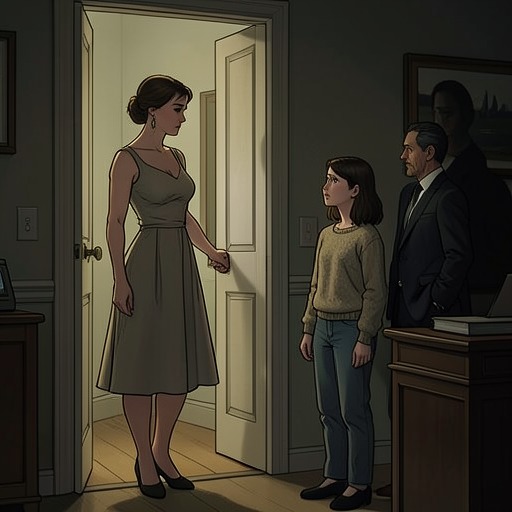
Doss–Manitow family relationship
Dr. DeathThe Doss–Manitow family relationship is a close but complicated neighborhood connection through which care and conflict pass between households. Joanne Doss tutored Becky Manitow, and Judy Manitow cared enough about Stacy Doss to encourage her father to seek professional help for her. At the same time, the families guarded their privacy, drifted apart, and interpreted the Dosses’ troubles differently. Their connection gives the family crisis a wider shape: what appears to be ordinary neighborly concern is entangled with hurt, obligation, and uncertainty about who has the right to explain another family’s suffering.
Neighborly Ties and Private Troubles
The families’ connection was not limited to living near one another. Joanne tutored Becky, linking the two households through education and care. Later, as Becky struggled at school and became increasingly thin, she entered therapy; she had also tried to act as a therapist for Stacy. The friendship between Becky and Stacy cooled, and Stacy said Becky had distanced herself and barely spoke to her. These changes left Alex Delaware considering whether the girls’ separation reflected a broader unease between the families, while the evidence did not settle the reason for it.
The relationship also contained signs of mutual concern. Judy and Bob Manitow were dealing with Becky’s problems, but they had also cared about Stacy enough to press Richard Doss to contact Alex Delaware. They chose Stacy’s therapist rather than Becky’s, a decision Alex understood as possibly reflecting their effort to keep the girls’ difficulties separate and protect the family’s privacy. He also considered that Becky herself might have chosen distance. The referral therefore expressed concern while preserving boundaries: the Manitows helped Stacy, but the reasons for their particular arrangement remained uncertain.
The Children and the Family Divide
Stacy’s account of her own household helps explain why contact with the Manitows mattered. She remembered Joanne as passive, and described Richard and Eric Doss as the family members who supplied most of its opinions. Stacy did not think they consciously excluded her; rather, she felt that her father and brother moved through conversation as a pair, leaving her struggling to join in. Her recollections of Joanne’s household role were similarly divided: Joanne cooked and performed her duties, but Stacy remembered little sign that the work mattered to her. A box of menus and magazine clippings suggested to Stacy that her mother had once taken interest in planning meals, even though that earlier self seemed distant from the mother she knew.
The neighboring families’ children also became linked through separate experiences of rejection. Eric had ended his relationship with Allison, and Alex wondered whether Bob’s anger about the Dosses might partly reflect the pain of seeing Becky’s heart broken. That was Alex’s hypothesis, not an established explanation. He also considered that Becky’s declining school performance after Joanne could no longer tutor her, her problems at school, and her withdrawal from Stacy might have contributed to the strain. The novel presents these connections as questions Alex weighs, not as proof that a single incident caused the girls’ distance or Bob’s response.
Joanne’s Illness and Competing Explanations
Joanne’s illness sharpened the divide between the households. Stacy recalled her mother’s decline as gradual and deeply disturbing, beginning when Stacy was sixteen. Richard and Eric blamed Eldon H. Mate for helping Joanne die, and Mate became a major subject of discussion in the Doss home. Stacy, however, questioned whether her mother’s death could be understood simply as something Mate had done to her: she believed Joanne had made a decision, even as she struggled to resolve what that meant.
Bob’s account was much more categorical. In a phone conversation with Alex, he described Joanne as psychologically unwell, interpreted her decline as depression and a choice to withdraw from life, and said she had refused psychiatric help. He believed Richard should have had her committed and that treatment might have kept her alive. His anger was forceful enough that Alex held the phone away from his ear. This position contrasts with Stacy’s moral uncertainty and with the family’s earlier emphasis on Mate. Bob offered a confident diagnosis, but Alex did not treat the anger itself as proof of what had motivated it.
Care, Resentment, and Uncertainty
After seeing Stacy’s pain, Alex had initially decided against contacting Judy, concerned that further inquiry might intrude on Stacy and entangle him more deeply in the families’ affairs. Bob’s angry dismissal of the Dosses changed the direction of his thinking. Alex reconsidered the connections among Joanne’s tutoring of Becky, Becky’s difficulties and estrangement from Stacy, Eric’s separation from Allison, and Bob’s resentment. He wondered whether Bob’s reaction reflected hurt over Becky, impatience with Joanne’s illness, discomfort with Richard and Joanne’s public affection, or frustration born of his own difficulty accepting psychological suffering. These were competing possibilities, not conclusions.
The families’ connection consequently rests on an uneasy overlap between care and judgment. Judy’s referral showed that the Manitows had made an effort to help Stacy, while Bob’s condemnation of Joanne revealed how sharply he differed from the Dosses’ account of her final illness. In the Doss household, the aftermath was also marked by a failure to forgive: Alex reflected that Richard had not forgiven Joanne and was paying for that refusal. The contrast does not resolve responsibility for Joanne’s death; it shows instead how the same suffering prompted different explanations, and how those explanations shaped the relationships around both families.