Double Murder of Alice Zoghbie and Roy Haiselden
Dr. DeathThe Double Murder of Alice Zoghbie and Roy Haiselden is revealed through a carefully arranged scene that turns two deaths into a message. The bodies are bound to a tree, their hands joined, and a picnic basket with champagne and small jars stands nearby. The tableau makes the discovery central not only to the investigation but also to the question of what the killer intends others to understand.
Discovery and Scene
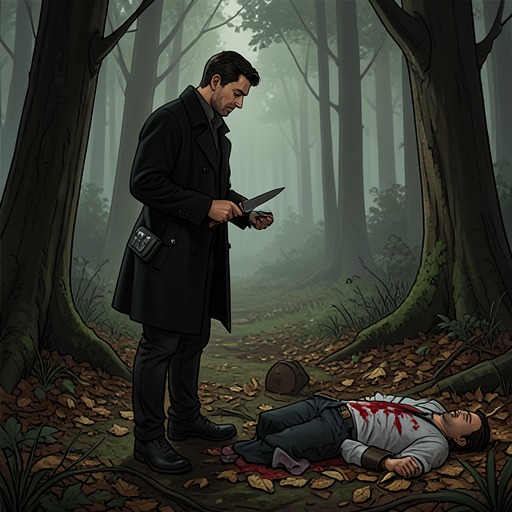
The bodies are found in a small, enclosed backyard, screened from neighboring houses by Italian cypress hedges and a tall fence. A broad sycamore shades the yard; beneath it, Alice Zoghbie and Roy Haiselden are propped against the trunk. Thick rope secures both at the chest and waist, making their placement appear deliberate rather than incidental.
Their identities emerge from the scene. Zoghbie’s white hair helps identify her, while Haiselden is recognizable by his distinctive toupee. Three triangular marks are visible on each victim’s abdomen. Their hands are clasped together, a stark gesture of connection within a scene otherwise arranged to display the violence done to them. Nearby, a wicker picnic basket, a bottle of champagne, and two small jars add another composed element. Together, these details make the backyard feel like a staged setting, though the scene alone does not establish what the objects signify.
Investigative Interpretation and Public Message
The discovery also changes the investigators’ understanding of the killings by linking them to the murder of Eldon Mate and to the struggle over who would control its meaning. Alex Delaware proposes that Michael Burke may have killed Alice Zoghbie and Roy Haiselden not only to attract attention, but to obtain records that could incriminate him. The murders thus acquire a possible practical purpose alongside their public, theatrical effect: silencing witnesses or removing evidence could serve the same criminal design as the display itself.
Alex Delaware treats the timing as suggestive but not conclusive. Michael Burke may have planned the murders earlier, he reasons, while Richard Doss’s arrest could have accelerated the plan: Burke would not want someone else credited with the killing of Eldon Mate. In that account, the double murder is bound to the investigation’s shifting public narrative, with the prospect of renewed press attention making the connection to the Mate case harder to contain. These are investigative hypotheses, not facts established by the crime scene.
Alex Delaware’s theory gives the victims’ deaths a further, deliberately unsettling meaning. He sees Michael Burke as trying to eliminate the old guard and announce himself as a new “Dr. Death,” combining the pursuit of attention with the removal of people and records that might threaten him. Yet the confidence of that reading is questioned: a colleague points out that Leimert Fusco misrepresented himself. The exchange leaves the proposed motive compelling but still open to scrutiny, preserving a distinction between the apparent message of the murders and proof of who sent it.
The Sequence of Recognition
The scene is filtered through Alex Delaware’s response: after seeing the two bodies, he struggles to steady himself, then shifts his attention to the objects set nearby. That movement matters to the investigation’s form. The victims are encountered first as people whose deaths demand explanation; only afterward does the basket, champagne bottle, and pair of small jars enter view as possible clues. The staged setting therefore works on two levels at once: it confronts the observer with an arrangement, but leaves the meaning of its separate elements to be tested rather than assumed.
This order also marks the difference between what the scene shows and what Alex later infers. The joined hands and the carefully placed objects make deliberate arrangement evident, but they do not, by themselves, establish the killer’s identity or explain the victims’ connection. Alex’s subsequent theory about Michael Burke gives the tableau a possible audience and purpose, while the challenge concerning Leimert Fusco’s misrepresentation cautions against treating a persuasive interpretation as proof. The murder scene remains both evidence and message, with its meaning dependent on an investigation that has not yet resolved who composed it or why.
The Tableau and Its Limits
The joined hands give the scene an image of intimacy, but they do not explain the relationship between Alice Zoghbie and Roy Haiselden or establish what either wanted. That uncertainty matters: the arrangement invites interpretation without making its meaning self-evident. Alex Delaware reads the killings as a calculated public announcement, yet the evidence supports a distinction between the scene’s deliberate composition and the motive assigned to it. The backyard can be understood as a message, while its precise authorship and intended meaning remain questions for the investigation.