Eldon Mate's doctor's bag
Dr. DeathEldon Mate's doctor's bag is an old leather medical kit found in Paul Ulrich's Malibu cabin after Ulrich is shot. The gold initials EHM on its clasp point toward Eldon Mate, while its surgical instruments, injection supplies, and lethal drugs give the otherwise quiet cabin a disturbing medical dimension. The bag matters not simply for what it contains: it is hidden from Tanya Stratton, then taken into police custody without anyone pursuing the initials, leaving a consequential clue visible but unexplained.
Discovery and Appearance
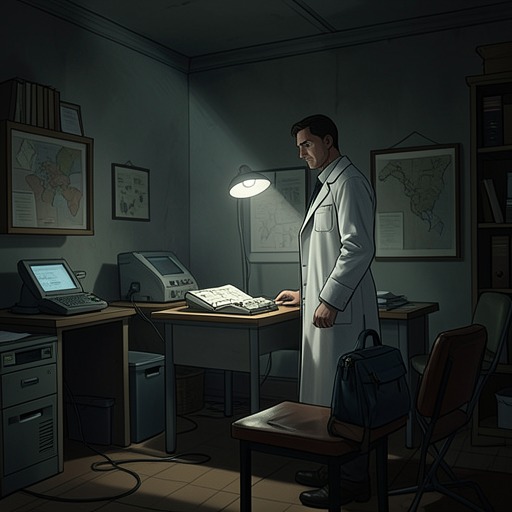
While the sheriffs assembled a search party, Milo Sturgis inspected the cabin. There were no obvious trophies and little else of interest. A more careful search later that day found nothing of evidentiary importance except the bag. Its appearance was specific and unassuming: old, burnished leather, with gold initials fastened over the clasp. The initials, EHM, made the object identifiable in a way the cabin itself was not. Amid the absence of conventional trophies, this marked personal possession became the search’s central discovery.
The bag was not presented as an item lying openly among Ulrich’s belongings. Tanya said she had never seen it. Alex Delaware believed her, reasoning that Ulrich had kept the bag concealed and would have produced it only when he was ready to use it. That distinction matters: the evidence does not show Tanya handling or knowing about the kit, and her lack of recognition separates her from the object’s apparent purpose. The bag therefore implies a hidden part of Ulrich’s life without, by itself, explaining when he acquired it or what he had done with it.
Contents and Medical Implications
Inside were scalpels, scissors, and other shiny instruments, along with a coil of intravenous tubing, sterile hollow needles in several gauges, rolls of gauze, disposable hypodermic injectors, and small ampules bearing fine-print labels. Two substances were singled out by name: thiopental and potassium chloride. This inventory turns the bag from a suggestive personal artifact into a functional medical kit. Its contents are suited to invasive procedures and drug administration, not merely to routine examination, though the discovery alone does not establish that any particular item was used in the cabin.
The named drugs sharpen the implication without settling it. Their presence raises the possibility of deliberate, medically mediated harm or death, but the narrative does not report a procedure performed with them there. Nor does the account establish how long the drugs had been in the bag, who placed them there, or whether Ulrich had used them. The distinction between what the contents make plausible and what the search proves is essential: the bag offers physical evidence of capacity and preparation, not a complete account of an act.
A Clue with an Unfinished Chain
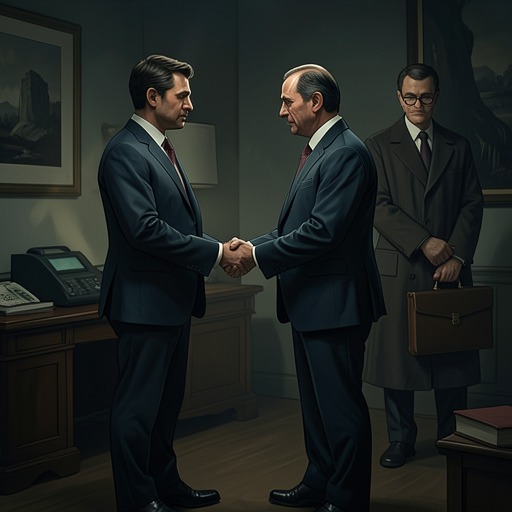
The initials invite the connection to Eldon Mate, but that connection is not developed through a formal identification at the scene. A sheriff’s detective took the bag into custody and did not ask what EHM stood for. Milo Sturgis knew the significance but did not volunteer it. The object thus passes into official hands while its most conspicuous identifying mark remains unspoken. Its evidentiary importance depends on knowledge that is present in the investigation but not shared with the detective who takes custody of it.
That moment gives the bag a double status. It is a physical object collected from Ulrich’s cabin, yet its meaning is not secured by collection alone. The detective’s failure to ask about the initials leaves the clue dependent on the investigators’ interpretation rather than making it part of the immediate record. The narrative emphasizes this gap between possession and understanding: police have the bag, but the link suggested by its clasp is not voiced as they prepare to leave the cabin.
Medical Uncertainty and Narrative Significance
The kit’s significance resonates with the account of Joanne Doss’s illness, where medical objects and procedures had accumulated without an explanation. Richard Doss described doctors ordering extensive tests, including scans and two lumbar punctures, while a later review of the records showed that fifteen doctors had tried to determine the cause of Joanne’s suffering. The results were repeatedly negative. In that history, medical intervention produces procedures and records but no settled diagnosis. The bag presents the opposite kind of unease: not a search for what is wrong, but equipment and drugs capable of acting directly on a body.
That contrast does not prove that the bag was used in Joanne’s case. Rather, it places the object within a story where medicine carries competing meanings: investigation, care, and the power to intervene. Its contents make the latter possibility concrete, while its hidden location and unexplained provenance keep the evidence incomplete. The bag is consequently both a practical tool and a narrative hinge—a marked possession that points toward Mate, exposes a concealed medical dimension to Ulrich’s cabin, and leaves the reader to distinguish suspicion from what the search actually establishes.