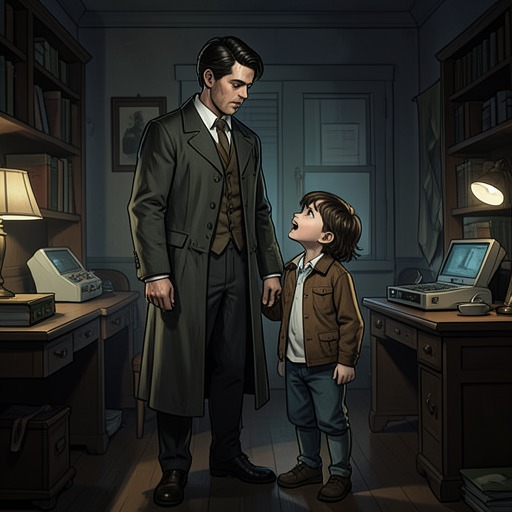
Eric Doss–Stacy Doss sibling relationship
Dr. DeathEric Doss and Stacy Doss are siblings bound by family loyalty but divided by grief, anger, and different ways of responding to pressure. Their relationship is marked by an asymmetry: Stacy often holds her opinions back and tries to see beneath Eric’s composed exterior, while Eric treats her vulnerability as weakness and believes she resents his presence. Their mother’s illness and death deepen that distance, leaving important feelings largely unspoken.
Place in the Family
Stacy describes a household in which her father and Eric seemed to command the conversation. She answers that the two of them had the opinions in the family, then admits that she has opinions of her own but tends to keep them to herself. Her description of joining their conversations as like leaping onto a fast-moving train conveys more than a difference in conversational style: she experiences the father-and-son alliance as already in motion, difficult and potentially risky to enter.
Stacy does not describe this exclusion as deliberate. She says neither Eric nor their father consciously shuts her out; rather, the pattern has grown between them. That distinction matters to her account of the siblings. She does not cast Eric simply as an enemy, but as one half of a close, forceful pair whose momentum leaves her with less room to speak. Her tendency to keep her views private helps explain how the family arrangement can persist without an explicit confrontation.
Different Readings of Their Bond
Eric’s interpretation is more bitter. He tells Alex Delaware that Stacy basically hates him, regards his departure as the best thing that happened to her, and is likely to come to Stanford only because their father leans on her. He predicts that she will initially comply, then want to spend time with him and begin hating him again. His forecast turns their relationship into a recurring cycle of proximity and resentment: distance seems to ease the conflict, while renewed contact threatens to restore it.
Stacy’s account is less absolute. She does not say that she hates Eric; instead, she acknowledges that he yells at her and describes the imbalance between them without presenting it as a settled estrangement. The gap between his certainty and her qualified account suggests that the siblings do not share a common explanation for their friction. Eric anticipates rejection and treats it as nearly inevitable; Stacy recognizes hurtful behavior but also continues to interpret what lies behind it.
Their Mother’s Illness and Death
Stacy believes Eric suffered more than she did during their mother’s illness, despite appearing to their father to be the more resilient sibling. She recalls him sitting with their mother and playing cards, acting as though nothing was seriously wrong and insisting, in effect, on hope rather than acknowledging the family’s fear. Stacy says that she had already done much of her crying by the time their mother died, whereas Eric continued to behave as though their mother would recover. In her view, his achievement-oriented, composed surface concealed grief he had never fully faced.
Their disagreement about how Stacy should grieve brings that difference into the open. A few days before their mother died, Eric found Stacy crying. She recalls that he shouted at her for dwelling on her own feelings and argued that the family needed to concentrate on their mother and stay positive. His response can be read as an attempt to protect their mother’s emotional world, but it also denies Stacy space to express her sadness. The episode shows care and control entangled: Eric insists that her attention belong elsewhere, while Stacy remembers the outburst as evidence of how little room he allowed her distress.
Stacy also links Eric’s later disappearance and missed academic obligation to his difficulty coping with their mother’s death, though she initially offers a more ordinary explanation. She thinks he may have gone walking in the mountains because he did some of his best thinking there, then admits that he is having a genuinely hard time. She says they have not spoken for weeks, though they sometimes exchange emails, and suspects that hearing about Eldon H. Mate may have brought their mother’s death back to him. Alex Delaware likewise frames Eric’s anger in connection with having helped their mother die and being unable to discuss it. The siblings’ silence is therefore not an absence of shared history, but part of the burden each handles differently.
Loyalty, Disclosure, and Distance
The siblings’ account of the family dog, Helen, offers another view of their intimacy. Eric had cared for the aging dog, who lost the use of her legs; he built her a small wagon and pulled her in it. After Helen died, he spent the night away from home. Stacy had understood that he put the dog out of her misery, but says he had never spoken to her about it before. When he finally raised it, he laughed. Stacy defends the act as humane because Helen was sick, even as the disclosure unsettles her: she knew what had happened, but had not previously heard Eric say it himself.
That exchange contrasts with the siblings’ silence about their mother. In both cases, Stacy tries to make sense of Eric’s actions through compassion, but the dog’s death becomes something he can eventually discuss while their mother’s death remains entangled with anger and unspoken responsibility. Stacy’s defense does not erase the strain between them; it shows that her concern persists even when Eric’s behavior frightens or confuses her. Their relationship consequently remains unresolved: she sees the pain beneath his performance, while he expects her to resent him, and neither account fully closes the distance between them.