Guillerma Salcido Mate
Dr. DeathGuillerma Salcido Mate is Eldon Mate’s estranged wife and Donny Mate’s mother. She enters the investigation after Eldon’s death, asserting that she remains his widow despite their long separation. Her account makes a remote, decades-old marriage materially present: a faded marriage license, an interrupted pension payment, and a son whose resemblance to his father did not bring him acceptance. Guillerma’s faith and insistence on her own dignity shape how she explains both the marriage and her reason for coming to Los Angeles.
Identity and Background
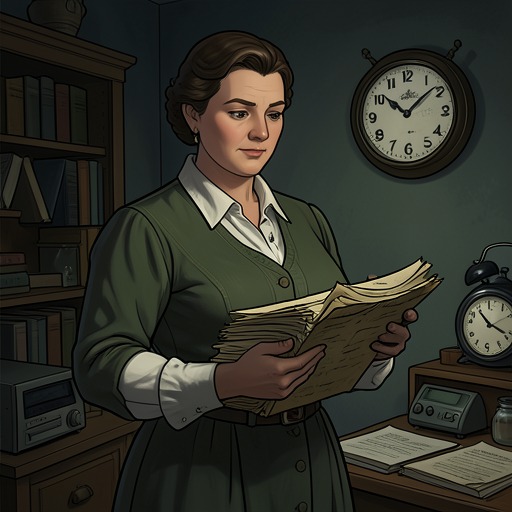
Guillerma identifies herself as Eldon’s wife, and then as his widow, even while acknowledging that she no longer uses his name. She backs that claim with a marriage license issued in San Diego twenty-seven years earlier. Its grubby folds and faded photocopied lettering make the document look worn by time, but it records the marriage of Guillerma Salcido de Vega and Eldon Howard Mate. When she produces it, she is not simply offering a recollection: she is establishing a documented relationship that matters to her after his death.
Her present life is in Oakland, where she works caring for elderly people at a convalescent home. She describes herself as busy and accustomed to working, correcting the implication that Eldon’s regular payments had been enough to support her. The details place her outside the world of Eldon’s medical career and Los Angeles life, but not outside its consequences: the pension he sent each month had become part of her finances, and his death abruptly made its continuation uncertain.
Marriage, Separation, and Donny
Guillerma says she had not seen Eldon for twenty-five years and four months, since shortly after their son was born. She remembers that Eldon told her early in the relationship that he did not like children. She became pregnant anyway, expecting that having a child of his own might change his mind. It did not. Eldon left her after Donny’s birth, a decision that set the terms of the family’s long separation.
Eldon’s rejection extended, in Guillerma’s account, to Donny himself. She says their son was light-complexioned like his father and looked strikingly like him, yet Eldon still did not like the boy. The resemblance, which might ordinarily suggest connection, instead sharpens the account’s central contradiction: Donny looked like the father who would not accept him. Later, when Milo Sturgis studies Donny’s booking photograph, the likeness is again emphasized; the image confirms the physical resemblance without undoing the emotional absence Guillerma described.
She distinguishes the monthly money from genuine support. Eldon sent five hundred dollars by money order, every month and on time, but she says she always worked and rejects the idea that this amounted to supporting her. After his death, the payment due five days earlier had not arrived. She expects the Army Reserve pension to be redirected to her and asks how to contact the relevant office. That practical question shows the immediate consequence of widowhood for her: alongside grief or memory, there is a missing payment and an unfamiliar system to navigate.
The Journey to Los Angeles
Guillerma hesitates before deciding to come. She had not known whether she should make the trip after hearing of Eldon’s death, and she has never been to the place where he lived, although she says she has been to Los Angeles. She takes a Greyhound from Oakland, then gets lost on a city bus among streets dug up for construction. Her arrival is thus not a confident return to a shared home but a difficult journey into a city and a life from which she had long been absent.
The trip is also purposeful. Guillerma wants to know what is happening now that Eldon is gone and to determine how the pension will reach her. She brings documents, explains the history of their marriage, and asks for concrete help. Her claim to be his widow is both personal and administrative: it asserts a bond that endured in name and financial arrangement even though the marriage had ceased to function as a shared life decades earlier. Her suggestion that the disorder and disorientation of the visit might be a sign gives the journey a spiritual frame, without resolving what she believes it signifies.
Faith, Race, and Dignity
Guillerma anticipates that Milo Sturgis may be judging her because Eldon was a doctor and she is a brown woman. She recalls that, while walking Donny in a stroller, people mistook her for the maid. The detail joins race and class to the everyday visibility of family life: a mother beside a child who resembles his light-complexioned father was still read by strangers as hired help. She says such assumptions no longer trouble her, presenting that composure as something grounded in faith rather than in social recognition.
Her Christian belief also sets a moral limit on what she will seek from Eldon’s death. She says she would not claim money connected to his killing because she believes Jesus would weep over such a choice. She knows others may regard her as excessively religious, but describes faith as a source of spiritual riches. Her lighthearted acknowledgment that a good meal is welcome keeps that conviction from becoming a claim of material indifference: she needs the pension and asks about it, yet distinguishes ordinary financial need from profiting from a killing.
Donny and the Investigation
Guillerma’s account helps Alex Delaware and Milo Sturgis place Donny within the history surrounding Eldon’s death. When they discuss the timing of an art show and Donny’s later imprisonment, Alex recalls that Donny’s mother had said he was living on the street by then. The investigators consider whether Donny’s paintings might have depicted his father being dissected and whether the work could have been an attempt to win Eldon’s attention, followed by a possible effort to enact the image. These remain hypotheses, not established facts. The discussion also notes that Guillerma had never mentioned Donny’s artistic talent and did not want to talk about him, leaving the investigators with a significant silence as well as her earlier account of his rejection.
Guillerma’s place in the story is therefore not that of a witness who solves the crime. Her evidence establishes the history of the marriage, the abandonment after Donny’s birth, the recurring pension, and the continuing force of her claim to be Eldon’s widow. It also gives the investigation a measure against which to read its theories about Donny: the resemblance to Eldon is visible, but their relationship was not a simple inheritance of affection or belonging. The available narrative does not disclose what becomes of Guillerma after her visit; it leaves her at the point where a long-absent wife has come to claim recognition and practical answers.