Happy Trails Motel
Dr. DeathHappy Trails Motel, a small roadside establishment in Lancaster, is where Joanne Doss was found dead in circumstances initially attributed to Eldon Mate’s assisted-death practice. Its unremarkable rooms and exposed location make it more than a backdrop: the motel’s distance from Los Angeles, its mismatch with Mate’s established methods, and Joanne’s history with Richard Doss turn the choice of place into a central clue—and an unanswered question.
Setting and Physical Layout
The motel stood on the outskirts of Lancaster, in the high desert north of Los Angeles. The drive from the city ran through several freeways and into the Antelope Valley; after the foothills, the landscape gave way to stretches of dirt and gravel. The journey was described as just over an hour at the speed limit, and Joanne made it late at night, when the view outside the car would have been almost entirely dark. The distance and darkness give the motel a sense of separation without making it remote from the roads and businesses of the area.
The approach was specific and ordinary: a turn onto Avenue J, then about half a mile past Tenth Street West. Vacant lots and modest businesses lined the area, including a battery repair shop, a clearance furniture store, a janitorial supply business, and a quick haircut shop. Across the street from the motel stood a new-looking strip mall, some storefronts still empty and a prominent sign advertising space for lease. Alex Delaware wondered whether it was one of Richard Doss’s development projects, but the connection remained a possibility, not an established fact. The motel’s visibility from across the street nonetheless makes the site’s position significant to the later theory that Joanne’s choice of Lancaster carried a personal message.
The building itself was a single-story, U-shaped group of roughly a dozen rooms, with the front office at the left end of the U. Its neon vacancy sign was dark. The rooms had red doors; only two had cars parked in front when Delaware visited. Blue-gray walls and a low roof covered in white gravel gave the place a plain, worn appearance. At the rear, coils of barbed wire ran along a grape-stake fence separating the motel from a trailer park. An alley followed the building’s west side. The wire thus marked a boundary between the motel and its neighboring homes, while also adding a stark, defensive feature to an otherwise modest property.
Joanne Doss’s Death and the First Account
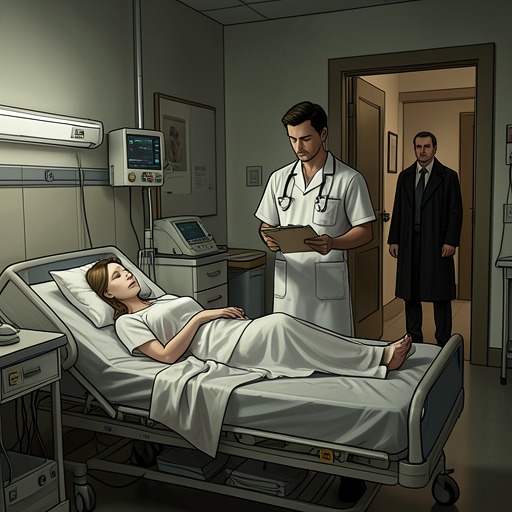
A maid entering to clean a room at Happy Trails Motel discovered Joanne’s fully clothed body. The first newspaper report identified her as a 43-year-old Pacific Palisades woman and said that blood tests showed two drugs associated with Eldon Mate’s assisted-death work. Puncture marks suggested intravenous injection, while the absence of forced entry or a struggle led investigators to suspect an assisted suicide. The report noted that Mate’s van had not been seen in the area. These details offered a plausible attribution, but not proof that Mate had been present.
The lead investigator described a scene that appeared peaceful: classical music was playing on the radio, and Joanne had eaten a final meal. He also said that Mate encouraged his patients to listen to music. The report placed the death within the context of Mate’s previous cases, calling Joanne the forty-eighth person whose death he had facilitated. Yet the story received no follow-up, and there was not even an obituary in the paper. Mate did not claim credit. The sparse coverage left the motel as the main public frame for the death while providing little independent confirmation of what had happened there.
A Location That Did Not Fit the Pattern
Delaware’s research made the motel itself a discrepancy. Mate had shifted from using motels to using vehicles, and Joanne’s death came after that change. His last known earlier motel case had been two years before hers, at the Cowboy Inn near Fresno, where another patient with Lou Gehrig’s disease had died. In the intervening cases, Mate had made public statements and attracted press attention. In Joanne’s case, there was no reported sighting of his van, no public claim, and no evident reason for him to return to a rented room. Delaware concluded that the motel death did not fit the pattern and considered the possibility that Mate had not been responsible.
That uncertainty sharpened when Delaware questioned people connected to the motel. The owner said he had not been working the night Joanne died; his son had been covering for him, and had since returned to Florida. According to the owner, Joanne checked herself in, paid by credit card, and appeared unsteady. The police had taken the receipt. This account made a self-directed arrival possible, but did not explain how she reached Lancaster in her physical condition or what happened after she entered the room.
Maribel, the maid who spoke with Delaware, said that two people went into the room after she arrived, around midnight. She had not seen them until the discovery of the body. Her recollection therefore complicated the owner’s account of Joanne checking herself in alone: the motel records and the reported arrival did not settle who accompanied her later. The surviving information establishes neither the identities of those two people nor the precise sequence inside the room. The motel’s routine staffing and limited observations leave the crucial interval largely unobserved.
Personal Meaning and Unresolved Questions
In a conversation with Delaware, Richard revealed that Lancaster had been part of his working life. He had spent long periods there on development projects, sometimes traveling by helicopter to Palmdale and driving the rest of the way. He had repeatedly asked Joanne to visit him, inviting her to lunch and describing the desert as capable of beauty; she always refused, citing the distance, traffic, heat, dryness, or busyness. Richard broke down when he recognized the reversal: Joanne had ended up in the very place she had always declined to visit. His grief did not establish why she went there, but it gave Lancaster a private meaning that the newspaper account could not convey.
Delaware considered whether Joanne had chosen the motel and the journey to express hatred toward Richard, prolonging his pain with a deliberate message. He also considered other possibilities, including that Mate might have returned to a motel at Joanne’s request and kept the death quiet because she wanted discretion. These remained hypotheses rather than resolved findings. The route and location supported the suspicion that Lancaster mattered, while the evidence of Joanne’s deteriorating condition made the mechanics of her journey difficult to explain. Happy Trails Motel consequently stands at the intersection of a public attribution and a private mystery: the drugs and puncture marks suggested Mate’s involvement, but the missing van, the changed method, the self-check-in, the second person, and Richard’s account all kept the circumstances of Joanne’s death unsettled.