Humanitron
Dr. DeathThe Humanitron is Eldon Mate’s improvised death apparatus, the machine through which he provided what he called a silent passage for his chosen travelers. It is central to the story’s shift from the public image of Mate as an assisted-death provider to the investigation of his murder: the device appears to explain how he died, but its presence proves to be a display concealing the violence that actually killed him.
Design and operation
Milo Sturgis describes the Humanitron as far less sophisticated than its reputation suggests: a wobbling assembly of mismatched screws and spare parts, more like a failed junior-high science project than high technology. Its roughness does not mean it was ineffective. Sturgis says it had been used fifty times, while later reporting identifies Mate as having facilitated forty-eight deaths by the time of Joanne Doss’s death and records two additional travelers before Mate himself died. The contrast between its makeshift appearance and its repeated use gives the machine its unsettling character: it is not an elaborate medical device, but a crude mechanism around which Mate built a consequential practice.
A staged death
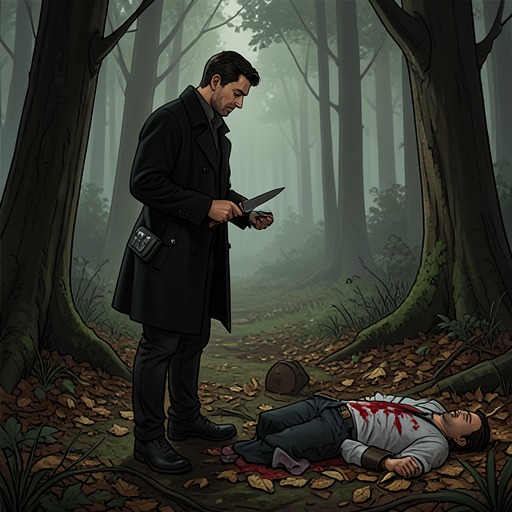
The Humanitron’s most consequential appearance is at the scene of Eldon Mate’s own murder, where its familiar procedure initially suggests that he died by the method he had used on others. He was connected to an intravenous bottle of thiopental, the tranquilizer he used, and another containing potassium chloride, intended to stop the heart. His thumb rested against the small trip-wire mechanism that would start the flow. The apparatus seemed to arrange the scene as a final assisted death, with Mate positioned to activate the device himself.
The coroner’s findings overturn that apparent explanation. Although the potassium chloride had begun to take effect, the machine was not what killed Mate: a blow to the head fractured his skull and caused a subdural hematoma, and his body had then been mutilated, with death attributed to extensive blood loss. The Humanitron was therefore part of the staging, not the lethal cause. Its familiar equipment offered a false account of the death while the injuries disclosed a violent assault and deliberate mutilation.
The physical arrangement also suggests how the killer prepared the van. Sheets of thick cardboard had been cut to fit the driver’s-seat windows and were streaked with arterial blood, evidence that they had been used during the cutting. Milo Sturgis reasons that Mate likely brought the cardboard as a homemade substitute for curtains, along with the mattress on which he lay, expecting to conduct another assisted death rather than become its subject. The killer could use the coverings to conceal the work inside the van; their removal afterward left the scene visible, turning the murder into a display. That reconstruction is an inference, but it links the device’s ordinary role in Mate’s practice to the killer’s calculated use of the setting.
Photographs of the van preserve the contrast between the machine’s grim function and its frail construction. Behind Mate’s body, the Humanitron appears as a few bowed metal slats, with two blood-washed glass IV bottles dangling from its top frame. In death-scene images, the apparatus does not look like a powerful instrument capable of controlling life so much as a delicate, improvised prop. The photographs make visible what the staged arrangement tries to obscure: the machine can suggest a practiced procedure, but it cannot make Mate’s death voluntary.
Publicity, Silence, and the Machine’s Meaning
The Humanitron also belongs to the public story Eldon Mate made of his work. By the time Joanne Doss died, Mate had facilitated forty-eight deaths; afterward he helped two more travelers before his own death. The cases did not all receive the same attention. Mate informed the press about Maria Quillen, traveler forty-seven, whose body was left at the County Morgue in a pink comforter with his business card tucked into it. Alberta Jo Johnson, number forty-nine, and Brenton Spear, number fifty, were also associated with rented-van deaths and public statements by Mate. The machine’s record was therefore not only a succession of private procedures: Mate sometimes turned the deaths into publicly narrated episodes, keeping himself and his practice in view.
Joanne Doss’s case breaks that pattern. She died in a motel room, not in the van, and Mate made no attempt to claim credit; there was no follow-up report about her final night. Her death, later understood in the context of the machine’s other uses, does not fit the public sequence of van, press attention, and Mate’s statement. That silence makes the Humanitron more than a means of death: it becomes a measure of what Mate chose to disclose, and of the gaps that force the investigation to question the apparent account of his work.
The language of bodily artistry further complicates the device’s clinical appearance. When considering who might have mutilated Eldon Mate, the narrative turns to Donny Salcido Mate, who called himself the Rembrandt of the flesh, and to the possibility that his art of carving might be bound up with hatred of his father and a wish to resemble him. The Humanitron’s orderly medical purpose sits uneasily beside that imagined carving: one apparatus promises a controlled passage out of life, while the body becomes a surface on which violence can be made visible. The contrast sharpens the device’s double meaning. It stands for Mate’s claimed mercy, but also for the theatrical, bodily violence that the staged scene uses to disguise his murder.
The Language of Passage
The name Humanitron lends a manufactured, almost institutional sound to a device made from spare parts, while Mate’s phrase for its purpose, “Silent passage for Happy Travelers,” recasts death as travel. The euphemism softens the violence of the act and assigns those who use the machine a role in a journey; the clinical bottles and trip-wire give that language a procedure to attach to. But Mate’s own death exposes the distance between the promise of a controlled passage and the reality of the van: the machine can frame a death as orderly and voluntary even when the body bears evidence of murder. Its name and ritual therefore function as more than labels for an apparatus. They are part of the story Mate tells about his work, a story the forensic facts can contradict.