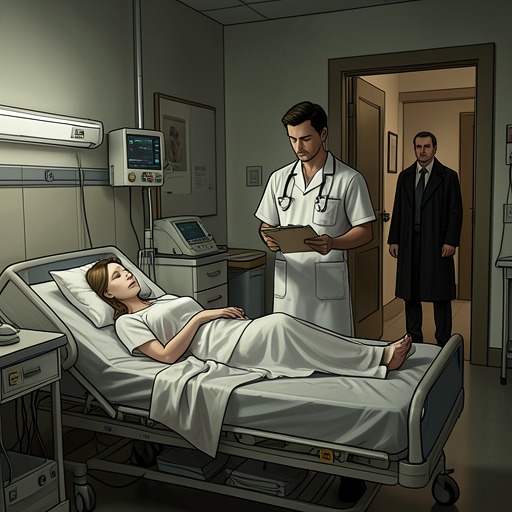
Joanne Doss found dead at Happy Trails Motel
Dr. DeathJoanne Doss’s death at the Happy Trails Motel is presented first as a likely assisted suicide and then as a case that resists that explanation. The evidence points toward Eldon Mate’s methods, yet the missing signs of his usual involvement leave the death uncertain. As Alex Delaware searches for an account of Joanne’s final night, details of her marriage and the family’s fear about Eric deepen the question of who was responsible.
Discovery and Initial Findings
A report attributed to Dr. Mate’s Machine and datelined Lancaster describes a motel maid finding Joanne’s fully clothed body while entering a room to clean it early in the morning. Joanne, 43, was from Pacific Palisades; the report identifies her as the wife of a businessman and the mother of two. There were no reported sightings of Eldon Mate’s van nearby, but the first physical findings seemed to point toward his involvement.
Toxicological analysis detected two drugs that the report said Eldon Mate used consistently. Puncture marks suggested that the drugs had been injected intravenously, while the absence of forced entry or a struggle gave investigators no immediate indication of an assault. Those details led sheriff’s detectives to suspect assisted suicide. The finding was an inference from the scene and the drugs, however, not a confirmed account of who administered them or how Joanne came to be in the room.
The lead investigator, David Graham, described the scene as peaceful: classical music was playing on the radio, and Joanne had eaten a last meal. He understood that Eldon Mate encouraged patients to listen to music. Together, the music, meal, and apparent lack of struggle made the room legible as a planned death, but they did not establish who had arranged it. The quiet scene offered an impression of deliberateness without resolving the central question of agency.
The Pattern That Does Not Fit
The report said Joanne’s health had been deteriorating and that she would be the forty-eighth person whose death Eldon Mate had facilitated. It also noted his success in avoiding conviction and his most recent indictment, concluding that criminal charges were unlikely. Yet the public record stopped there: Alex found no follow-up and not even an obituary. Eldon Mate did not claim credit, and Alex could find no additional account of Joanne’s final night in the available data.
That silence mattered because Alex had seen a pattern in Eldon Mate’s other cases. Three patients with definitive diagnoses had been associated with three van trips and three public statements; Alex believed Eldon Mate sought press attention. Joanne’s death offered neither a reported van sighting nor a statement. An earlier motel case, involving Lou Gehrig’s disease patient Reynolds Dobson at the Cowboy Inn near Fresno, had occurred two years before. Against that history, the motel setting alone could not explain why Joanne’s death appeared both consistent with Eldon Mate’s work and conspicuously unlike its public pattern.
Alex’s conclusion was not that the initial account had been disproved, but that it failed to settle the matter. The drugs and injection marks supported the investigators’ suspicion; the missing publicity and van sighting weakened the expected pattern of attribution. The gap between a plausible method and an absent public claim turned the sparse report into a problem of interpretation. By the forty-eighth death, the lack of attention itself became part of what needed explaining.
Lancaster in Richard’s Account
Richard Doss’s recollection gave Lancaster a personal history absent from the report. He said Joanne had never gone there before that night, although he had spent many hours in the area working on projects, building shopping centers, and traveling from Los Angeles by helicopter to Palmdale before driving the rest of the way. He remembered asking, even begging, her to visit: he wanted her to see what they were accomplishing, have lunch, and share the inexpensive, casual meals they had enjoyed when they were dating. She always refused, citing the distance, traffic, dryness, heat, or busyness.
Richard returned to the contrast that she had resisted all those invitations and nevertheless ended up in Lancaster. His account did not identify how she arrived at the motel or establish that he knew the circumstances of her death. Instead, it attached a history of disappointed invitations to the place where she died. His abrupt, bitter laughter gave way to a suppressed sob; in that moment, Lancaster was no longer just a location in a police report, but the setting of a painful reversal in the couple’s shared history.
Competing Possibilities and Family Fear
The question of how Joanne reached the motel remained open. Alex considered whether she could have managed the death herself: she was a microbiologist with access to lethal chemicals and the skills to inject herself. But her physical condition made it difficult for him to imagine her driving to Lancaster alone. He also considered the possibility that Eldon Mate had been there after all, perhaps returning to rented rooms at Joanne’s request and keeping the death private for the sake of the children. These remained possibilities, not established facts; even Alex recognized that the proposed reason for secrecy did not sit comfortably with the conspicuous choice of a motel suicide.
A further source of fear arose when Alex connected Eric’s account of killing the family dog, Helen, with his talk about putting people out of their misery. Alex raised the possibility that, if Eric could kill Helen, he might have done something similar to a person, including his mother. Stacy first denied the suggestion and then confirmed that Eric had hinted at it without directly confessing. She recalled his description of Helen looking up at him and licking his face before he struck her once with a rock, and his insistence that the dog had been sick and that ending her suffering was necessary. This disclosure established that Eric had spoken in ways that frightened Stacy; it did not prove that he caused Joanne’s death. The report’s apparent assisted-suicide scenario thus remains unsettled, caught between evidence consistent with Eldon Mate’s practice, a husband’s grief-stricken recollection, and a daughter’s account of her brother’s disturbing hints.