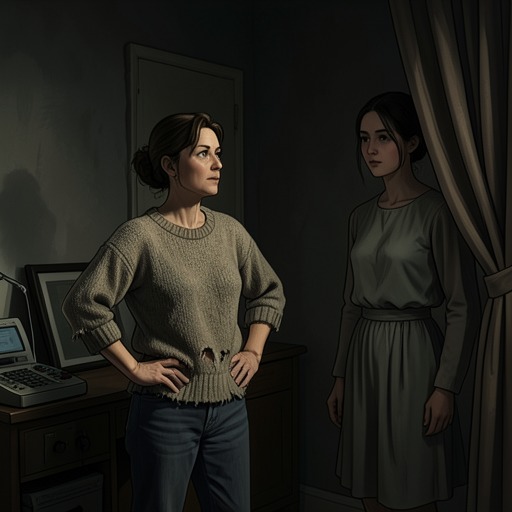
Joanne Doss–Stacy Doss mother–daughter relationship
Dr. DeathJoanne Doss and Stacy Doss had a mother–daughter relationship that Stacy described as outwardly proper but inwardly difficult to reach. Joanne performed the expected acts of motherhood, and Stacy did not deny that she had been a good mother; yet Stacy remembered little felt connection, even from the years before Joanne became ill. After Joanne died with Eldon Mate’s involvement, that old distance became part of the loss: Stacy had received no warning, no goodbye, and no clear explanation of her mother’s wish to leave.
A Mother Present, Yet Difficult to Reach
Stacy resisted reducing her childhood to a simple accusation. She said that Joanne had done the right things and was not claiming that her mother had failed at every practical duty. She could imagine that they must have had fun when Stacy was young and Joanne was healthy, but she could not remember it. That gap between the possibility of shared happiness and the absence of a vivid memory helps define the relationship as Stacy understood it: not a story of an openly hostile mother, but of intimacy that never became secure enough to remain accessible in memory.
Her strongest image for Joanne was not a concrete failing but an inability to get hold of her. Stacy described her mother as seeming made of air, a presence that could not be grasped. The metaphor gives emotional shape to a relationship whose difficulty was hard for Stacy to put into words. Joanne could be physically there and carry out the recognized duties of a mother while remaining, to her daughter, elusive. Stacy’s account therefore distinguishes competent care from felt closeness; the former did not resolve the latter.
The Morning Without a Goodbye
The distance persisted even at the end. On the morning before Stacy went to school, Joanne called her in to say hello and told her she looked pretty. Stacy remembered the exchange as ordinary: her mother sometimes said such things, and nothing in Joanne’s appearance or manner seemed different. There was no sign Stacy could recognize as a farewell. She had no warning that Joanne was about to die, and Joanne never told her what she intended or said goodbye.
That apparently routine moment became painful in retrospect precisely because it had not announced itself as exceptional. Stacy could recall a small expression of maternal attention, but not a disclosure or an opportunity to respond. The compliment establishes that some tenderness was present; it does not supply the explanation she wanted. Stacy was left to hold both facts together: Joanne had reached out to her that morning, and she had already made a decision that Stacy did not know about.
Reading Joanne’s Death as a Decision
Stacy said she was shocked when she first heard the news of what Joanne had done with Eldon Mate. After the shock passed, however, she felt the act made sense in light of what she understood as her mother’s passivity and prior self-erasure. In Stacy’s account, Joanne had already withdrawn from herself before Mate became involved. This was not comfort or approval; it was an attempt to make the death intelligible by locating the choice in Joanne rather than treating it as something Mate had imposed on her.
That distinction separated Stacy’s judgment from the explanation favored by her father and Eric Doss. They blamed Mate and made him the central villain in the family’s discussions. Stacy acknowledged the force of that account but said it did not match what she believed to be true: Joanne had decided to die. Mate, in her view, was the means through which that decision was carried out, not its original cause. Her reasoning made the mother’s agency central without making the decision less devastating to the family she left behind.
Family Silence and Stacy’s Unresolved Grief
When Stacy spoke with Alex Delaware, she admitted that earlier conversations had not conveyed how deeply the family failed to communicate. She described them as living together and existing together without connecting. She also said this estrangement had begun before Joanne became sick, challenging any account that would treat illness alone as the source of their distance. Joanne’s death intensified an older disconnection rather than creating it from nothing.
Stacy’s grief consequently involved more than the fact of her mother’s death. She struggled with the decision itself, with the family’s competing explanations, and with the absence of a goodbye that might have let her understand Joanne’s wishes directly. When she pressed Alex Delaware for an answer rather than a therapeutic reflection, he agreed that ultimately the decision had been Joanne’s. That exchange recognized Stacy’s interpretation without erasing the hurt beneath it. Her crossed arms and shoulders drawn forward, as though bound by straitjacket straps, gave the conversation a physical sign of how constricted the unresolved conflict remained: she could name the choice, but naming it could not restore the connection or provide the farewell she had never received.