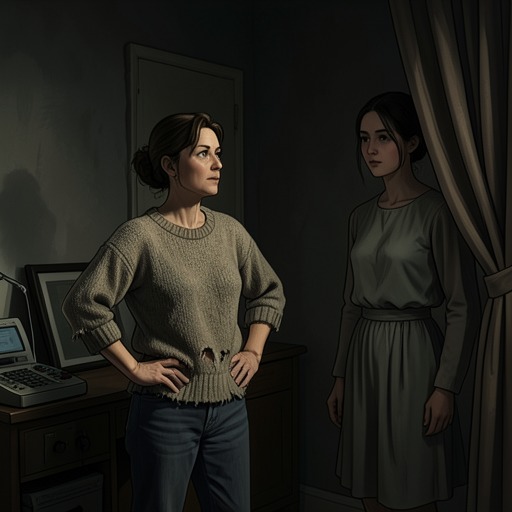
Joanne Doss’s unexplained illness and decline
Dr. DeathJoanne Doss’s unexplained illness and decline form one of the novel’s central family mysteries: her body changes dramatically, yet repeated medical investigation yields no cause, leaving those closest to her to argue over whether she was physically ill, psychologically withdrawing, or making a choice they could not accept. The uncertainty is consequential in itself. It shapes Richard Doss’s account of their marriage, Stacy Doss’s memories of her mother, and the family’s bitter disagreement over the help Joanne received from Eldon Mate.
Symptoms and the Search for a Cause
Richard Doss describes the illness as beginning with fatigue in a woman who had once been energetic and athletic. Joint pain, headaches, skin sensitivity, and exhaustion followed. The change was gradual enough that he first suspected a flu or passing virus and tried to give Joanne room to rest. By the time he understood that something more serious might be happening, he felt she had become difficult to reach, as if withdrawn from ordinary life.
The family pursued extensive testing. Richard recalls visits to dozens of doctors and lists CAT scans, MRIs, serologic and toxicologic tests, and two lumbar punctures; he later learned that a neurologist had performed the punctures while searching without a clear lead. Richard also considered whether Joanne’s work with plants or laboratory materials might have exposed her to something harmful, but no suspected cross-sensitivity fit her equipment or reagents. The investigation widened rather than clarified the mystery.
The surviving medical file makes that absence of an answer concrete. It contains laboratory reports, handwritten notes, and records from fifteen doctors who had tried to identify the source of Joanne’s suffering. Blood work, urinalysis, X-rays, CAT scans, PET scans, MRIs, and the lumbar punctures all appear in the file; the results described include clear spinal fluid and normal readings for several measures. The operative pattern is negative findings, not a confirmed diagnosis. That record supports neither a definitive physical explanation nor the claim that nothing was wrong.
Withdrawal and Physical Transformation
As the illness progressed, Joanne’s life contracted. She stopped entertaining and socializing, declined business dinners, and gave up tennis, golf, and the gym at the Cliffside Country Club. She went to bed earlier, rose later, and eventually spent most of her time in bed, attributing it to worsening pain. Richard suggested that inactivity could be making her muscles stiff, but she did not answer him. Her retreat from activity preceded his decision to take her to doctors.
Food became the conspicuous exception to her withdrawal. Richard says she continued to eat cookies, cake, potato chips, and other sweet or greasy foods while arranging grocery deliveries for times when he was at work. In less than a year, according to his account, her weight rose from 110 pounds to 210. He remembered a previously lithe, athletic partner and struggled to reconcile that image with the person she had become. He admits that his feelings changed and that, in practical terms, he no longer felt she was his wife. Yet he says he did not restrict her food because it seemed to be the one thing keeping her going, and withholding it felt cruel.
A washed-out Polaroid gives the change a stark visual form: a long view of a king-size bed, rumpled gold bedding and pillows, with Joanne’s face appearing amid them. The photograph’s framing makes her seem almost reduced to a head among the bedding. It does not explain the illness; instead, it shows how far her appearance had diverged from the energetic woman Richard remembered. His description of her as a stranger and an alien conveys the distance the transformation opened between them, while also revealing the limits of his own ability to understand it.
Competing Explanations Within the Family
Stacy Doss was sixteen when her mother began to deteriorate. In therapy, she recalls the decline as gradual and insidious, ending in a condition she found grotesque. Her memories reach beyond physical symptoms to a longstanding pattern of passivity: Joanne let Richard make decisions, including what the family would eat, and seemed to perform domestic tasks without personal investment. Stacy remembers finding a menu box filled with dinner plans and clippings, evidence that her mother may once have taken pleasure in planning meals. To Stacy, the contrast suggested a self that had receded before the illness became visible.
The family’s explanations conflict sharply. Stacy once overheard Bob Manitow tell Judge Manitow that Joanne had nothing physically wrong with her and was slowly committing suicide. She was furious at the statement, but the negative tests and Richard’s later decision to stop taking Joanne for further examinations made her wonder whether even her father suspected a psychological cause. That doubt never becomes certainty: Stacy also observes that doctors do not know everything, and the record offers no established diagnosis to settle the question.
Richard, by contrast, describes Joanne’s withdrawal and eating as signs that she had dropped out of life, and says her decline could be understood as depression. Bob Manitow later gives a still more categorical account, blaming psychological problems and asserting that psychiatric treatment and commitment might have saved her. These judgments are not equivalent to the test results. They are interpretations made by family members and a physician in the face of an unexplained illness, and their confidence contrasts with the medical file’s failure to identify a cause.
Family Consequences and Unresolved Meaning
For Stacy, the uncertainty becomes inseparable from grief. She wonders whether her mother had truly been sick, whether the symptoms were psychosomatic, and why Joanne left without saying goodbye. She also resists the family’s tendency to make Eldon Mate the sole explanation for what happened. Richard and Eric Doss blamed Mate and treated him as a monster; Stacy insists that Joanne’s own decision must be considered, even though she cannot resolve what that decision meant.
The illness also exposes the family’s emotional distance. Stacy says that the Dosses lived together without connecting, and that the lack of communication predated Joanne’s visible decline. She remembers her mother as difficult to reach even when she was healthy, while describing the illness as deepening the estrangement. Eric Doss, she says, suffered more intensely than she did from the beginning and struggled with their mother’s decline. Her account complicates Richard’s version: Joanne’s illness was not only a medical puzzle but an experience each family member absorbed differently.
The narrative never supplies a diagnosis that reconciles these accounts. Instead, it places symptoms, normal test findings, a husband’s changing attachment, a daughter’s uncertain memories, and competing psychological judgments beside one another. Joanne’s deterioration remains both a bodily reality and a disputed story about agency. That unresolved tension helps explain why her death continues to divide the family: the question is not only what made her ill, but how much of her withdrawal others could recognize, interpret, or prevent.