Leimert Fusco
Dr. DeathLeimert Fusco is a former FBI profiler whose professional discipline and painstaking casework give way to an increasingly consuming personal investigation of Michael Burke. His significance lies in that transformation: the same focused attention that helps expose a pattern in Burke’s murders also enables Fusco to pursue his own version of justice beyond the limits of his authority.
Identity and Introduction
Fusco enters the investigation through a telephone call to Alex Delaware. His voicemail identifies him as a special agent, but his voice makes a striking first impression: deep and harsh, likened in Delaware’s narration to heavy shoes dragging over rough cement. When Delaware calls back, Fusco interrupts the greeting to thank him for responding quickly. The exchange introduces a man accustomed to taking charge of a conversation, even while approaching Delaware as a potential source of help.
Fusco is not merely an outside investigator seeking a favor. He had belonged to the original Behavioral Science Unit at Quantico, where he was among its first members, and he held a PhD in psychology. FBI official Mary Donovan describes him as highly admired within the Bureau. His stature and training make his subsequent conduct more consequential: he knows investigative methods and institutional boundaries from the inside, even as his personal fixation draws him across them.
When Fusco approaches Milo Sturgis, he presents the proposed meeting as an attempt to enlist Milo’s expertise, while suspecting that the senior official who contacted him chiefly wants to hear what he has learned and possibly claim credit. He says he has postponed the meeting and intends to keep doing so unless his superiors insist. The exchange establishes his wary independence and his investment in the investigation; he treats access to his thinking as something to control, not freely surrender.
Investigation and Casework
When Leimert Fusco finally meets Milo Sturgis, the case he wants to discuss is not simply the murder of Eldon Mate. Fusco produces a two-inch-thick, brick-red accordion file tied with string and explains that its subject is Michael Ferris Burke, who entered medical school under that name but was born Grant Huie Rushton and had used other identities in between. The file’s alternate title, the Rushton file, points to a pattern of self-reinvention that becomes central to the investigation. Milo recognizes the name only vaguely; at this stage, the connection between Burke and Mate remains a question rather than a settled conclusion.
The dossier reveals the labor behind Fusco’s conclusions. Its pages are orderly, organized under subheadings, and assembled with the meticulousness of a postmortem report. It combines Fusco’s summaries and analyses with original police reports and extensive crime-scene descriptions. Delaware finds the presentation precise but often dwelling on the grisly particulars, a quality he partly attributes to the cold and fatigue as he reads through the night. The file is not just a record of past violence: it is the instrument through which Fusco connects separate cases and keeps Burke at the center of his attention.
Fusco describes himself as working on the road, with other projects besides Burke. He plans to fly to Seattle to press the University of Washington for information and examine unresolved killings, a sensitive undertaking in a region already burdened by publicity about serial murder and the unsolved Green River case. His itinerary shows both the reach of his investigative work and his willingness to reopen cases local authorities might prefer to leave undisturbed. He gives Milo a number that routes to his beeper and says his fax operates around the clock, making himself available while remaining in motion.
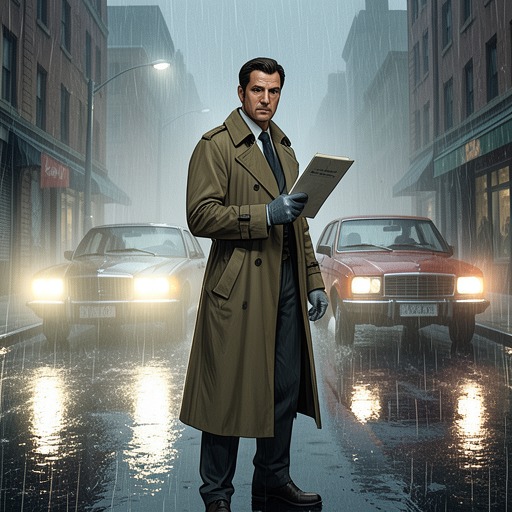
The agent’s physical presence complicates the authority of his professional manner. He is shorter than Delaware first assumes, with a heavy torso, bowed legs, white hair, and a limp; black pens line his shirt pocket, while a beeper and cell phone hang from his belt. He carries no briefcase, instead stuffing a sandwich into his jacket, and leaves the restaurant looking, in Delaware’s impression, like a tired salesman who has failed to meet his quota. The contrast between that unprepossessing figure and the formidable, meticulously compiled dossier makes his work seem less like an official assignment than an effort he carries everywhere.
Personal Grief and Institutional Rupture
Fusco’s pursuit of Michael Burke grew out of a personal loss that changed the meaning of his investigative work. Months after Victoria Fusco’s death, he became convinced that Roger Sharveneau, Burke, or both had murdered her. He said he recognized Sharveneau from the hospital ward and remembered seeing him in Victoria’s room without a legitimate reason to be there. The suspicion was not established as fact, but it became the organizing force of Fusco’s inquiry: a profiler’s search for connections now carried the urgency of a father trying to identify those responsible for his daughter’s death.
The Bureau’s attempts to contain that inquiry only sharpened the conflict. Buffalo police refused Fusco permission to interview Sharveneau in jail, pointing out that the FBI had no standing in the case and that Fusco’s interest was personal. He did not accept the boundary. After Sharveneau was released, Fusco continued pressing the man’s lawyer; even after Sharveneau died by suicide, Fusco did not stop. The account does not establish that Fusco found Sharveneau or caused his death: investigators had no evidence that he located him. It does show how his suspicion persisted beyond the point at which ordinary investigative authority could sustain it.
As the fixation intensified, Fusco’s official work deteriorated. The Bureau sent him back to Quantico for several months to teach beginning profilers, a reassignment meant to cool his pursuit. He appeared calmer, but was secretly using much of his time to research Burke and accessing databases without permission. Summoned to New York to meet with his superiors, he was dismissed on a disability pension. By the time Mary Donovan later describes his conduct to Delaware, Fusco has committed numerous felonies, mostly thefts rather than violent crimes. The contrast is stark: an admired founding member of the Behavioral Science Unit, trained in psychology and profiling, has become an unauthorized investigator whose expertise still serves a case but whose methods have broken with the institution that formed him.
From Pattern Recognition to Violence
Fusco’s dossier led Delaware to reconsider a group of four Washington State murders committed while Michael Burke was a medical student. Fusco regarded the killings as consistent with Burke’s technique because the victims had been left propped against or near trees. One case in particular, the murder of Marissa Bonpaine, made the pattern concrete: the twenty-year-old waitress was last seen serving shrimp cocktail at a stand in Seattle’s Pike Place Market, then found a week later in a remote part of the Olympic National Forest, splayed in front of a fir. Investigators found no footprints, and eleven days of rain had further obscured the scene. Her throat had been slashed, her abdomen mutilated, and her body sexually postured; a deep trapezoidal wound above the pubic bone suggested a deliberate geometry. These details made the old case resonate with the violence Delaware was investigating in the present.
A small notation in the original Seattle report, nearly missed on the page, became the detail that altered Delaware’s understanding. He realized that Fusco, who possessed the original file and had said he was flying to Seattle, could have recognized the same clue. Delaware began to suspect that Fusco had used the Bonpaine case to anticipate the movements of the man he believed to be Burke. The inference transformed Fusco’s research from a retrospective effort to connect crimes into a live pursuit, one in which he might already be acting on the pattern he had uncovered.
The pursuit culminates in the shooting of Paul Ulrich, who was in fact Michael Burke, at a cabin above the ocean. Afterward, Delaware looks at the scene through the imagined perspective of the shooter and reconstructs how Fusco could have watched the cabin from a suitable vantage point. Police found no trace evidence, not even a tire track. Delaware reasons that Fusco had planned an escape route through the roads branching into the hills and may have used a rented car obtained with false identification. The methodical planning echoes the organization of his dossier, but now the same planning supports an act of lethal, extrajudicial violence. Fusco’s focus has crossed the boundary between identifying a killer and killing the man he believes to be one.
Two weeks before Christmas, Delaware calls FBI headquarters and asks Mary Donovan whether the Bureau has had any success finding Fusco or helping him. Her response begins by asking what Delaware means by success; the exchange leaves Fusco’s whereabouts and prospects unresolved. The question nevertheless recasts the pursuit as more than a completed act of revenge. The former profiler remains a missing, damaged figure whom the Bureau might still locate, while the novel offers no assurance that professional intervention can undo what his obsession has set in motion.