Mate Portrait Abandoned at a Gallery
Dr. DeathMate Portrait Abandoned at a Gallery introduces a disturbing object into the investigation of Eldon Mate’s murder: an unsigned painting that turns Mate into both the body on the dissection table and the figure cutting into it. Its unexplained delivery made the artwork a potential clue, while its imagery gave the crime a new, public form.
Discovery and the public account
The painting surfaced at Primal Images, an art gallery on Colorado Avenue in Santa Monica. Grant Kugler, the gallery’s owner, arrived the previous night to unpack an installation and found what the newspaper called a surprise donation propped against the rear door. Wrapped in brown paper, the package contained an original, unsigned oil painting described as a copy of Rembrandt’s The Anatomy Lesson. It followed the source painting’s dissection-room arrangement but altered its central image: the murdered physician Eldon Mate appeared twice, as the cadaver and as the dissector. The delivery’s placement and anonymous character left the reason for choosing Kugler’s gallery unresolved; he said he could not explain why it had been left there and described himself as more interested in social commentary than representational art.
The front-page article, headed The Mysterious Portrait of Dr. Death, reported that unnamed police sources saw intriguing similarities between the painting and details of the Mate crime scene. It presented those correspondences as grounds for questions, not as proof of who had made the work or why its maker had abandoned it. The report said the painting had been taken into police custody, shifting it from an unexplained gallery donation into evidence associated with the murder investigation. The public account therefore established both a concrete investigative development and a conspicuous gap: the image connected itself to the crime, but its unsigned surface and unexplained arrival disclosed neither an artist nor a motive.
The painting as evidence
The investigation then brought the canvas into the Robbery-Homicide room on the second floor of the West L.A. station. Milo Sturgis had it propped on a chair among half a dozen detectives hunched over their desks, making the image an object of police scrutiny rather than merely a newspaper sensation. Its arrival had produced no clear answer about authorship or purpose, but the close examination sharpened what the picture itself communicated.
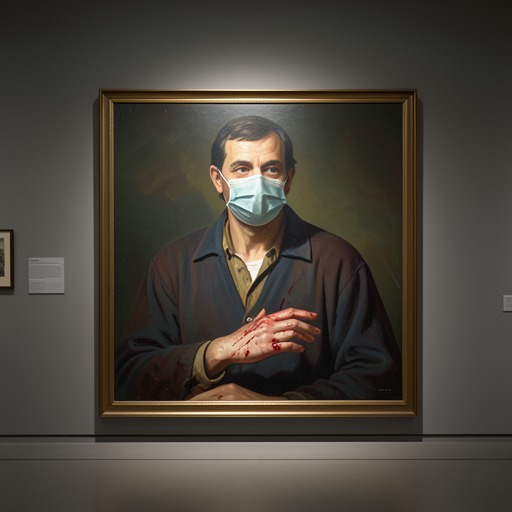
The palette was almost entirely browns and blacks, with muted light and only a thin wash of pink at the dissected left arm, where the flesh had been reduced to tendons and ligaments. The corpse had Eldon Mate’s soft, fussy face. Seven elaborately robed, ruffed, and goateed men looked down at him with academic detachment, while a second Mate, dressed in a black robe, white lace collar, and tall black hat, probed the arm with a scalpel and wore an expression of boredom. By assigning Mate both roles, the painting made him simultaneously the object of scrutiny and the agent of dissection.
The contrast with Rembrandt’s original supplied the picture with much of its force. Where the original’s artistic mastery could distract from the cruelty of the dissection, Zero Tollrance’s less accomplished version made that violence difficult to look past. Angry, swirling brushstrokes and thickly laid pigments rose into sharp peaks from the canvas; the result was less a polished historical tableau than a blunt, unsettling transformation of the familiar composition. The form did not settle whether the painter meant accusation, mockery, or something more personal, but it turned the medical scene into an image of violence and fixation.
Milo reported that the painting bore not a single fingerprint, a detail that strengthened the possibility of a careful maker without identifying one. He asked Alex Delaware whether seeing the work suggested anything beyond rage toward Eldon Mate or ambivalence about him. Alex offered no further interpretation. The image could make those opposing feelings visible, but it could not resolve who had painted it, why it had been left at the gallery, or how its creator was connected to the murder.
The publicity-stunt possibility
Milo Sturgis also considered a less psychological explanation: Zero Tollrance might be a struggling artist exploiting Eldon Mate’s murder to revive a fading career. If Tollrance appeared on television the next day with an agent and publicist, Milo reasoned, the painting could be treated as a publicity stunt rather than evidence of a deeper fixation. Alex Delaware countered that Tollrance’s failure to appear would itself be suggestive, though it would not establish what the silence meant.
The competing possibilities leave the portrait’s central mystery open. Its treatment of Mate supports readings of both rage and ambivalence, yet neither the painting’s public notoriety nor the lack of an obvious commercial follow-up identifies its maker or explains the abandonment. The artwork raises questions the investigation can pursue, but supplies no final answer about the artist’s purpose.
From Headline to Evidence Room
The portrait’s passage from newsprint to police evidence was also a shift in how Alex Delaware encountered it. After reading the front-page account, he expected Milo Sturgis to get in touch; the call came while Alex had finished only half a cup of coffee. Milo invited him to view the painting in the evidence room, and Alex accepted, remarking that representational art was his interest. The brief exchange turned a startling public report into a direct encounter with the canvas, bringing Alex into the investigation at the point where the image could be examined rather than merely reported.