Murder as performance and message
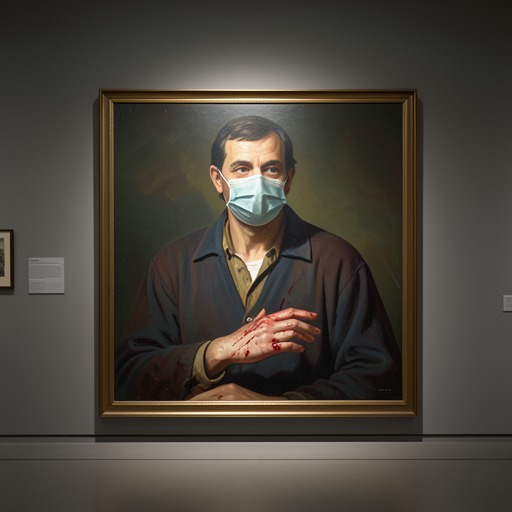
Dr. DeathMurder as performance and message is the novel’s pattern of treating violence not only as an act against a victim but also as a communication addressed to witnesses, investigators, and the public. Bodies, press statements, staged discoveries, and competing claims to medical authority turn death into a contest over who controls its meaning. The pattern is clearest in the contrast between Eldon Mate, who publicizes his role in assisted deaths, and Michael Burke, who hides behind respectability while seeking the attention and authorship attached to murder.
Competing accounts of illness and death
The pattern begins before the investigation identifies a murderer: people around Joanne Doss offer sharply different explanations for her decline and death. Richard Doss describes her as a testament to modern medicine’s failure. He recalls a long succession of tests, including CAT scans, MRIs, and lumbar punctures, without an explanation for her symptoms. He says she withdrew from social life and activity, spent increasing amounts of time in bed, and gained more than a hundred pounds in less than a year. His account makes the visible changes in her body central, but does not establish what caused them.
A file Alex Delaware later examines records that fifteen doctors tried to determine the cause of Joanne’s suffering. Its reports include blood work, urinalysis, X-rays, scans, and the lumbar punctures Richard had described; the recorded results are repeatedly negative. A washed-out Polaroid, showing Joanne’s face among pillows on a king-size bed, makes her physical deterioration an image as well as a disputed medical history. The image bears witness to a change that the tests did not explain, while leaving its cause unresolved.
Joe Safer offers a different, more judgmental account: he says Joanne was psychologically unwell, chose to withdraw from life and eat herself to death, and refused psychiatric help. He also argues that Richard should have had her committed. These accounts do not settle what happened to Joanne. Their conflict instead demonstrates how the description of a death can become a struggle over responsibility: medical uncertainty, a husband’s recollection, and a lawyer’s diagnosis all compete to define the same suffering. That dispute matters to the murder pattern because Mate’s public identity rests on the authority to say what a death means and when it should occur.
Mate’s public record and its missing case
Mate makes death publicly legible. In Alex’s review of the cases, Traveler forty-seven is Maria Quillen, who had terminal ovarian cancer. After Mate helped her die, her body was left at the County Morgue’s front door, wrapped in a frilly pink comforter, with Mate’s business card tucked into the folds. Mate informed the press of the details. The body’s placement and identifying card make the death a statement as well as a concealed act.
Another case, numbered forty-nine, follows Joanne’s death. Alberta Jo Johnson, who had muscular dystrophy, was left wrapped at Charles Drew Medical Center in South Los Angeles. This was another van job and another public statement by Mate. Alex finds a third comparable case in Brenton Spear, who had Lou Gehrig’s disease: again there was a van and a press conference. The three cases Alex groups together involve definitive diagnoses, a recognizable method of transporting and leaving the bodies, and public communication from Mate. The repetition gives the deaths a pattern that reporters and investigators can recognize.
Joanne’s death does not fit it. Alex finds no public statement from Mate about her and no van. That absence becomes significant precisely because Mate has made the other deaths conspicuous. Her case lacks the public announcement that might have placed it within his familiar pattern, leaving investigators to confront a less legible death. The contrast also complicates the meaning of Mate’s publicity: it can present assisted dying as a deliberate, accountable act, but it also draws attention to Mate himself.
A rival claim to the role
The murder messages Alex recalls are concise assertions of authority: to Marissa, “I'm the doctor”; to Mate, “I'm the doctor and you're not.” The second is not merely a threat. It casts the killing as a challenge to Mate’s standing, claiming the right to decide and act in the doctor’s place. In a story where Mate has become publicly identified with assisted death, the claim turns that identity into something another person can imitate, steal, or contest.
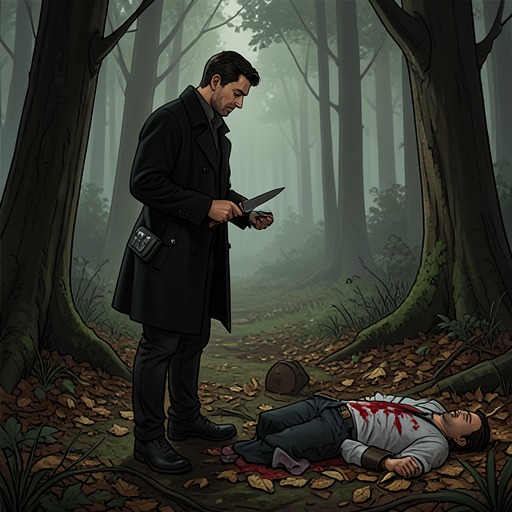
The murders of Alice Zoghbie and Roy Haiselden sharpen the challenge. Alex reasons that the two were attacked in Alice’s house by someone they knew: a respectable, trusted young doctor who had apprenticed to Mate. The trusted professional identity is crucial to the contrast. The apparent authority that might reassure others becomes cover for violence, while the victims’ deaths may also serve the killer’s interests. Alex suspects that the murderer wanted records that could incriminate him, so the attack may have been both an effort to destroy evidence and a message about power over the investigation.
When Milo Sturgis reports that police have connected the scene to an anonymous caller and that news outlets have picked up the killings, Alex argues that the publicity serves Burke. In Alex’s interpretation, Richard Doss’s arrest may have accelerated Burke’s plan: Burke would not want someone else to receive credit for Mate’s murder. Alex sees him trying to eliminate the old guard and announce himself as a new Dr. Death. This is an investigative theory, not a neutral statement of motive; its force comes from the way the crimes, the search for records, and the renewed media attention appear to converge.
Staging the discovery
Paul Nelson Ulrich’s earlier role in discovering Mate’s body becomes newly revealing once Alex recognizes him as Michael Burke. Alex imagines Burke orchestrating the discovery so that he could arrive at the crime scene for a legitimate reason, then watch the police encounter his handiwork. The apparent witness is also, in Alex’s reconstruction, the killer returning to observe the response. Discovery itself becomes part of the performance: Burke can be close to the investigation without appearing to confess to what he has done.
Ulrich’s public manner also acquires a different meaning. He had presented himself as a respectable financial consultant, yet showed an unusual preoccupation with whether the killings would reach the newspapers. In conversation with Milo, he raised the prospect of the victims’ names appearing in print and talked about fifteen minutes of fame, celebrity, and Dr. Mate. Alex retrospectively reads that insistence as a double signal: Ulrich seemed concerned about publicity while testing how close he could come to admitting that he wanted it. His mustache, which had seemed like an eccentric flourish against his conservative dress, also looks to Alex like a mask.
The two performances therefore work in opposite ways without having opposite aims. Mate openly supplies the press with details of assisted deaths; Burke, as Alex understands him, conceals his identity while engineering opportunities to witness the attention generated by murder. At the scene of Alice and Roy’s deaths, police have an anonymous caller to follow and reporters are already involved. Burke’s concealment does not mean he wants obscurity. It lets him approach criminal celebrity while withholding the direct confession that would end the game.
Meaning and limits of the pattern
In these episodes, violence communicates through both presence and absence. A card tucked into Maria Quillen’s comforter, a public statement following the deaths of Mate’s travelers, and a killer’s claim to be the doctor are overt signals. Joanne’s lack of a van and press announcement is a revealing break in that sequence. At Alice’s house, an anonymous call and an apparently legitimate arrival create a different kind of spectacle, one in which the author of the violence can watch others interpret it.
The recurring performance does not make every death’s motive certain. Alex’s account of Burke’s designs remains an interpretation, and the medical evidence surrounding Joanne does not resolve her illness. Instead, the pattern shows how easily a death can be made to signify competing things: compassionate assistance, medical failure, personal blame, professional authority, or murderous self-promotion. The killer who claims to be the doctor tries not only to take a life but to seize the right to name what that life and death mean.