Power and control
Dr. DeathPower and control is a recurring idea through which the novel connects private grief to public violence. In the Doss family, control appears as Richard Doss’s restless activity, Eric Doss’s anger, and Stacy Doss’s detached observations; in the investigation, it becomes a way to understand the appeal of doctors who claim authority over life and death. The idea does not reduce these characters to a single motive. Instead, their different responses show how the desire for control can take the forms of care, possession, performance, or violence—and how none of those forms can undo loss.
Control in the Doss family
Stacy Doss describes Richard Doss as someone who needs to keep moving, thinking, and doing. Before Joanne Doss became ill, the couple shared an active life that included jogging, dancing, tennis, and travel. Her illness ended that shared routine, leaving Richard Doss on his own and, in Stacy Doss’s account, making him cranky. The contrast matters: activity had been part of their common life, but after illness it also becomes a sign of his difficulty living with circumstances he cannot direct or repair.
Stacy Doss recounts her father’s self-description as a hard-hearted capitalist, while observing that he takes pride in the very identity other people criticize. Her amused manner does not erase the steady contempt beneath it. The scene suggests a family dynamic in which judgments of power are expressed through teasing and criticism, rather than through open discussion of grief. Stacy Doss can interpret her father for a stranger with apparent ease, but that observational distance may also keep her from participating directly in the pain she describes.
Her account of Richard Doss’s anger toward Eldon Mate distinguishes hostility from an actual plan. Richard Doss uses violent language jokingly about people he dislikes or believes are cheating him in business, Stacy Doss explains; she presents the talk as a habitual macho performance, not a literal declaration of intent to kill. Eric Doss and Richard Doss, she says, respond to what they cannot control by getting angry and wanting to crush it. Her description links masculine aggression to helplessness, while also warning against treating violent rhetoric as proof of a specific action.
Medical authority and the power over death
During the eleventh session, Stacy Doss discusses Eldon Mate without sharing the anger Richard Doss and Eric Doss direct at him. She calls Eldon Mate pathetic and a loser, but adds that Joanne Doss would have stopped living with or without him. That assessment separates the fact of her mother’s deterioration from the family’s need to assign power over it to a single person. It also makes Stacy Doss’s position distinct: she does not absolve Eldon Mate so much as refuse the consoling idea that his presence alone determined what happened to Joanne Doss.
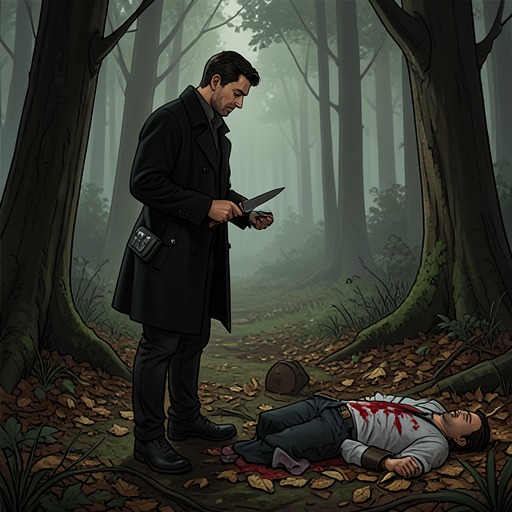
Leimert Fusco uses the idea of power to connect Eldon Mate with Michael Burke. In Fusco’s interpretation, the two men’s actions appear different—one associated with helping patients die, the other with murder—but share an attraction to playing God. Fusco argues that the common element is not simply medical skill, but the power to decide another person’s fate. His analysis turns the language of mercy into a question about authority: a claimed compassionate purpose does not, by itself, establish what the practitioner wanted or what the act meant.
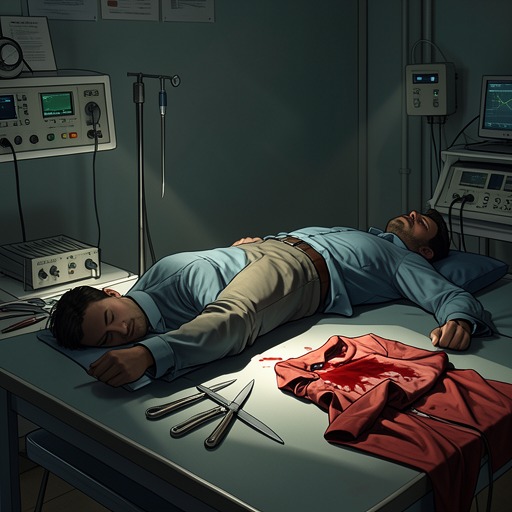
Fusco further speculates that Michael Burke may have shifted from rape and murder to killing hospital patients, taking advantage of his knowledge of hospital systems. He lists possible ways a patient’s death might be made difficult to detect, including interference with breathing or medical lines and the use of drugs such as insulin or potassium. These are Fusco’s hypotheses, not a confirmed account of particular deaths. Their importance to the concept lies in the contrast between apparent care and concealed control: medical knowledge can protect patients, but in the wrong hands it can also make coercion look like an ordinary clinical outcome.
Domination as performance and investigative theory
The idea also surfaces in how people occupy space and present authority. Milo Sturgis describes Richard Doss as a small man seated behind a gigantic desk, with his chair raised on a pedestal. Milo Sturgis interprets the arrangement as a performance of intimidation and domination. The detail makes control visible as staging: the elevated chair and oversized desk enlarge the authority Richard Doss wishes to project, even before any particular threat is established.
Fusco’s account of Michael Burke likewise emphasizes the difference between impulse and method. He believes Burke could act with extreme violence but also exercise exquisite care when circumstances demanded it. Fusco points to the patience required to become a doctor and to Burke’s ability to move between places and identities; he compares him to something difficult to grasp because it keeps changing. In this reading, control is not the opposite of violence. It is the capacity to choose how violence is expressed, conceal it, or make it difficult for investigators to recognize. The theory remains Fusco’s reconstruction, but it gives the investigation a framework for considering how apparent changes in behavior might conceal a continuing appetite for power.
Possession, guilt, and the limits of control
Richard Doss’s background complicates any simple interpretation of his anger. Eric Doss describes him as a self-made man from an immigrant family whose parents ran a grocery in Bayonne, New Jersey. Eric Doss frames his father’s guilt around the belief that he failed to save his wife. When asked whether saving her was within Richard Doss’s power, Eric Doss rejects the question as impossible to answer. His resistance exposes a painful limit: guilt can persist even when no one can establish that the loss was preventable, turning an uncontrollable event into a private accusation.
Later, Alex Delaware asks Stacy Doss to consider, hypothetically, why Richard Doss might hate Eldon Mate if he had paid Quentin Goad. Stacy Doss proposes that Richard Doss may have seen Eldon Mate as taking something that belonged to him, adding that Richard Doss likes his possessions. Her answer is explicitly speculative, as is the underlying assumption that payment occurred. Still, it draws a line between the family’s earlier account of anger and a possible motive rooted in possession: the fear that another person has taken what one regards as one’s own. Across these conversations, power and control name not a single proven explanation but a recurring pressure—the wish to command another person’s choices, to master an illness, or to make grief answerable to will, even when the evidence and the events themselves resist that mastery.